
A Study of the Effectiveness of Community Participation in Health Personnel Education in the Bachelor of Nursing Science Program
Keywords:
effectiveness, personnel education management, community participationAbstract
This mixed-methods study followed both quantitative and qualitative research processes, in order to evaluate to determine if community-based health personnel should participate in the Bachelor of Nursing Science academic program. Goals of study were to evaluate effectiveness and recommend policies for the 30 nursing colleges under a Faculty of Nursing, commonly called Praboromarajchanok Institutes. The quantitative sample consisted of 326 nursing students. The qualitative informants included 40 students, 40 professors, and 40 community representatives. The data were analyzed using descriptive statistics and content analysis.
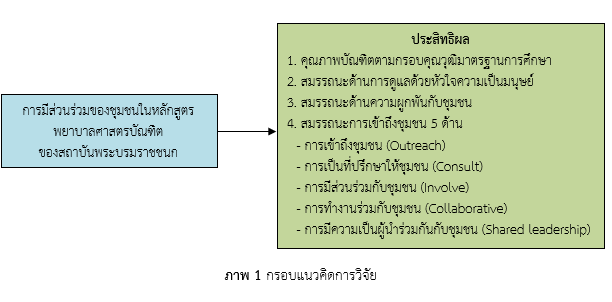
The research results were the following: 1) the overall quality of graduates, accordingly with the educational standard qualifications framework, was at a high level; 2) faculty of caring with a human heart was also at a high level; 3) and so was the level of community engagement. However, the community participation competency was assessed in only four levels of competency: reaching out, consulting, involving, and collaborative. The fifth level, which is shared leadership, is not yet accessible. Nevertheless, this study concludes that referring community health personnel to a nursing science academic program creates a good level of community participation.
References
Chanthai, K. (2014). Curriculum for Developing Competency of Nurses as Community Health Managers. Nonthaburi: Bureau of Nursing. Office of the Permanent Secretary, Ministry of Public Health Ministry of Public Health. (in Thai).
Community Health Research and Development Institute. (2015). “Towards a Healthy Community” Community Health System Development Manual with Health Insurance Funds at the Local or Area Level. Bangkok: Sahamit Printing and Publishing Company Limited. (in Thai)
Department of Academic Affairs, Ministry of Education. (2018). Guidelines for Developing Bachelor of Nursing Programs with Community Participation. Bangkok, Thailand: Department of Academic Affairs, Ministry of Education. (in Thai).
Krejcie, R. V., & Morgan, D. W. (1970). Determining sample size for research activities. Educational and Psychological Measurement, 30(3), 607–610.
Office of the Higher Education Commission. (2017). Evaluation of Education with Community Participation in Bachelor of Nursing Programs. Bangkok, Thailand: Office of the Higher Education Commission. (in Thai).
Office of the National Economic and Social Development Board Office of the Prime Minister. (2017). National Economic and Social Development Plan. Issue twelfth, 2017 - 2021. Retrieved November 21, 2023 from https://www.nesdc.go.th/ewt_news.php?nid=6420&filename=develop_issue
Parnichparinchai, T. (2016). Transformative learning : A learning management in pre-service teacher. The Golden Teak : Humanity and Social Science Journal (GTHJ.), 22(2), 1-11. (in Thai)
Phanich, W. (2015). Ways to create learning for students in the 21st century. Learning Innovation Journal, 1(2), 2-14. (In Thai).
Poohongthong, C. (2018). Transformative learning: challenges for instructors in higher education. Journal of Behavioral Science, 24(1), 163-182. (in Thai)
Pukbunmee, R. (2017). The Role of Nurses in the Thailand 4.0 Era. Retrieved November 21, 2023 from https://www.rama.mahidol.ac.th/ramachannel/article
Schaffer, M. A., Hargate, C., & Marong, K. (2015). Engaging Communities in Nursing Education. International Journal of Research on Service-Learning and Community Engagement, 3(1), Article 8. (PDF) Engaging Communities in Nursing Education. Retrieved November 21, 2023 from https://www.researchgate.net/publication/350158585_Engaging_Communities_in_ Nursing_Education [accessed Oct 19 2023].
Talib, Z., Palsdottir, B., Briggs, M., Clithero, A., Cobb, N. M., Marjadi, B., Preston, R., & Willems, S. (2017). Defining community-engaged health professional education: A step toward building the evidence. National Academy of Medicine, Washington, DC. Retrieved November 21, 2023 https://nam.edu/wp-content/uploads/2017/01/Defining-Community-Engaged-Health-Professional-Education-AStep-Toward-Building-the-Evidence.pdf, Page 1-4.
Thai Nursing Council. (2019). Announcement of the Nursing Council Nursing Standards 2019. the government gazette: Volume 136, Special 97. (in Thai).
Thongchua, T., & Tummek, P. (2017). Human resource development guidelines in the 21st century: educational dimensions. Journal of Peace Studies Review, MCU, 5(3), 389-403. (in Thai).
World Health Organization. (2016). Global Strategic Directions for Strengthening Nursing and Midwifery 2016-2020. Bureau of Nursing, Office of the Permanent Secretary. Nonthaburi: Medi Journal. (in Thai)
Downloads
Published
Issue
Section
License
Copyright (c) 2024 Journal of Nursing and Education

This work is licensed under a Creative Commons Attribution-NonCommercial-NoDerivatives 4.0 International License.



