
Effects of a Self-efficacy Mobile Application on Maintaining Flow and Amount of Breast Milk among Mothers of Premature Infants
Abstract
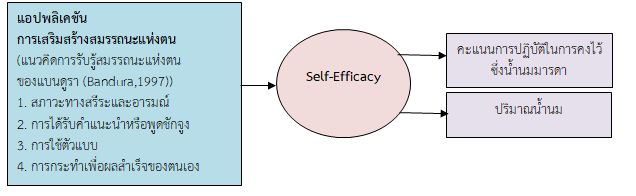
This quasi-experimental design aimed to examine the effects of a self-efficacy application for mobile phone on how maintaining breast milk among mothers of premature infants as well as controlling the amount. The subjects were mothers with premature infants, hospitalized in the neonatal intensive care unit (ICU) of a tertiary hospital in northern Thailand. Fifty mothers were selected by purposive sampling. The subjects were assigned equally into the experimental and the control groups with 25 mothers in each group. The research tools included a self-efficacy mobile application, data collection instruments, as well as a mother and premature infant’s personal information questionnaire and an observation form. The content validity index was 0.89, and the interrater reliability of practice observation level was equal to 1. Data were analyzed using descriptive statistics, independent t-test, and paired t-test. The results were as follows.
1. The mothers in the experimental group had statistically significant higher practice scores than those in the control group (p < .01)
2. The mothers of premature infants, after using the application, had statistically significant higher practice scores than before (p < .01)
3. The mothers in the experimental group had statistically significant more breast milk than those in the control group (p < .01)
The results of this study show that application enhances practical skills of mothers of premature infants to maintain breast milk. Thus, the application can be used as one of the strategies to improve practical skills of breastfeeding among mothers of premature infants.
References
Bandura, A. (1997). Self – efficacy: Toward a unifying theory of behavioral change. Psychological Reviews. 84(2), 191-215
Boonchalerm, P., Prasopkittikun, T., Sangperm, P., & Jirasakuldej, W. (2012). Effects of the mother – preterm infant preparation program on breastfeeding self-efficacy and sucking quality. Journal of Nursing Science, 30(5), 61-71 (in Thai)
Burns, N. & Grove, S. K. (2009). The Practice of Nursing Research: Appraisal, Synthesis, and Generation of Evidence (6th ed.). St. Louis, Missouri: Saunders Elsevier.
Hayeese, W., Sap-In, N., Wangsawat, T., & Chaimongkol, N. (2015). Quality of life of Muslim preterm infant in three southernmost provinces of Thailand. Princess of Naradhiwas University Journal, 7(1), 1 -14. (in Thai)
Hayise, V., Chaimongkol, N., Sriyasak, A., & Yeepaloh, M. (2020). The results of giving knowledge through an application on caring for premature infants after discharge from the hospital according to the Muslim way. Journal of Princess of Naradhiwas University, 13(1), 39-55. (in Thai)
Jirapaet K. (2014). Atlas Normal Findings and Common Problems in Neonates. Bangkok: Sutthakan. (in Thai)
Kaewnil, W., Jintrawet, U., & Urharmnuay, M. (2013). Effects of coaching on maintaining breast milk among mothers of preterm infants. Nursing Journal, 40(3), 11-20. (in Thai)
Kulaphanich, M., Supavititpatana, B., & Chaloumsuk, N. (2019). Effect of self-efficacy enhancement on breastfeeding among adolescent mothers. Nursing Journal, 46(2), 36-46. (in Thai)
Lakornket, N. & Jirapeat, V. (2017). The effects of promoting breast feeding self-efficacy program on sufficient of breast milk supply and maintenance of lactation behavior in mothers of newborn after explore laparotomy. Journal of The Royal Thai Army Nurses, 18, 211-220.
Office of the National Economics and Social Development Council of the Prime Minister. (2016). National Health Development Plan No. 12 (2017-2021). Bangkok: The Bureau of Policy and Strategy, Ministry of Public Health. (in Thai)
Onpiw, N. & Keawsiri, P. (2022). The effects of lactation program on milk secretion time and milk volume among cesarean section mothers of the newborns being separated in nursery. Thai Red Cross Nursing Journal, 15(2), 108-126. (in Thai)
Phon-ngam, K. & Mankong, R. (2021). The effects of hot moist gel pack breast compression combined with nipple stimulation on the onset of milk ejection and milk flow among cesarean section mothers with sick babies. Thai Red Cross Nursing Journal, 14(1), 156-169. (in Thai)
Sengiang, M., Sea-eaw, J., Meebun, P., Poh-adeh, L., & Noo-urai, N. (2021). Utilization behavior and satisfaction of line application that affecting seniors’ media literacy in Muang District, Songkhla Province. Journal of Humanities and Social Sciences, 3(1), 145-176. (in Thai)
Thampanichawat, W., Rungamornrat, S., & Payakkaraung, S. (2016). Nursing Care for High-rise Neonates. Bangkok: Mahidol University. (In Thai)
Tharana, N. & Tanasirijiranont, R. (2019). Effects of enhancing self-efficacy programs on perceived self-efficacy, knowledge and satisfaction in breastfeeding practice among first-time postpartum mothers. Nursing Journal Volume, 46(4), 70-82. (in Thai)
Watcharaphao, N., Chokdee, P., Chukwan, S., & Sukjit, W. (2022). The comparison of lactation induction efficacy between manual breast pumps and electric breast pumps in isolated postpartum mothers after labor the Tertiary Care Uttaradit Hospital. Health Science Clinical Research. 37, 58-70. (in Thai)
Wesley, K. M. & Fizur, P. J. (2015). A review of mobile applications to help adolescent and young adult cancer patients. Adolescent Health, Medicine and Therapeutics, 6,141.
Witt, A. M., Bolman, M., Kredit, S., & Vanic, A. (2016). Therapeutic breast massage in lactation for the management of engorgement, plugged ducts, and mastitis. Journal of human lactation : official journal of International Lactation Consultant Association, 32(1), 123–131. doi.org/10.1177/0890334415619439 World Health Organization (1998). Evidence for the Ten Steps to Successful Breastfeeding. Retrieved June 10, 2021, from http://www.who.int/nutrition/publications/evidence_ten_step_eng.pdf
Downloads
Published
Issue
Section
License
Copyright (c) 2024 Journal of Nursing and Education

This work is licensed under a Creative Commons Attribution-NonCommercial-NoDerivatives 4.0 International License.



