
The Effects of a Competency Development Program Using the Simulation-Based Approach on Emergency Medical Operations of Patient with a History of Suspected Covid- 19 Infection in Basic life Support Unit, Mahasarakham Province
Keywords:
Performance Emergency medicince Simulation Emergency medical operation COVID19Abstract
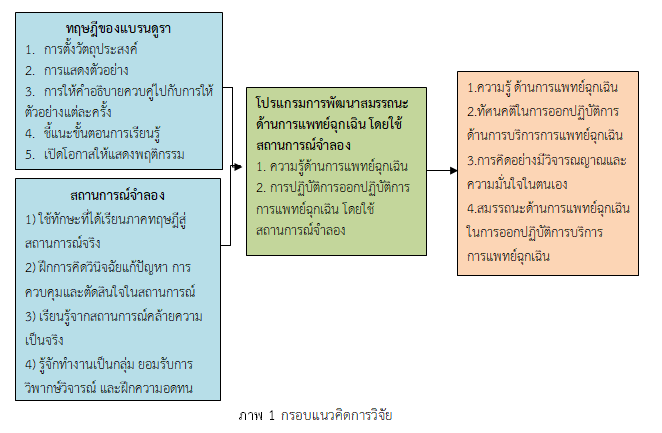
This two-group pretest-posttest quasi-experimental design research aimed to study the effects of an emergency medical competency development program, using the simulation approach to conduct emergency medical operations. As a case-study, we took the situation of a patient with a history of suspected Covid- 19 infection. The baseline laboratory setting was in Mahasarakham Province. The sample group was 112 basic-level emergency medical practitioners, including both medical emergency personnels and emergency medical volunteers. They were assigned either to experimental or control group (56 participants/group) using the purposive sampling method with inclusion criteria. The experimental group received the competency development program, while the comparison group did not receive the program. The research tools were a questionnaire with assessment forms: knowledge, attitude, critical thinking, self-confidence, and competency level. The results were as follows.
1. After using the program, the knowledge of participants regarding emergency medicine operations, critical thinking, self-confidence, and attitude in operating emergency medical services was significantly higher than before using the program (p < .001).
2. The experimental group had the competency in operating emergency medical services significantly higher than the control group (p<.001).
Therefore, this competency development program in emergency medicine could be implemented, and used as a guideline for practical training. Furthermore, it can be applied in other situations to increase confidence and ability to work among emergency medical practitioners.
References
Abelsson, A. (2017). Learning through simulation. Disaster and Emergency Medicine Journal, 2(3), 125-128.
Atchara, K., Aunjai, K., & Tuenjai, P. (2021). Development of the assessment form emergency medical practice skills of diploma program students medical emergency operations. Journal of Mahasarakham Hospital, 18(3), 139-152. (in Thai)
Awae, H., Khupantavee, N., & Damkliang, J. (2020). Self-efficacy on the ability to care for the injured at the scene of the accident and during the delivery. of medical emergency personnel. Songklanagarind Journal of Nursing, 40(3), 15-25. (in Thai)
Bandura, Albert (2000). Self-Efficacy: The Foundation of Agency1. In Walter, J. Perrig & Alexander Grob (eds.), Control of Human Behavior, Mental Processes, and Consciousness: Essays in Honor of the 60th Birthday of August Flammer. Erlbaum. pp. 16.
Binsalaehman, N., Songwathana, P., & Sornsrivichai, V., (2018). Situation of emergency medical service of local administrative organizations in Southern border provinces and related factors. Narathiwat Rajanagarindra Journal, 10(1), 40-49. (in Thai)
Chompoopan, W., Chanaboon, A., Seedaket, S., & Yomseeken, J. (2020). Heart and blood vessels. Nursing Journal of The Ministry of Public Health, 30(2), 93-103. (in Thai)
Chow, N., Fleming-Dutra, K., Gierke, R., Hall, A., Hughes, M. M. Pilishvili, T., et al. (2020). Preliminary estimates of the prevalence of selected underlying health conditions among patients with coronavirus disease 2019—United States, February 12–March 28, 2020. Morbidity and Mortality Weekly Report, 69(13), 382.
Chubkhuntod, P., Thasanoh Elter, P., Gaewgoontol, N. & Potchana. R. (2020). Effects of simulation based learning model on knowledge, self-efficacy and abilities of applying nursing process skills during intrapartum care of nursing students. Journal of Health Science, 29(6), 1062-1072. (in Thai)
Khunsawai, B., Promarak, T., & Tippayanate, N.(2020). Effects of smart safe program on self efficacy for basic life support of village health volunteers in Community Thadcherngchum Sub-district Muang District Sakon Nakhon Province. UBRU Journal for Public Health Research, 9(2), 69–79.
Lunenburg, F. C. (2011). Self-efficacy in the workplace: Implications for motivation and performance. International Journal of Management, Business, and Administration, 14(1), 1-6.
Mahaprom, T., Chatrung, C., Noparoojjinda, Supawadee Peawnalaw, S., & Doungkeaw, J. (2020). Development of an instructional model based-on simulation-based learning in nursing care of persons with health problems. Multidisciplinary Journal for Health, 1(2), 47-61. (in Thai)
Ministry of Public Health. (2010). Thai Public Health 2011 – 2016. Nonthaburi: Ministry of Public Health. (in Thai)
Naratporn, S. (2012). Development of a Competency Framework for Professional Nurses in the Stroke Semi-Intensive Care Unit. Maharaj Nakorn Chiang Mai Hospital (Independent study, Master of Nursing Science Program in Nursing Administration). Graduate School, Chiang Mai University. (in Thai)
National Institute of Emergency Medicine. (2017). Laws, Announcements, Criteria, Conditions, Criteria and Procedures Relating to Education, Training and Certification of Emergency Operators, Ministry of Public Health Inspection Plan. Fiscal Year 2017. Nonthaburi: National Institute of Emergency Medicine.
Panomwan, B. (2015). Development of competency framework for professional nurses in accident and emergency unit, Lanna Hospital, Chiang Mai Province. (Independent study, Master of Science in Nursing Administration). Graduate School, Chiang Mai University. (in Thai)
Prabket, S. (2021). Simulation and real situation of emergency medicine students at Sirindhorn College of Public Health, Yala Province. Journal of MCU Nakhondhat, 8(6), 238-253. (in Thai)
Sinthuchai, S., Ubolwan, K., & Boonsin, S. (2017). The effect of learning management by a virtual simulation on knowledge, satisfaction, and self-confidence of fourth year nursing students in pre-graduation vocational skill training course. Ramathibodi Nursing Journal, 23(1), 113-127. (in Thai)
Somchit, S. & Kanyarat, U. (2017). Learning by using virtual reality situations: application in teaching and learning management. Journal of the Royal Thai Army Nurses, 18(1), 29-38. (in Thai)
Suphalak, T., (2017). Teaching by simulation in virtual reality in the course of practical principles and techniques of nursing. Journal of Boromarajonani College of Nursing Uttaradit, 9(2), 70-84. (in Thai)
Suwannakeeree, W., Jullmusi, O., Inkaew, T., Tangkawanich, T. & Rueangram. S. (2017). Satisfaction and self-confidence in critical care nursing of nursing students learning with simulation based learning. Journal of Nursing and Health Sciences, 11(3), 167-177. (in Thai)
Uthaisang, T. (2021). COVID-2019: Building morale for medical personnel. MCU Haripunchai Review, 5(2), 94 -107. (in Thai) World Health Organization. (2020). Coronavirus Disease (COVID-19): Weekly Epidemiological Update, 31 August 2020. Retrieved June 20, 2023 from https://www.who.int/home/search-results?indexCatalogue= genericsearchindex1&searchQuery=Coronavirus%20disease%20 (COVID-19)%3A%20weekly%20epidemiological%20update%2C%2031%20August%202020. &wordsMode=AnyWord Zhao, B.,
Kong, F., Aung, M.N., Yuasa, M., & Nam, E. W. (2020). Novel coronavirus (COVID-19) knowledge, precaution practice, and associated depression symptoms among university students in Korea, China, and Japan. International Journal of Environmental Research and Public Health, 17(18), 6671. doi: 10.3390/ijerph17186671
Downloads
Published
Issue
Section
License
Copyright (c) 2024 Journal of Nursing and Education

This work is licensed under a Creative Commons Attribution-NonCommercial-NoDerivatives 4.0 International License.



