
The Effects of a Family Partner Program on Knowledge, Self-care Behavior and Quality of Life among Patients with Heart Failure
Keywords:
Heart Failure, Self-Care, Family-Based, CarerAbstract
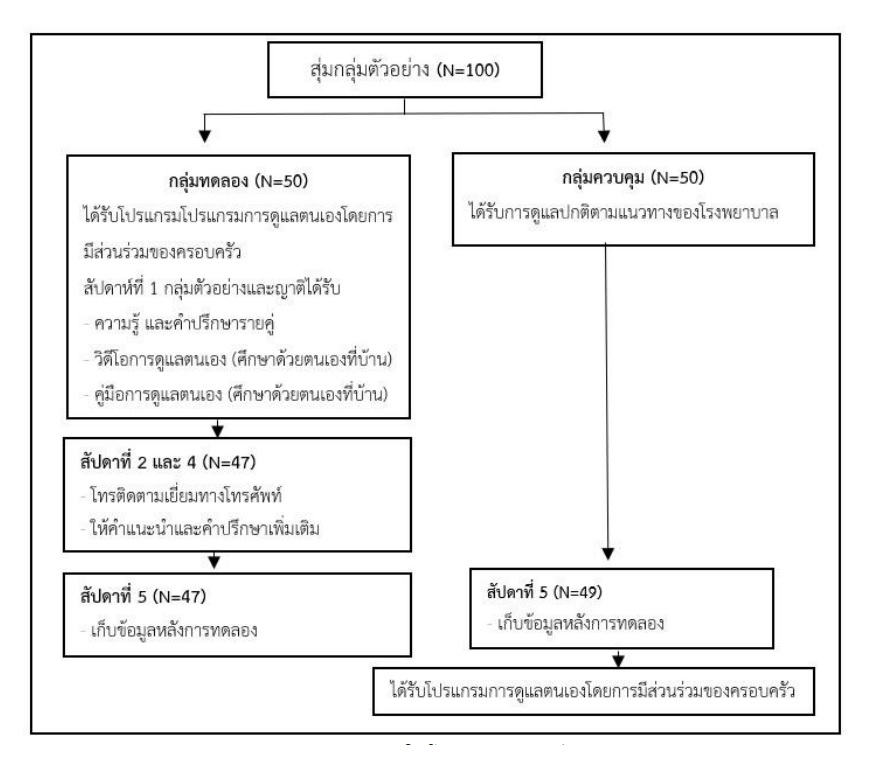
This quasi-experimental research study with two group pretest posttest design aimed to evaluate a new family-partner program on knowledge, self-care and quality of life among patients with heart failure. The sample was patients with heart failure who had received treatment at outpatient department in Krabi hospital and primary care providers. Patient-care provider dyads were randomly allocated to intervention (n=50) or control group (n=50). Those in the intervention group received usual care plus a family partner program comprising face-to-face counselling, a heart failure manual as well as short video series and telephone support. The control group only received usual care. The instruments consisted of the Self-Care of Heart Failure Index and Minnesota Living with Heart Failure Questionnaire. Cronbach’s alpha was .83 and .87 respectively. The Dutch of Heart Failure Knowledge Scale was used and Kuder-Richardson formular 20 coefficients was .81. Descriptive statistics, paired-t test, and independent-t test were used to analyze data.
The results revealed that after intervention, patient in both intervention and control groups had significantly higher knowledge, self-care maintenance, self-care management and self-care confidence scores compared to baseline (p<0.05), whereas there was no significant difference in quality of life scores for both physical and mental dimensions. The comparison between intervention and control group showed that after intervention, intervention group had knowledge (t=-3.25, p<0.05), self-care maintenance (t=-2.35, p<0.05) and self-care confidence (t=-1.09, p<0.05) scores significantly higher than control group. However, no significant difference were found in self-care management (t=0.47, p>0.05), overall quality of life (t=1.53, p>0.05), and both physical and mental quality of life (t=0.36, t=2.31 respectively, p>0.05) scores.
Therefore, the family partner program can be utilized for increasing knowledge, self-care maintenance, and self-care confidence among patients with heart failure.
References
Buck, H. G., Stromberg, A., Chung, M. L., Donovan, K. A., Harkness, K., Howard, A. M., et al. (2018). A Systematic Review of Heart Failure Dyadic Self-Care Interventions Focusing on Intervention Components, Contexts, and Outcomes. International Journal of Nursing Studies, 77(2), 232-242.
Danielsen, R., Thorgeirsson, G., Einarsson, H., Ólafsson, Ö., Aspelund, T., Harris, T. B., et al. (2017). Prevalence of Heart Failure in the Elderly and Future Projections: The AGES-Reykjavík Study. Scandinavian Cardiovascular Journal, 51(4), 183-189.
Dokainish, H., Teo, K., Zhu, J., Roy, A., AlHabib, K. F., ElSayed, A., et al. (2016). Heart Failure in Africa, Asia, the Middle East and South America: the INTER-CHF Study. International Journal of Cardiology, 204, 133-141.
Durante, A., Paturzo, M., Mottola, A., Alvaro, R., Vaughan Dickson, V. & Vellone, E. (2019). Caregiver Contribution to Self-Care in Patients with Heart Failure: A Qualitative Descriptive Study. Journal of Cardiovascular Nursing, 34(2), E28-E35.
Fisher, J. D. (1972). New York Heart Association Classification. Archives of Internal Medicine, 129(5), 836-836. doi:10.1001/archinte.1972.00320050160023
Heidenreich, P. A., Bozkurt, B., Aguilar, D., Allen, L. A., Byun, J. J., Colvin, M. M., et al. (2022). 2022 AHA/ACC/HFSA Guideline for the Management of Heart Failure: Executive Summary: a Report of the American College of Cardiology/American Heart Association Joint Committee on Clinical Practice Guidelines. Journal of the American College of Cardiology, 79(17), 1757-1780.
Heo, S., Moser, D. K., Riegel, B., Hall, L. A. & Christman, N. (2005). Testing the Psychometric Properties of the Minnesota Living with Heart Failure Questionnaire. Nursing Research, 54(4), 265-272.
Jaarsma, T., Cameron, J., Riegel, B. & Stromberg, A. (2017). Factors Related to Self-Care in Heart Failure Patients According to the Middle-Range Theory of Self-Care of Chronic Illness: A Literature Update. Current Heart Failure Reports, 14(2), 71-77.
Janwanishstaporn, S., Karaketklang, K. & Krittayaphong, R. (2022). National Trend in Heart Failure Hospitalization and Outcome Under Public Health Insurance System in Thailand 2008–2013. BMC Cardiovascular Disorders, 22(1), 1-12.
Ketilsdottir, A., Ingadottir, B. & Jaarsma, T. (2019). Self-Reported Health and Quality of Life Outcomes of Heart Failure Patients in the Aftermath of a National Economic Crisis: A Cross-Sectional Study. European Society of Cardiology Heart Failure, 6(1), 111-121.
Khitka, P., Sittisombut, S. & Chaiard, J. (2017). Interventions for Promoting Self-Care Behaviors among Persons with Heart Failure: A Systematic Review. Nursing Journal, 44(4). 71-79. (in Thai)
Kingkaew, N. & Antadech, T. (2019). Cardiovascular Risk Factors and 10-Year CV Risk Scores in Adults Aged 30-70 Years Old in Amnat Charoen Province, Thailand. Asia-Pacific Journal of Science and Technology, 24(04), 1-10.
Krethong, P., Jirapaet, V., Jitpanya, C. & Sloan, R. (2008). A Causal Model of Health-Related Quality of Life in Thai Patients with Heart-Failure. Journal of Nursing Scholarship, 40(3), 254-260.
Lee, A. A., Piette, J. D., Heisler, M., Janevic, M. R., Langa, K. M. & Rosland, A.-M. (2017). Family Members’ Experiences Supporting Adults with Chronic Illness: A National Survey. Families, Systems, & Health, 35(4), 463–473. https://doi.org/10.1037/fsh0000293
McDonagh, T. A., Metra, M., Adamo, M., Gardner, R. S., Baumbach, A., Böhm, M., et al. (2021). 2021 ESC Guidelines for the Diagnosis and Treatment of Acute and Chronic Heart Failure: Developed by the Task Force for the Diagnosis and Treatment of Acute and Chronic Heart Failure of the European Society of Cardiology (ESC) With the Special Contribution of the Heart Failure Association (HFA) of the ESC. European Heart Journal, 42(36), 3599-3726.
Nawinprasert, K., Soivong, P. & Boonchuang, P. (2015). Effects of the Self-Efficacy and Social Support Enhancement Program on Adherence to Therapeutic Regimens and Revisiting to Hospital among Persons with Heart Failure. Nursing Journal, 42 (Supplement), 11-23. (in Thai)
Rerkluenrit, J. & Wonnapong, S. (2014). Development of a Self-Care Programme for Heart Failure Patients in Nakhonnayok Province: A participatory Action Research Project. Thai Journal of Nursing Council, 29(4), 64-77. (in Thai)
Rice, H., Say, R. & Betihavas, V. (2018). The Effect of Nurse-Led Education on Hospitalisation, Readmission, Quality of Life and Cost in Adults with Heart Failure. A Systematic Review. Patient Education and Counseling, 101(3), 363-374.
Riegel, B., Carlson, B., Moser, D. K., Sebern, M., Hicks, F. D. & Roland, V. (2004). Psychometric Testing of the Self-Care of Heart Failure Index. Journal of Cardiac Failure, 10(4), 350-360.
Riegel, B., Dickson, V. V., & Faulkner, K. M. (2016). The Situation Specific Theory of Heart Failure Self-Care: Revised and Updated. Journal of Cardiovascular Nursing, 31(3), 226-235.
Son, Y. J., Choi, J. & Lee, H. J. (2020). Effectiveness of Nurse-Led Heart Failure Self-Care Education on Health Outcomes of Heart Failure Patients: A Systematic Review and Meta-Analysis. International Journal of Environmental Research and Public Health, 17(18), 6559.
Srisuk, N., Cameron, J., Ski, C. F. & Thompson, D. R. (2017). Randomized Controlled Trial of Family‐Based Education for Patients with Heart Failure and Their Carers. Journal of Advance Nursing, 73(4), 857-870.
Stamp, K. D., Dunbar, S. B., Clark, P. C., Reilly, C. M., Gary, R. A., Higgins, M., et al. (2016). Family Partner Intervention Influences Self-Care Confidence and Treatment Self-Regulation in Patients with Heart Failure. European Journal of Cardiovascular Nursing, 15(5) 317-327.
Suetrong, A. & Choowattanapakorn, T. (2016). Factors Predicting Quality of Life in Older Persons with Heart Failure. Thai Journal of Cardio-Thoracic Nursing, 27(2), 58-69. (in Thai)
Suwanno, J., Petpichetchian, W., Riegel, B., & Issaramalai, S. A. (2009). A Model Predicting Health Status of Patients with Heart Failure. Journal of Cardiovascular Nursing, 24(2), 118-126.
Tankumpuan, T., Asano, R., Koirala, B., Dennison-Himmelfarb, C., Sindhu, S., & Davidson, P. M. (2019). Heart Failure and Social Determinants of Health in Thailand: An Integrative Review. Heliyon, 5(5), e016.
Terdsudthironapoom, P. (2015). The Effects of Self-Care Promoting Program on Self-Care Behaviors and Quality of Life among Patients with Heart Failure in Prachuapkhirikhan Hospital. Thai Journal of Cardio-Thoracic Nursing, 26(1), 2-14. (in Thai)
Van der Wal, M. H., Jaarsma, T., Moser, D. K., & van Veldhuisen, D. J. (2005). Development and testing of the Dutch Heart Failure Knowledge Scale. European Journal of Cardiovascular Nursing, 4(4), 273-277.
Virani, S. S., Alonso, A., Aparicio, H. J., Benjamin, E. J., Bittencourt, M. S., Callaway, C. W., et al. (2021). Heart Disease and Stroke Statistics 2021 Update: A Report from the American Heart Association. Circulation, 143(8), e254-e743.
Wakefield, B. J., Boren, S. A., Groves, P. S., & Conn, V. S. (2013). Heart Failure Care Management Programs: A Review of Study Interventions and Meta-Analysis of Outcomes. Journal of Cardiovascular Nursing, 28(1), 8-19.
Zhao, Q., Chen, C., Zhang, J., Ye, Y., & Fan, X. (2020). Effects of Self-Management Interventions on Heart Failure: Systematic Review and Meta-Analysis of Randomized Controlled Trials. International Journal of Nursing Studies, 116,1-11.
Downloads
Published
Issue
Section
License
Copyright (c) 2022 Journal of Nursing and Education

This work is licensed under a Creative Commons Attribution-NonCommercial-NoDerivatives 4.0 International License.



