
Health Promotion for Patients with Diabetes Mellitus and Hypertension in the Community: A New Model to Enhance Nursing Students’ Competencies
Keywords:
Health Promotion Competencies, Nursing Students, Diabetes Mellitus, Hypertension, PBRI Model, CommunityAbstract
This research and development aimed to develop and evaluate the effectiveness of a model for enhancing nursing students’ health promotion competencies in the community, alongside patients with diabetes mellitus and hypertension. The study consisted of 3 steps.
The first step consisted in studying the present condition, problems and guidelines so to develop nursing students’ competencies for health promotion towards diabetic and hypertension patients. Focus group discussions were held with 6 nurse lecturers and 12 fourth-year nursing students. Proper documentation was analyzed. The second step was to develop the new instructional model according to the preliminary analysis. The model was approved by 5 senior experts. Finally the third step consisted in evaluating the effectiveness of the developed model. Participants in the experiment were 50 fourth-year nursing students. Research tools consisted of: 1) open-ended questions for focus group discussions, 2) the developed model, and 3) a knowledge quiz about the desirable health promotion practices to adopt with diabetic and hypertension patients in community (Power of discrimination 0.31-0.47), and assessment questionnaire of nursing students’ competency for health promotion among patients with diabetes mellitus and hypertension in the community (Cronbach Alpha coefficient=0.96). The data were analyzed by descriptive statistics, paired t-test, and content analysis. The results showed the following.
1. There is no health promotion course in bachelor of nursing program (update 2018) and there was a limitation of practice in communities during the COVID-19 situation. These affect the nursing students learning in the community. Therefore, colleges should develop more programs or extra-curriculum activities for enhancing health promotion competency of nursing students.
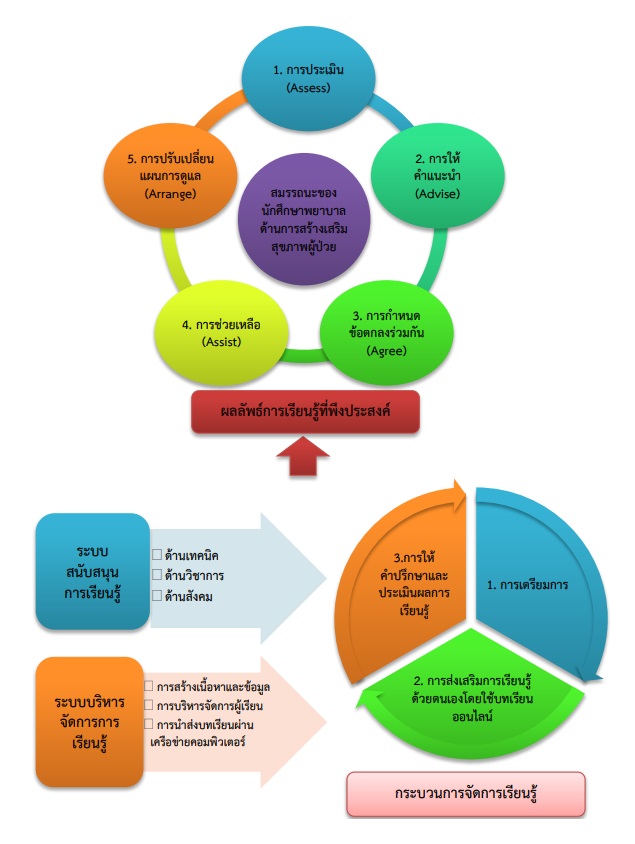
2. The new model was developed accordingly with the “Praboromarajchanok Institute model” (PBRI model) policy, which emphasizes on the well-being of the community by using the concept of surveillance and controlling of diabetes and hypertension patients ("7 Colors Ball, Tool of Life"). It consisted of 5 components: 1) the principles and objectives, 2) the desirable learning outcomes, 3) the learning process (preparing for learning, encouraging self-directed learning through online lessons, advising and learning evaluation), 4) the learning support systems (technical, academic, and social support), and 5) the learning management system (creating content and information, delivering lessons through a computer network, and student management).
3. The effectiveness of the new model was evaluated after 4 weeks of experiment. After that period, nursing students’ knowledge and competencies for health promotion in the community among patients with diabetes mellitus and hypertension was significantly higher than before, at the .05 level (t=97 and 10.91, respectively, p<.001).
The results of this study provide a guide to enhance nursing students’ competencies for health promotion among patients with diabetes mellitus and hypertension in the community.
References
Almutairi, N., Hosseinzadeh, H., & Gopaldasani, V. (2020). The Effectiveness of Patient Activation Intervention on Type 2 Diabetes Mellitus Glycemic Control and Self-Management Behaviors: A Systematic Review of RCTs. Primary Care Diabetes, 14(1), 12-20.
Aunban, P., & Tanomrat, S. (2021). The Development of a Program to Develop Competency for Nursing Students in Health Behavior Changes of Hypertension Patients in the Community. Journal of Social Science and Buddhistic Anthropology, 6(11), 1-20.
Carolan, C., Davies, C. L., Crookes, P., McGhee, S., & Roxburgh, M. (2020). COVID 19: Disruptive Impacts and Transformative Opportunities in Undergraduate Nurse Education. Nurse Education in Practice, 46, 102807.
Chaleoykitti, S., Artsanthia, J., & Daodee, M. S. (2020). The Effect of COVID-19 Disease: Teaching and Learning in Nursing. Journal of Health and Nursing Research, 36(2), 255–262. (in Thai)
Chrvala, C. A., Sherr, D., & Lipman, R. D. (2016). Diabetes Self-Management Education for Adults with Type 2 Diabetes Mellitus: A Systematic Review of the Effect on Glycemic Control. Patient Education and Counseling, 99(6), 926-943.
Chunthawanich, S. (2010). Qualitative Research Methodology (17th ed.). Bangkok: Chulalongkorn University. (in Thai)
Cohen, J. (1992). Statistical Power Analysis. Current Directions in Psychological Science, 1(3), 98-101.
Division of Non-Communicable Diseases, Ministry of Public Health. (2022). Data of Non-Communicable Diseases. Retrieved May14, 2022 from http://www.thaincd.com/2016/mission /documents-detail.php?id=13684&tid=32&gid=1-020
Eberly, L. A., Rusangwa, C., Neal, C. C., Mukundiyukuri, J. P., Mpanusingo, E., Mungunga, J. C., et al. (2019). Cost of Integrated Chronic Care for Severe Non-Communicable Diseases at District Hospitals in Rural Rwanda. British Medical Journal Global Health, 4(3), e001449.
Faul, F., Erdfelder, E., Lang, A. G., & Buchner, A. (2007). G* Power 3: A Flexible Statistical Power Analysis Program for the Social, Behavioral, and Biomedical Sciences. Behavior Research Methods, 39(2), 175-191.
Glasgow, R. E., Emont, S., & Miller, D. C. (2006). Assessing Delivery of the Five ‘As’ for Patient-Centered Counseling. Health Promotion International, 21(3), 245-255.
Hair, F. J., Black, C. W., Babin, J. B., & Anderson, E. R. (2010). Multivariate Data Analysis (7th ed.). New Jersey: Pearson Education.
Health Education Division, Department of Health Service Support, Ministry of Health. (2014). ABCDE-Health Literacy Scale of Thai Adults. Nonthaburi: Ministry of Public Health.
Kankeu, H. T., Saksena, P., Xu, K., & Evans, D. B. (2013). The Financial Burden from Non-Communicable Diseases in Low-and Middle-Income Countries: A Literature Review. Health Research Policy and Systems, 11(1), 1-12.
Kim, S., Jeong, S. H., Kim, H. S., & Jeong, Y. J. (2022). Academic Success of Online Learning in Undergraduate Nursing Education Programs in the COVID-19 Pandemic Era. Journal of Professional Nursing, 38, 6-16.
Kim, S. Y., Kim, S. J., & Lee, S. H. (2021). Effects of Online Learning on Nursing Students in South Korea during COVID-19. International Journal of Environmental Research and Public Health, 18(16), 8506.
Koch, L. F. (2014). The Nursing Educator's role in E-Learning: A Literature Review. Nurse Education Today, 34(11), 1382-1387.
Kraichan, S. (2018). Health Promotion Competencies of Bachelor of Nursing Students in Academic Year 2015 at Srimahasarakham Nursing College. Journal of Humanities and Social Sciences Nakhon Phanom University, 156-163. (in Thai)
Lackland, D. T., & Weber, M. A. (2015). Global Burden of Cardiovascular Disease and Stroke: Hypertension at the Core. Canadian Journal of Cardiology, 31(5), 569-571.
Lahti, M., Hätönen, H., & Välimäki, M. (2014). Impact of E-Learning on Nurses’ and Student Nurses Knowledge, Skills, and Satisfaction: A Systematic Review and Meta-analysis. International Journal of Nursing Studies, 51(1), 136-149.
Lastra, G., Syed, S., Kurukulasuriya, L. R., Manrique, C., & Sowers, J. R. (2014). Type 2 Diabetes Mellitus and Hypertension: An Update. Endocrinology and Metabolism Clinics, 43(1), 103-122.
NCD Countdown 2030 Collaborators. (2018). NCD Countdown 2030: Worldwide Trends in Non-Communicable Disease Mortality and Progress towards Sustainable Development Goal Target 3.4. Lancet, 392(10152), 1072–1088.
Nortvig, A. M., Petersen, A. K., & Balle, S. H. (2018). A Literature Review of the Factors Influencing E‑Learning and Blended Learning in Relation to Learning Outcome, Student Satisfaction and Engagement. Electronic Journal of E-learning, 16(1), 46-55.
Pender, N. J., Murdaugh, C. L., & Parsons, M. A. (2015). Health Promotion in Nursing Practice. (7th ed.). New Jersey: Pearson.
Polit, D. F., & Beck, C. T. (2021). Nursing Research: Generating and Assessing Evidence for Nursing Practice. (11th ed.). Philadelphia: Wolters Kluwer.
Prachomklao College of Nursing, Phetchaburi Province. (2018). Bachelor of Nursing Program (Course updated 2018). Phetchaburi: Prachomklao College of Nursing. (in Thai)
Promla, W., & Aukakimaphan, J. (2018). The Effective of a Health Promotion of Elderly in Pathumthani Province. The Journal of Pacific Institute of Management Science (Humanities and Social Science), 4(2), 59-67. (in Thai)
Pumsangua, K., & Prasittivatechakool, A. (2014). Patterns in Developing Nursing Students of The Royal Thai Army Nursing College to be Health Promotion Leaders in Relevance to Exercise, Food Consumption and Stress Management. Journal of The Royal Thai Army Nurses, 15(1), 73-80. (in Thai)
Rungnoei, N., Dittabunjong, P., Oumpram, K., Sirilarp, A., & Boonthum, S. (2020). A Model of Student Peer Leader Development for Enhancing Health Promoting Behaviors among Nursing Students. Phetchaburi: Prachomklao College of Nursing. (in Thai)
Shahaj, O., Denneny, D., Schwappach, A., Pearce, G., Epiphaniou, E., Parke, H. L., et al. (2019). Supporting Self-Management for People with Hypertension: A Meta-Review of Quantitative and Qualitative Systematic Reviews. Journal of Hypertension, 37(2), 264-279.
Sittisart, W., Meethip, N., & InJeen, J. (2019). The Effectiveness of a Health Promoting Behavior Program for Elderly with High Blood Pressure at Banklong Sub District Health Promoting Hospital, Phitsanulok. Nursing Journal of The Ministry of Public Health, 29(1), 153-165. (in Thai)
Srisuwanan, P. (2017). Result of Hypertension Patient Behavior Change Research with Pender’s Health Model. Journal Health Research and Development Nakhon Ratchasima Public Health Provincial Office,3(2), 105-118. (in Thai)
SuangKaew, S., & Kooariyakul, A. (2014). Competency Development Model of Nurse Students toward a Health Promotion Practitioner. Journal of Nursing and Education, 7(2), 32-46. (in Thai)
Teantaworn, W. (2013). Surveillance, Control and Prevention System of DM and HT in Thailand: Policy to Action (3rd ed.). Bangkok: The Agricultural Co-operative Federation of Thailand. (in Thai)
Teantaworn, W. (2021). Strategies for driving Praboromarajchanok Institute Towards a Healthy Community. Retrieved October 29, 2021 from https://www.pi.ac.th/uploads/news/document/20210901144650aQkwvK2.pdf (in Thai)
Telford, M., & Senior, E. (2017). Healthcare students' experiences when integrating e-learning and flipped classroom instructional approaches. British Journal of Nursing, 26(11), 617-622.
Trust, T., & Pektas, E. (2018). Using the ADDIE model and universal design for learning principles to develop an open online course for teacher professional development. Journal of Digital Learning in Teacher Education, 34(4), 219-233.
Welty, G. (2007). The ‘design’ phase of the ADDIE model. Journal of GXP Compliance, 11(4), 40-48.
World Health Organization. (2020). World health organization statistics 2020: monitoring health for the SDGs, sustainable development goals. Retrieved July 3, 2021 from https://apps.who.int/iris/bitstream/handle/10665/332070/9789240005105-eng.pdf
World Health Organization. (2021). Noncommunicable diseases. Retrieved July 3, 2021 from https://www.who.int/news-room/fact-sheets/detail/noncommunicable-diseases
Downloads
Published
Issue
Section
License
Copyright (c) 2022 Journal of Nursing and Education

This work is licensed under a Creative Commons Attribution-NonCommercial-NoDerivatives 4.0 International License.



