
The Effects of a Life Skills Development Program Using 3D Cartoon Animation Videos on Disadvantaged Children of Northern Thailand
Keywords:
Life Skills Development Program, Disadvantaged Children, Ajzen’s Theory of Planned Behavior, TPB, Cartoon Animations Videos, Northern ThailandAbstract
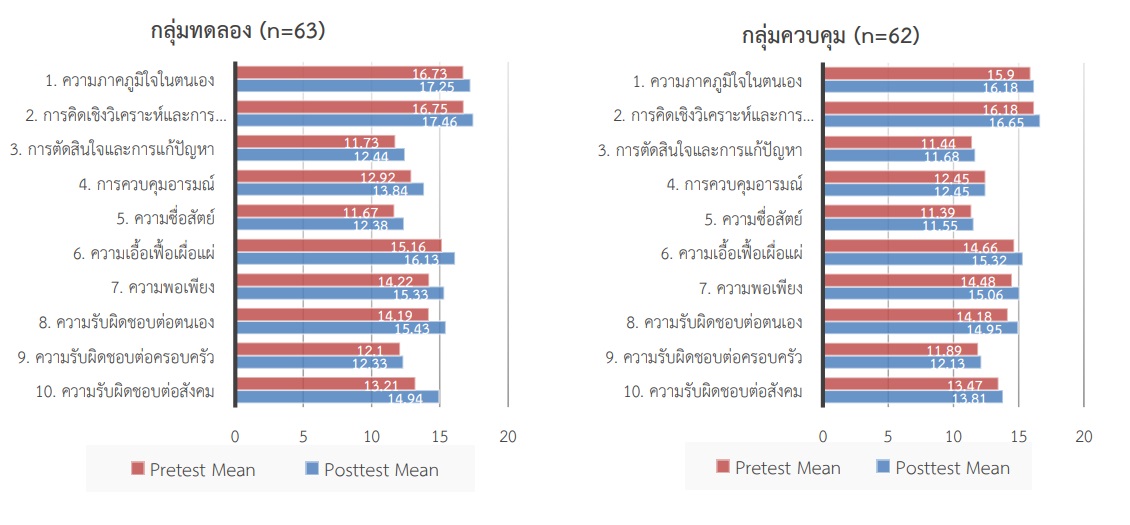
This quasi-experimental study with a two-group pretest-posttest design aimed to examine the effects of a life skills development program with 3D cartoon animation videos on life skills of elementary education disadvantaged children from the boarding schools under the royal patronage in Northern Thailand (Sueksa Songkhro and Rajaprajanugroh schools). Based on Ajzen’s theory of planned behavior (TPB), the program was implemented with 3D cartoon animations and storytelling images. Its content covered ten skills, including: 1) self-esteem, 2) critical thinking and media consumption, 3) decision-making and problem-solving, 4) emotion management, 5) honesty, 6) generosity, 7) sufficiency, 8) self-responsibility, 9) family responsibility, and 10) social responsibility. The participants, aged 9-12 y-o, were firstly selected with multi-stage sampling and subsequently divided into experimental and control groups. While members of the experimental group (N=72) were exposed to the life skills development program with 3D cartoon animations, those in the control group (N=72) received regular instructional routines. General demographic data were collected using questionnaires, whereas life skills data were evaluated using a life skills assessment for elementary school students. The life skills assessment was validated for internal consistency and resulted in a Cronbach’s alpha coefficient of .87. The obtained data were analyzed by descriptive statistics, chi-square test, and t-test.
Results revealed that the participants in the experimental group, who participated in the life skills development program with 3D cartoon animations, had a posttest mean in life skills significantly higher than their pretest mean (p<.05). Furthermore, this posttest mean was also significantly higher than that of the control group (p<.05).
Per findings, this life skills development program, combined with regular instructional routines, is applicable as a life-skills training approach for disadvantaged children.
References
Ajzen, I. (1991). The Theory of Planned Behavior. Organizational Behavior and Human Decision Processes, 50(2), 179-211.
Akfırat, O. N. & Kezer, F. (2016). A Program Implementation for the Development of Life Skills of Primary School 4th Grade Students. Journal of Education and Practice, 7(35), 9-16.
Chiangkul, W. (2009). “The Problem of Equality and Quality of Thai Education” State of Thai Education 2550/2551. Bangkok: V.T.C.Communication. (in Thai).
JungLee, M., ChiWu, W., ChiehChang, H., JungChen, H., ShanLin, W., YenFeng, J., et al. (2020). Effectiveness of a School-Based Life Skills Program on Emotional Regulation and Depression among Elementary School Students: A Randomized Study. Children and Youth Services Review, 118(2020), 105-464.
Kaewpatima, T. (2004). Development of a Life Skills Scale for Prathomsuksa 4-6 Students. Thesis in Educational Research and Evaluation, Kasetsart University. (in Thai).
Khamaikawin, P. (2014). Proposed Educational Strategies to Develop Essential Life Skills in Social Inclusion Promotion for Underprivileged Children. Degree of Doctor of Philosophy Program in Development Education Department of Educational Policy, Management, and Leadership, Chulalongkorn University. (in Thai).
Kummabutr, J. (2012). Effect of A Parent Training Program in Conjunction with a Life Skills Training Program on The Life Skills of School-Age Children. Doctor of Philosophy Nursing, Mahidol University. (in Thai).
Leksak, A. (2014). The Effects of Life Skills Development Program Using 3D Cartoon Animations on the Life Skills of Third Grade Students. Master of Nursing Science in Pediatric Nursing, Mahidol University. (in Thai).
National Statistical Office. (2018). Analysis of Children and Youth 2560. Bangkok: Text and Journal Publication. (in Thai).
Panmuang, C., Kraisakul, K., & Samakkee, P. (2014). Development of a Guidance Activities Packages Based on Multimedia for Life Skills Development of Rajchaprachanukhroh 19 School Mattayomsuksa 1 Students. Narkbhutparitat Journal Nakhon Si Thammarat Rajabhat, 6(2), 14-25. (in Thai).
Phuphaibul, R. (2006). The Theory of Planned Behavior: Related Research on Adolescents Behaviors. Ramathibodi Nursing Journal, 10(1), 24-33. (in Thai).
Phuphaibul, R., Kerddonfeg, P., Areeyanuchitkul, S., & Chantarachote, J. (2014). Comparison of the Effects of Life Skills Training Programs Using Cartoon Books and Using Animation Movies on Life Skills of School-Agers. Ramathibodi Nursing Journal, 20(2), 271-287. (in Thai).
Phuphaibul, R., Tachudhong, A., Areeyanuchitkul, S., Kongsaktrakul, C., Kerddonfeg, P., & Prasitchai, J. (2010). Documents for the Workshop on the Development of Life Skills and Health Skills of Elementary School Students and Family Participation. The Development Potentials of Thai People Project. Retrieved March 25, 2019 from https://www.rama.mahidol.ac.th/sdmc/th/ thaipopulation/AnnualThaiPopulation-th/. (in Thai).
Sondee, S. (2013). The Effects of Teaching Life Skill Program Using Animation Cartoon on Life Skills and Emotional Quotient among the Fifth-Grade Students. Master of Nursing Science in Pediatric Nursing, Mahidol University. (in Thai).
Special Education Bureau. (2016) Techniques for Cultivating Morals, Ethics, and Life Skills for Sueksa Songkhro. Bangkok: Special Education Bureau. (in Thai).
Sripakho, P. (2012). The Effects of The Life Skills Development Program Using Cartoon Books Media on Life Skills Among Grade Five Students. Master of Nursing Science in Pediatric Nursing, Mahidol University. (in Thai).
UNICEF. (2018). Situation analysis Teenage pregnancy in Thailand. Retrieved June 16, 2018 from www.unicef.org/thailand/media/1131/file/.pdf.
Downloads
Published
Issue
Section
License
Copyright (c) 2022 Journal of Nursing and Education

This work is licensed under a Creative Commons Attribution-NonCommercial-NoDerivatives 4.0 International License.



