
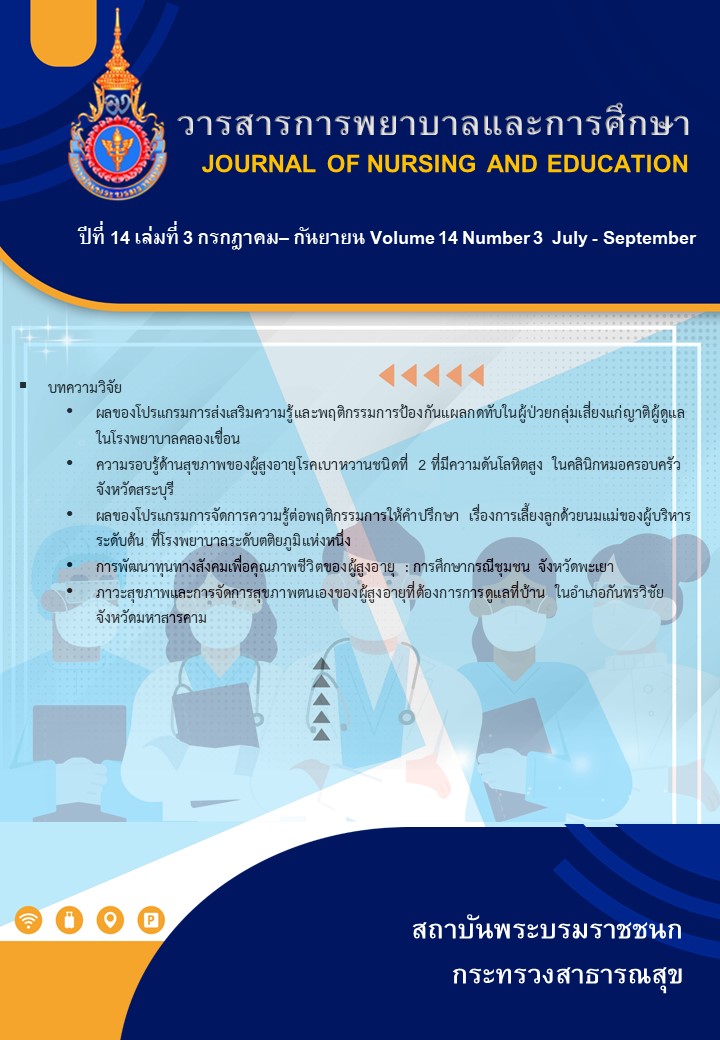
Effect of the Knowledge Management Program on First-Line Nurse Managers’ Breastfeeding Counseling Behavior at a Tertiary Hospital
Keywords:
Breastfeeding, Counseling Behavior, Knowledge Management ProgramAbstract
This research was a quasi-experimental study with both pre- and post-experiment. The objective of this study was to study the effect of a knowledge management program on first-line nurse managers’ breastfeeding counseling behavior at a tertiary hospital. The sample group consisted of 70 first-line nurse managers working in breastfeeding-related departments. The G*Power program was used to calculate the sample size. The samples were divided into experimental and control groups, each separated into groups of 35. The research tool was the breastfeeding knowledge management program, general questionnaires, and scale-counseling behavior forms. The research tool was examined for content validity by five experts. The content validity index was at 0.86. Cronbach’s alpha coefficient was at 0.96. Data were analyzed using descriptive and statistical paired t-tests and independent t-tests.
As for the results of the study on first-line nurse managers’ breastfeeding counseling behavior in both pre- and post-experiment, it was found that comparing the level of first-line nurse managers’ breastfeeding counseling behavior between the experimental and control groups, it was found that after using the knowledge management program, first-line nurse managers had a statistically significant difference in counseling behavior scores (p > .05). Additionally, compared with pre- and post-usage of the knowledge management program, it was found that the mean scores of post-experimental counseling behaviors were significantly different (p < .05) and higher than the pre-experimental one.
The findings indicated that the developed breastfeeding knowledge management program can be positively used to improve breastfeeding counseling behaviors on First-Line Nurse Managers so that first-line nurse managers should have to learn about this continuously.
References
Jiraphaet, K, Common problems in infants. Documents for the workshop on Advanced course
in breastfeeding: Common problems in breastfed infants, February 6, 2019 at Charoen Thani Hotel, Khon Kaen. 2019 [In Thai].
Unicef, Breastfeeding: A Key to Sustainable Development. [Internet]. March 2016, [cited 2016] Available from:http://www.worldbreastfeedingweek.org/pdf/BreastfeedingandSDGsMessaging%20WBW2016%20Shared.pdf.
Wichitsukon, K. Development of a model for promoting breastfeeding among teachers, Faculty of
Nursing, Chiang Mai University and nurses at Maharaj Nakorn Chiang Mai Hospital. Nurse Message, 41, (Special Edition), pp. 2014 [In Thai].
Wongphinit U. Nurse’s role in promoting exclusive breastfeedingat hospital discharge. The Thai Red
Cross Nursing Journal. 2558; 8(1): 24-33 [In Thai].
Nursing Division, Ministry of Public Health, Roles and duties of registered nurses according to their work practice. Publisher: Tawan Media. 2018. [In Thai].
Corey, G. Theory and Practice of Group Counseling (5thed.). California: Thomson Brook/Cole Inc. 2004.
Chaleoykitti S., Keskomon T., Health Counseling: Development of Quality of Care. Journal of The Police Nurse. 2558; 7(1): 255-262 [In Thai].
Bonnie, R. M., A systems thinking framework for knowledge management. Georgetown:
University Press; 2004.
Permpool S., Knowledge Management in the Development of the Practice Competency of Nursing Supervisors at a the Tertiary Level Hospital in Prachinburi Province. [dissertation]. Bangkok: Christian
University of Thailand; 2013 [In Thai].
Tiansarrd J., Kanogsunthorntrat N., Kitiyakara C., Effects of Counseling and Educational Program based on Motivational Interviewing on Health Behaviors and Clinical Outcomes in Patient with Pre-dialysis Chronic Kidney Disease. Thai Journal of Nursing and Midwifery Practice. 2018; 5(2): 19-38 [In Thai].
Punjuy R., Lueboonthavatchai, O., Thato R., The Effect of Group Counseling Program on Coping Ability of Caregivers of Schizophrenic Patients in Community. The Journal of Psychiatric Nursing and
Mental Health. 2557; 28(3): 117-129 [In Thai].
Srithammanit T., Effective Human Resource Management of Private Hospital. [dissertation]. Bangkok: Thammasat University; 2016 [In Thai].
Tannukit P., Charanasomboon S., The Development of Competency Training Program for Hospitals First- Line Managers under the Jurisdiction of the Medical Service Department, Bangkok Metropolis Administration. Journal of Charoenkrung Pracharak Hospital. 2016; 12(2): 16-26 [In Thai].
Charoenboon W., Ujaratana P. Suwankot. K., The Effects of Readiness Preparation for Being Charge Nurses at a Tertiary Level Hospital in the Department of Medical Services under the Ministry of Public Health. Journal of Nakhonratchasima College. 2016; 10 (2): 111-124 [In Thai].
Hannon, P. Succession planning: Developing the next generation of nurse leaders. A Dissertation Submitted in Partial Fulfillment of the Requirements for the Degree of Doctor of Philosophy in The Graduate School of Texas Woman’s University. College of Nursing. 2014.
Jaowattana Y., Knowledge Management Model for Support and Improve Consulting Services in Information and Communication Technology for private organization. [dissertation]. Bangkok: Sripatum University; 2011. [In Thai].
Trozter, J. P. The counselor and the group: Integrating theory, training, and practice. California:
Wadsworth; 1977.
Karen A, Katherine F, Michelle T. Effects of a randomized counselor trial on the enhancement of prenatal lactation on infant health care. MPH et al. 2006.
Downloads
Published
Issue
Section
License

This work is licensed under a Creative Commons Attribution-NonCommercial-NoDerivatives 4.0 International License.



