
Family and Community Nursing II Practicum Course Provision under the COVID-19 Situation: The Effects of Blended Learning on Learning Outcomes
Keywords:
Blended Learning, Learning Outcomes, Nursing PracticeAbstract
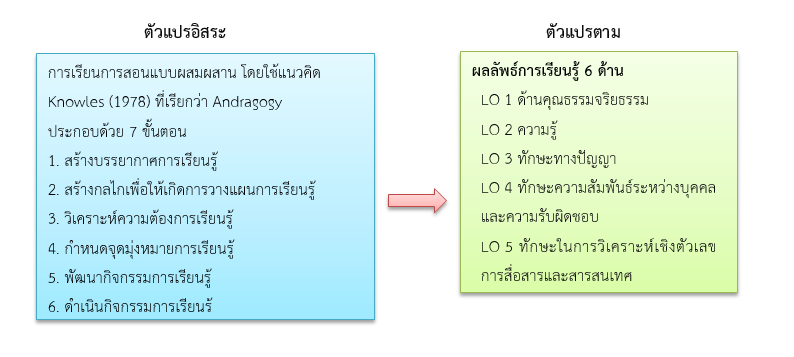
This quasi-experimental research aimed to compare the learning outcomes of nursing students in the family and community nursing II practicum course. The participants were 59 nursing students in their 4th year. A total of 31 students received blended learning management, and 28 students received regular learning management. The research tools were: 1) the blended learning program, inspired by the 7-Step mixed practice management method, and 2) the students' learning outcomes, according to the Thai Qualifications Framework for Higher Education, under the form of a rubric score assessment questionnaire. Data were analyzed by mean standardization and t-test. Content validity indexes of the questionnaire were equal to 1.
The results showed that the learning outcomes between those two groups were statistically significant, at the .05 level, for interpersonal skills and responsibilities, numerical analysis skills, communication, and information technology skills. Therefore, this blended learning program might be integrated and applied in other subjects, so to enhance the learning outcomes of nursing students in their practicum.
References
Assessment work. (2017). Graduate Quality Report Academic Year. Ratchaburi: Boromara -jonani College of Nursing, Chakriraj.
Bangthamai, P., Srisomphan, K., Somnukprasert, W. & Weerawatanodom, N. (2020). Effects of Blended Learning and Childbirth Delivery Simulation Based Learning on Academic Achievement, Satisfaction and The Students’ Opinions Towards Teaching by Reflective Thinking of Nursing Students, Boromarajonani College of Nursing Nonthaburi. Journal of The Royal Thai Army Nurses, 21(3), 350-591 (In Thai)
Bonk, C. J. & Graham, C. R. (2004). Handbook of Blended Learning: Global Perspectives. San Francisco: Pfeiffer Publishing.
Cheewakasemsuk, A. (2021). “Nursing Teaching and Learning Management with Blended Learning in New Normal Era”. Journal of Health and Nursing Research, 37(1), 25-37. (In Thai)
Jaroensuk, S., Pladleng, A., Wongratanarak, W., Chittayanun, K. & Sueapoomy, N. (2016). The Model of Assessment for Learning Development based on Thai Qualification Framework for Bachelor of Nursing Science, Boromarajonani College of Nursing, Chakriraj. Princess of Naradhiwas University Journal, 8(2), 28-43. (In Thai)
Khamkong, M. & Chaikongkiat, P. (2017). High-Fidelity Simulation-Based Learning: A Method to Develop Nursing Competency. The Southern College Network Journal of Nursing and Public Health, 4(Special Edition), 332-344. (In Thai)
Knowles, M. S. (1978). The Adult Learner: A Neglected Species (2nded.). Houston: Gulf.
Saenprasarn, C., Puapairoj, V. & Chaiphibalsarisdi, P. (2015). Effects of Constructivism Approach of Teaching and Learning on a Course of Nursing Process and Health Assessment.Thai Journal of Cardio-Thoracic Nursing, 26(1), 149-164. (In Thai)
Smaldino, S. E. (2012). Instructional Technology and Media for Learning. (10th Edition). New Jersey: Pearson Merrill/prentice hall.
Wayo, W., Charoennukul, A., Kankaynat, C. & Konyai, J. (2020). Online Learning Under the COV-Epidemic: Concepts and Applications of Teaching and Learning Management, Regional Health Promotion Center 9 Journal, 14(3), 285-298. (In Thai)
Zheng, L. (2015). A systematic literature review of design-based research from 2004 to 2013. Journal of Computers in Education, 2(4), 399-420.
Downloads
Published
Issue
Section
License
Copyright (c) 2022 Journal of Nursing and Education

This work is licensed under a Creative Commons Attribution-NonCommercial-NoDerivatives 4.0 International License.



