
Factors Predicting Quality of Life among Patients with Post-Percutaneous Coronary Intervention in Chonburi Province
Keywords:
Quality of Life, Ischemic Heart Disease, Percutaneous Coronary InterventionAbstract
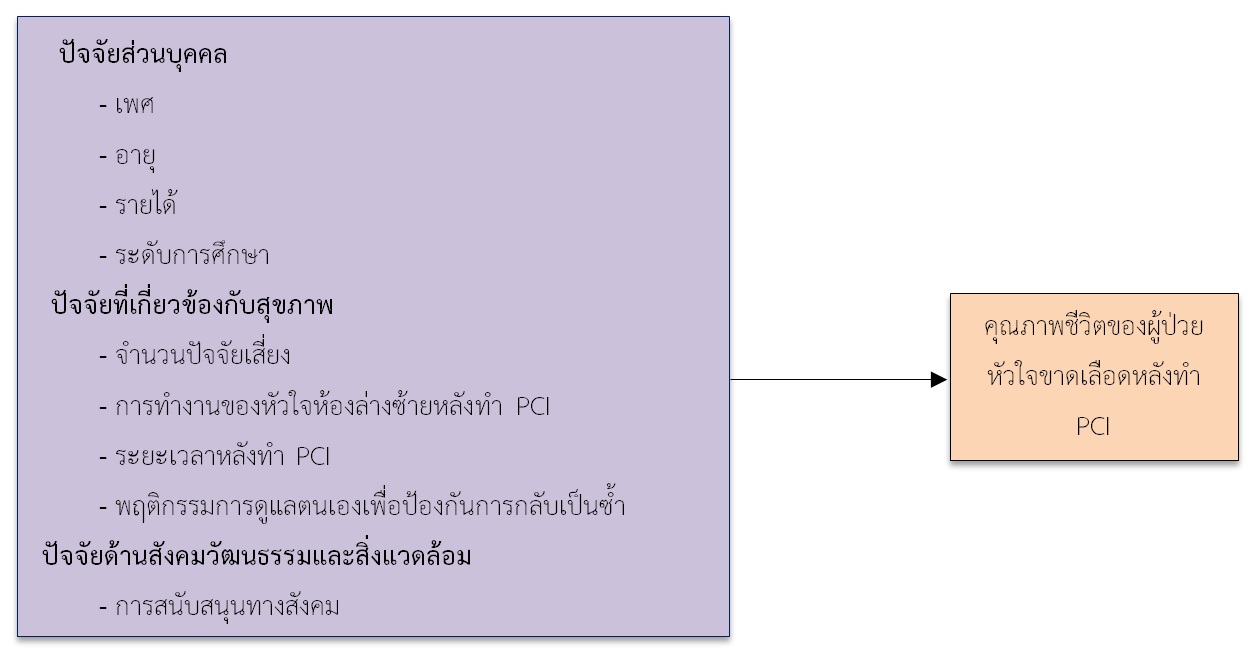
The purposes of this predictive research were both to study the quality of life and predict factors of quality of life among post-percutaneous coronary intervention patients. The sample group was 270 patients with ischemic heart disease. Participants were selected by sampling, among post-percutaneous coronary intervention treatment patients, accordingly with the principle of probability. Data were collected during the period from July to October 2020. The instruments used for the interviews consisted of personal information, and data collected from the patient's medical records, as well as the following: Quality of life assessment forms EQ-5D-5L; Self-Care Behavior to Prevent Recurrence questionnaire; social support questionnaires and community environment conducive to health promotion questionnaire. Their reliability scores were 0.73, 0.96, and 0.94, respectively. The data were analyzed by descriptive statistics and inferential statistical analysis of multiple regression.
Results showed that the quality of life was very high, with a mean utility of .97 (SD = .06) when assessed by the EQ-5D-5L assessment. The quality of life was directly assessed by visual analog scale method, with a mean score of 76.96 (SD=14.16). The regression coefficient of factors that could predict quality of life was calculated using visual analog scale. Factors that could predict the quality of life were left ventricular ejection fraction after percutaneous coronary intervention (b=0.298, p<.01) male (b=9.859, p<.01) self-care behaviors to prevent recurrence (b=0.189, p=.012) community health-enhancing environment (b=0.296, p=.008) number of risk factors (b=-1.974, p=.017) and period after percutaneous coronary intervention (b=0.574, p=.022) were able to predict the quality of life of 22.1% (R2=.221, p=<.001).
The results of this research suggested that professional nurses or medical personnel should be more careful in caring for female patients, patients with low cardiac contractility, patients with multiple risk factors or comorbidities, and patients who have recently undergone percutaneous coronary intervention should increase their knowledge, understanding and self-care skills for patients and their relatives. The patients should be referred to community nurses for continuous care to promote their quality of life.
References
Campbell, A., Converse, P. E., & Rodgers, W. L. (1976). The quality of American life: Perceptions, Evaluations, and Satisfactions: Russell: Sage.
Cassar, S., & Baldacchino, D. R. (2012 a). Quality of Life After Percutaneous Coronary Intervention: Part 1. British Journal of Nursing, 21(16), 965-971.
Cobb, S. (1976). Social Support as a Moderator of Life Stress. Psychosomatic Medicine, 38(5), 300-314.
Chansiri, K. (2016) The Relationship Between Basic Conditioning Factors, Self-Care Behaviors, and Quality of Life among Patients After Coronary Stent Implantation. Vajira Nursing Journal, 18(1), 12-23. (in Thai)
Charoenpattanaphak, P., Masingboon, K., Kunsongkeit, W. (2013) Factors Influencing Health - Related Quality of Life in Patients with Acute Myocardial Infarction. Journal of Gradurate Research Conference Khon Kaen University 2013, 1008-1020. (in Thai)
Chaykhetkaew, U. (2009) Health Technology Assessment Guide for Thailand. Nonthaburi: Chulabook. (in Thai)
Cohen, D. J., Van Hout, B., Serruys, P. W., Mohr, F. W., Macaya, C., den Heijer, P., et al. (2011). Quality of Life After PCI with Drug-Eluting Stents or Coronary-Artery Bypass Surgery. New England Journal of Medicine, 364(11), 1016-1026. doi: 10.1056/NEJMoa1001508
Darvishpour, A., Javadi-Pashaki, N., Salari, A., Sadeghi, T., & Taleshan-Nejad, M. (2017). Factors Associated with Quality of Life in Patients Undergoing Coronary Angioplasty. Journal of Health Sciences (Qassim University), 11(4), 1-7.
Huffman, J. C., Celano, C. M., & Januzzi, J. L. (2010). The Relationship Between Depression, Anxiety, and Cardiovascular Outcomes in Patients with Acute Coronary Syndromes. Neuropsychiatric Disease and treatment, 6, 123.
Jankowska-Polanska, B., Uchmanowicz, I., Dudek, K., & Loboz-Grudzien, K. (2020). Sex differences in the Quality of Life of Patients with Acute Coronary Syndrome Treated with Percutaneous Coronary Intervention After a 3-Year Follow-Up. Patient Preference and Adherence, 10, 1279-1287. doi: 10.2147/PPA.S106577
Koh, Y., Stehli, J., Martin, C., Brennan, A., Dinh, D. T., Lefkovits, J., et al. (2019). Does Sex Predict Quality of Life After Acute Coronary Syndromes: An Australian, State-Wide, Multicentre Prospective Cohort Study. BMJ Open, 9(12), e034034. doi: 10.1136/ bmjopen-2019-034034
National Statistical Office. (2019) Number of Patients/Cause of Death. Retrieved from http://service.nso.go.th/nso/web/statseries/statseries09.html (in Thai)
Pattanaphesaj, J. (2014). Health-Related Quality of Life Measure (EQ-5D-5L): Measurement Property Testing and Its Preference-Based Score in Thai pPopulation. Doctoral Dissertation, Geaduate Study, Mahidol University.
Ritpetch, N., Jitpanya, C. (2012) Factors Related to Quality of Life among Patienta with Heart Disease : A Research Synthesis in Thailand. Thai Journal of Cardio-thoracic Nursing, 23(2), 1-16. (in Thai)
Saengsiri, A., Wattradul, D., Kangchanakul, S., Natthumrongkul, S., Nopplub, S., Wonganunnont, S. (2015) The Factors Inuencing the Self-care Agency and Quality of Life of Patients with Coronary Artery Disease. Thai Journal of Cardio-thoracic Nursing, 26(1), 104-118. (in Thai)
VanVoorhis, C. W., & Morgan, B. L. (2007). Understanding Power and Rules of Thumb for Determining Sample Sizes. Tutorials in Quantitative Methods for Psychology, 3(2), 43-50.
World Health Organization. (2018). The Top 10 Causes of Death. Retrieved May 2, 2021 from http://www.who.int/healthinfo/global_burden_disease/estimates/en/.
World Health Organizaion EUROPY. (1986). Ottawa Charter for Health Promotion. Retrieved May 2, 2021 from https://intranet.euro.who.int/_data/assets/pdf_file/0004/129532/Ottawa_ Charter.pdf
Zhan, L. (1992). Quality of Life: Conceptual and Measurement Issues. Journal of Advanced Nursing, 17, 795-800.
Downloads
Published
Issue
Section
License
Copyright (c) 2022 Journal of Nursing and Education

This work is licensed under a Creative Commons Attribution-NonCommercial-NoDerivatives 4.0 International License.



