
Safe Sex Health Literacy among Undergraduate Students in Khon Kaen Province
Keywords:
Health Literacy, Safe Sex, Undergraduate StudentsAbstract
This research is qualitative research aimed to study health knowledge about safe sex among students. Bachelor's degree at a university in Khon Kaen Province A total of 50 respondents in this research were divided into a group of 22 undergraduate students, 21 students' parents, 4 professors, and 3 health workers. In-depth interview by content analysis
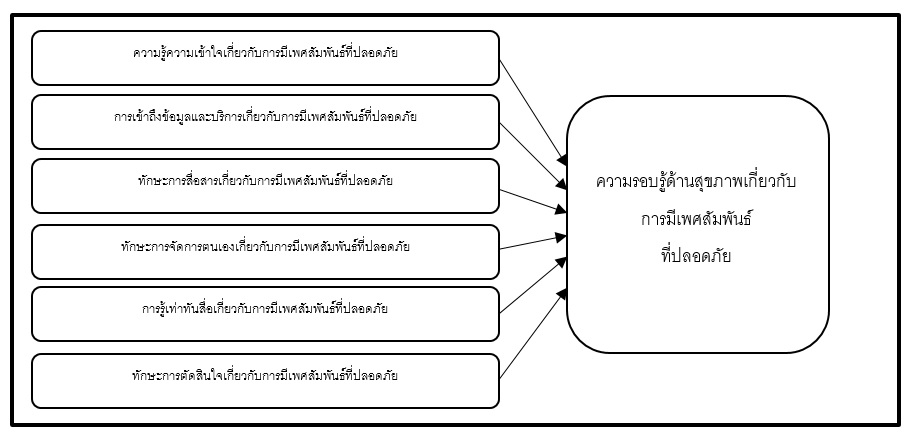
The results of the research revealed that the health knowledge about safe sex among students consisted of 6 aspects: 1) Cognitive aspects. Symptoms and transmission of sexually transmitted diseases are insufficient. 2) Access to information and services Students have access to information by means of Internet research. or most social media Less access to sexual health services in the area because students are shy and do not disclose their information to service providers 3) Communication skills Friends are the ones that students communicate about the safest sex life. And not communication about safe sex with family members 4) Self-management Students focus on self-management in preventing pregnancy. The group that had never had sex had different goals than those who had had sex, namely no sex. 5) Media literacy. Also found to believe information from social media which is implemented without passing a review of the data; and 6) decision-making. The students who had had sex decided to use a condom-based practice of safe sex. The group who had never had sex chose not to have sex first.
In conclusion, the results showed the understanding of health literacy about safe sex among students are therefore encouraged. Develop skills in evaluating student sexual health information obtained from social media. And develop a sexual health service system in other channels Reduce open communication among students to enable students to behave properly and maintain safe sex behavior for the rest of their lives.
References
Buarod, T., & Thongnopakun S. (2019). Sexual Media Literacy and Preventive Behaviors about Sexually Transmitted Diseases among Youth in University Students Chon Buri Province, Thailand. Disease Control Journal, 45(4), 402-12. (in Thai).
Bureau of AIDS, TB and STIs. (2010). Guidelines for the Development of Adolescent Clinics Friendly in the Care of Sexually Transmitted Diseases. (In Thai)
Bureau of Epidemiology, Department of Disease. Control, Ministry of Public Health. (2019). Disease Surveillance Report System 506. Retrieved September 30, 2019, from http://www.boe.moph.go.th/boedb/surdata/index.php
Bureau of Epidemiology, Department of Disease. Control, Ministry of Public Health. (2011). Situation of AIDS patients in 2011. Retrieved September 30, 2019, from http://www. Aidsthai. org/
Chaimano, M., & Ongkasing, C. (2018). A Study of Sexuality of Teenage Pregnancy in School. Journal of Education Thaksin University, 18(1), 65-76. (In Thai)
Division of AIDS and STIs, Department of Disease Control, Ministry of Public Health. (2020). A Guide to Raising Literacy of HIV and STDs. (In Thai)
Division of AIDS and STIs, Department of Disease Control, Ministry of Public Health. (2021). Prevalence of 5 Major Sexually Transmitted Diseases in Thailand in 2009-2020. (In Thai)
Hohmah, N. (2018). Health Literacy on Unwanted Pregnancy Prevention for Female Students in the Faculty of Education Yala Rajabhat University. Faculty of Education, Yala Rajabhat University. (In Thai)
Kaewkungwal, S. (2006). Psychology of Life Development of All Ages, Volume 2: Adolescence-Elderly Age, (9th ed.). Bangkok: Thammasat University. (In Thai)
Kownaklai, J., & Rujkorakarn, D. (2018). Unsafe Sexual Behavior among People Living with HIV/AIDS and Methods to Avoid Unsafe Sexual Intercourse. Journal of Nursing and Health Care, 36(4), 195-203. (In Thai)
Lertvicha, P. (2009). Brain Based-Learning. Bureau of Academic Affairs and Education Standards. (In Thai)
Muanphetch, C., Maharachapong, N., & Abdullakasim, P. (2020). Sexual Media Literacy and Sexual Behaviors among Adolescents in Thailand. Journal of Health Science Research, 14(2), 23-33. (in Thai)
Ngomsangad, Y., Srisuriyawet, R., & Homsin, P. (2019). Factors Influencing Health Literacy Related Pregnancy Prevention among Female Adolescent Students in Si Sa Ket Province. The Public Health Journal of Burapha University, 14(2), 37-51. (in Thai)
Nutbeam, D. (2000). Health Literacy as a Public Health Goal: a Challenge for Contemporary Health Education and Communication Strategies Into the 21st Century. Health Promotion International, 15(3), 259-67.
Seedaket, S., & Chotchai, T. (2021). Health Literacy of School-Age Pregnancy Prevention and Sexual Intercourse among High School Students in Khon Kaen Province. Journal of Health and Nursing Research, 37(1), 99-111. (In Thai)
Srimeechai, J., Rutchanagul, P., & Kummabutr, J. (2018). The Sexual and Reproductive Healthcare Behaviors of University Students Engaging in Virtual Marital Relationships. Journal of Boromarajonani College of Nursing, 34(3), 43-54. (In Thai)
Standard Report Group. KPI of Maternal and Child Health. (2019). Health Data Center (HDC), Ministry of Public Health. Retrieved October 30, 2019, from https://hdcservice.moph.go.th /hdc/reports/page.php?cat_id=1ed90bc32310b503b7ca9b32af425ae5
United Nations Children's Fund (Unicef), Ministry of education in Thailand. (2016). Review of comprehensive sexuality education in Thailand. (In Thai)
Downloads
Published
Issue
Section
License
Copyright (c) 2022 Journal of Nursing and Education

This work is licensed under a Creative Commons Attribution-NonCommercial-NoDerivatives 4.0 International License.



