
The Relationship between Smartphone Addiction Behaviors and Mental Health Problems among Nursing Students at Praboromarajchanok Institute
Keywords:
Smartphone Addiction, Stress, Depression, NomophobiaAbstract
This correlational research aimed to 1) make an assessment of smartphone addiction behaviors among nursing students, and 2) study the relationships between those smartphone addiction behaviors and stress, depression, and nomophobia (short term for "no mobile phobia") among nursing students from the nursing colleges under the jurisdiction of Praboromarajchanok Institute. The study was performed on nursing students who enrolled during the academic year 2020. The 442 nursing students participated in being selected by cluster sampling. The instruments consisted of 1) a demographic questionnaire, 2) the Thai Smartphone Addiction Scale Questionnaire (short version), 3) the Stress test Questionnaire (ST5), 4) a Thai version of The Patient Health Questionnaire for Adolescents (PHQ-A), and 5) a nomophobia questionnaire, yielding Cronbach alpha coefficients of .89, .83, .88, and .96, respectively. The frequency, percentile, mean, standard deviation, and Pearson’s correlation coefficient were all used for analyzing the data.
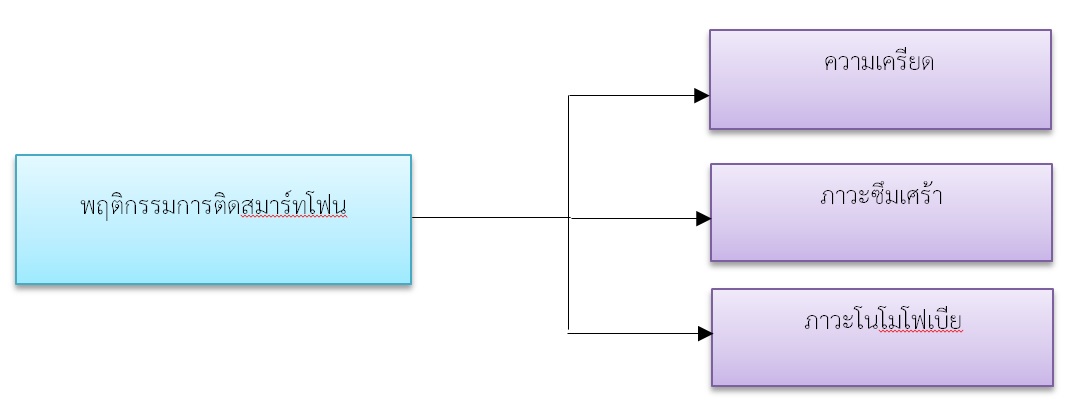
Results revealed that 21.72 % of nursing students had smartphone addiction. Smartphone addiction was significantly related to stress depression and nomophobia at p < .01. Therefore, nursing instructors should encourage nursing students to use smartphones correctly.
Moreover, the intervention should be created for nursing students who face smartphone addiction or psychological problems.
References
Aljomaa, S. S., Al.Qudah, M. F., Albursan, I. S., Bakhiet, S. F., & Abduljabbar, A. S. (2016). Smartphone Addiction among University Students in the Light of Some Variables. Computers in Human Behavior, 61, 155–164.
Baramee, J. (2008). Statistic for Health Research and SPSS Data Analysis. Chonburi: Srisilapa Printing.
Bülbüloğlu, S., Özdemir, A., Kapıkıran, G., & Sarıtaş, S. (2019). The Effect of Nomophobic Behavior of Nurses Working at Surgical Clinics on Time Management and Psychological Well-Being. Journal of Substance Use, 25, 318-323.
Buranasin, T. (2018). Thai Teenagers Found “Smartphone Addiction”. Retrieved March 2, 2022 from https://www.dmh.go.th/news-dmh/view.asp?id=27762
Celikkalp, U., Bilgic, S., Temel, M., & Varol, G. (2020). The Smartphone Addiction Levels and the Association With Communication Skills in Nursing and Medical School Students. The Journal of Nursing Research: JNR, 28(3), 1-9
Charoenwanit, S., & Soonthornchaiya, R. (2019). Development of Smartphone Addiction Scale: Thai Short Version (SAS-SV-TH). Journal of Mental Health of Thailand, 27(1), 25-36. (in Thai)
Cheumongkol, W., Inthitanon, T., & Wangsate, J. (2019). Impact of Smartphone and Tablet Use on Health and Academic Performance of Pharmacy Students at Srinakharinwirot University. Srinagarind Medical Journal, 34(1), 90-98. (in Thai)
Cho, S. & Lee, E. (2016). Distraction by Smartphone Use During Clinical Practice and Opinions about Smartphone Restriction Policies: A Cross-Sectional Descriptive Study of Nursing Students. Nurse Education Today, 40, 128-133.
Daei, A., Ashrafi-Rizi, H. & Soleymani, M. R. (2019). Nomophobia and Health Hazards: Smartphone Use and Addiction Among University Students. International Journal of Preventive medicine, 10, 1-5. https://doi.org/10.4103/ijpvm.IJPVM_184_19
Demirci, K., Akgönül, M., & Akpinar, A. (2015). Relationship of Smartphone Use Severity with Sleep Quality, Depression, and Anxiety in University Students. Journal of Behavioral Addictions, 4(2), 85–92.
Department of Mental Health. (2020). Stress test questionnaire (ST5). Retrieved Jun 11, 2021 from: https://www.dmh.go.th/test/qtest5/. (in Thai)
Elhai, J. D., Dvorak, R. D., Levine, J. C., & Hall, B. J. (2017). Problematic Smartphone Use: A Conceptual Overview and Systematic Review of Relations with Anxiety and Depression Psychopathology. Journal of affective disorders, 207, 251-259.
Gonçalves, S., Dias, P. C., & Correia, A. (2020). Nomophobia and Lifestyle: Smartphone Use and its Relationship to Psychopathologies. Computers in Human Behavior Reports, 2. https://doi.org/10.1016/j.chbr.2020.100025
Gray, J., Grove, S. K., & Sutherland, S. (2017). Burns and Grove's the Practice of Nursing Research: Appraisal, Synthesis, and Generation of Evidence. (8th ed.). Missouri: Elsevier.
Kardefelt-Winther, D. (2014). A Conceptual and Methodological Critique of Internet Addiction Research: Towards a Model of Compensatory Internet Use. Computers in Human Behavior, 31, 351-354.
Khan, S., Atta, M., Malik, N. I., & Makhdoom, I. F. (2021). Prevalence and Relationship of Smartphone Addiction, Nomophobia, and Social Anxiety among College and University Late Adolescents. Ilkogretim Online, 20(5), 3588-3595.
Khilnani, A. K., Thaddanee, R., & Khilnani, G. (2019). Prevalence of Nomophobia and Factors Associated with it: a Cross-Sectional Study. International Journal of Research in Medical Sciences, 7(2), 468-472.
Kim, M-o., Kim, H., Kim, K., Ju, S., Choi, J., Yu, M. (2015). Smartphone Addiction: (Focused Depression, Aggression and Impulsion) among College Students. Indian Journal of Science and Technology, 8(25), 1-6.
Kitisri, C., Nokham, R., & Phetcharat, K. (2017). A Smartphone Using Behavior and Health Status Perception of Nursing Students. Community Health Development Quarterly Khon Kaen University, 5(1), 19–34. (in Thai)
Kooariyakul, A., Onseng, W., Chidnayee, S. Suwanachat, S., & Soiphet, N. (2019). Factors Predicting Resilience in Nursing Students of Boromarajonani Nursing College. Uttaradit Boromarajonani College of Nursing, Uttaradit Journal, 11(2), 187-200
Krejcie, R. V. & Morgan, D. W. (1970). Determining sample size for Research Activities. Educational and Psychological Measurement, 30(3), 607–610.
Kroenke, K., Spitzer, R. L., & Williams, J. B. (2001). The PHQ-9: Validity of a Brief Depression Severity Measure. Journal of general internal medicine, 16(9), 606–613.
Kwon, M., Kim, D. J., Cho, H., & Yang, S. (2013). The Smartphone Addiction Scale: Development and Validation of a Short Version for Adolescents. PloS one, 8(12), e83558. https://doi.org/10.1371/journal.pone.0083558
Mohamed, S. M., & Mostafa, M. H. (2020). Impact of Smartphone Addiction on Depression and Self- Esteem among Nursing Students. Nursing Open, 7(5), 1346-1353.
Osorio-Molina, C., Martos-Cabrera, M. B., Membrive-Jiménez, M. J., Vargas-Roman, K., Suleiman-Martos, N., Ortega-Campos, E., & Gómez-Urquiza, J. L. (2021). Smartphone Addiction, Risk Factors and Its Adverse Effects in Nursing Students: A Systematic Review and Meta-Analysis. Nurse Education Today, 98, 104741.
Panyawong, W., Pavasuthipaisit, C., & Santitadakul, R. (2019). Development of the Thai version of the Patient Health Questionnaire for Adolescents (PHQ-A). Bangkok: Beyond Publishing co.ltd. (in Thai)
Patchaipoon, N., & Arin, N. (2021). Smartphone Usage Behavior and Stress in Chiang Mai University Students. Thai Journal of Clinical Psychology, 52, 1-15.
Petchprayoon, C., Supparerkchaisakul, N., & Pattrawiwat, K. (2017). Smartphone Addiction of Students: A Scale Development in the Context of Undergraduate Students in Bangkok. Dusit Thani College Journal, 11(3), 325-340. (in Thai)
Samaha, M., & Hawi, N., S. (2011). Relationships among Smartphone Addiction, Stress, Academic Performance, and Satisfaction with Life. Computers in Human Behavior, 57, 321-325.
Shewarat, P., Sarunya, H., Napakkawat, B., & Thanapoom, R. (2017). Prevalence of Nomophobia among Thai Undergraduate Students Using Smartphones in Public University. Chulalongkorn Medical Journal, 61(2), 249–59. (in Thai)
Silangam, W. (2018). Danger of Smartphone Addiction. Huachiew Chalermprakiet Journal, 22(43-44), 193-200. (in Thai)
Snodgrass, J. G., Lacy, M. G., Dengah, H. J. F. II, Eisenhauer, S., Batchelder, G., & Cookson, R. J. (2014). A vacation from Your Mind: Problematic Online Gaming is a Stress Response. Computers in Human Behavior, 38, 248–260.
Sohn, S. Y., Rees, P., Wildridge, B., Kalk, N. J., & Carter, B. (2019). Prevalence of Problematic Smartphone Usage and Associated Mental Health Outcomes Amongst Children and Young People: a Systematic Review, Meta-Analysis and GRADE of the Evidence. BMC Psychiatry, 19, 356 https://doi.org/10.1186/s12888-019-2350-x
Thomée, S., Härenstam, A., & Hagberg, M. (2011). Mobile Phone Use and Stress, Sleep Disturbances, and Symptoms of Depression among Young Adults a Prospective Cohort Study. BMC Public Health, 11, 66. https://doi.org/10.1186/1471-2458-11-66
Thongjuerpong, P. (2016). Factors and Effects of Smart Phone Addiction to Job Performance Nomo-Phobia and Conflict with Others. Journal of Information Systems in Business, 2(3), 40-54.
Ting, C. H., Chen, Y. Y. (2020). Chapter 8 - Smartphone Addiction. In: Essau CA, Delfabbro PH, Editors. Adolescent Addiction (Second Edition) [Internet]. San Diego: Academic Press. Retrieved Jun 11, 2021 from: https://www.sciencedirect.com/science/ article/pii/B9780128186268000086
Yang, J., Fu, X., Liao, X., & Li, Y. (2020). Association of Problematic Smartphone Use with Poor Sleep Quality, Depression, and Anxiety: A Systematic Review and Meta-Analysis. Psychiatry Research, 284. https://doi.org/10.1016/j.psychres.2019.112686
Yildirim, C., & Correia, A. P. (2015). Exploring the Dimensions of Nomophobia: Development and validation of a Self-Reported Questionnaire. Computers in Human Behavior, 49, 130-137.
Downloads
Published
Issue
Section
License
Copyright (c) 2022 Journal of Nursing and Education

This work is licensed under a Creative Commons Attribution-NonCommercial-NoDerivatives 4.0 International License.



