
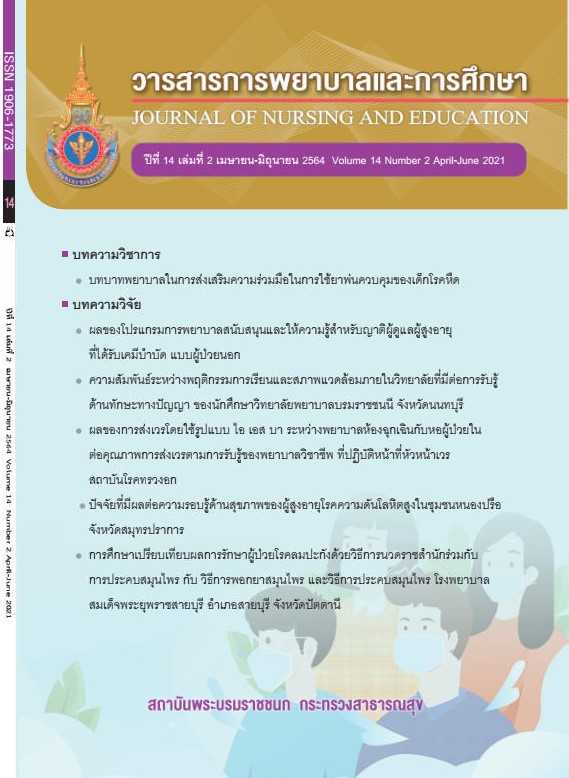
Nurse’s Roles in Promoting Medication Adherence in The Use of Inhalers for Asthmatic Children
Keywords:
Role of Nurses, Promoting Medication Adherence, Inhaled Corticosteroid Controller Medication, Asthmatic ChildrenAbstract
Asthma is a common chronic respiratory disease among children. Although many guidelines for caring asthmatic children were developed and widely used, up to 50 percent of asthmatic children still lack collaboration in the use of controlled inhalers. As a result of such problem, there is no efficiency in controlling asthma, making children with asthma suffer from coughing, wheezing, chest tightness, and shortness of breath. Sometimes their symptoms are so severe to cause respiratory failure and had to be treated as well as may cause stress and anxiety from illness. It also has a psychological impact on caregivers of asthmatic children. In order for asthmatic children to use the inhaler correctly and appropriately and lead to further asthma control, nurses, therefore, play an important role in promoting collaboration in the use of controlled inhalers by using the nursing process.
This article aims to present issues related to the meaning of collaboration, collaboration assessment tool, factors associated with collaboration, strategies to promote collaboration, and the nursing process to promote collaboration in the use of controlled inhalers in asthmatic children.
References
2. Chinratanapisit S, Suratannon N, Pacharn P, Sritipsukho P, Vichyanond P. Prevalence and Severity of Asthma, Rhinoconjuctivitis and Eczema in Children from the Bangkok
area: The Global Asthma Network (GAN) Phase I. Asian Pac J Allergy Immunol. 2018;
36. doi.10.12932/AP-120618-0336.
3. Tangcheewawatthanaku C. Factors Associated with Disease Controlled in Childhood Asthma at Phang-nga Hospital. Reg 11 Med J. 2018; 32(4):1269-82. (in Thai).
4. Sattabud M. Asthma Knowledge, Level of Control and Quality of Life in Asthmatic Children at Lahansai Hospital. Journal of The Department of Medical Services. 2019;42(3):40-6.(in Thai).
5. Mirab ZK, Mirab ZB, Ghassem BF, Safa M, Khalil ZS. Prevalence of Depression in Children with Asthma. Eur Respir J, 2016;48 (suppl 60):35-47.
6. Bellin MH, Osteen P, Kub J, Bollinger ME, Tsoukleris M, Chaikind L, et al. Stress and Quality of Life in Urban Caregivers of Children with Poorly Controlled Asthma: A Longitudinal Analysis. J Pediatr Health Care. 2015; 29(6):536-46.
7. Thai Asthma Council. Thai Asthma. Guideline in Adults 2020. [Internet]. 2020 [2021 Jan 9]; Available from: http://www.tac.or.th/index.php/en/download/category/1-guidelines. (in Thai).
8. Tangpathomwong C, Nookong A, Senasuttipan W. Children and Caregiver Factors Predicting Asthma Control of School Aged Children. Journal of Nursing and Health Care. 2016; (34)2: 67-76. (in Thai).
9. Klok T, Kaptein AA, Duiverman EJ, Brand PL. Long-term Adherence to Inhaled Corticosteroids in Children with Asthma: Observational study. Respir Med. 2015;109(9):1114-9.
10. Sthapornnanon N. Medication Nonadherence. Thai Bulletin of Pharmaceutical Sciences. 2012; (7)1: 1-18. (in Thai).
11. Wanngamwiset S, Nookong A, Payakkaraung S. Factors Predicting Medication Adherence in School-Aged Children with Asthma in Tertiary Care Hospital. Journal of Health Science Research. 2019;13(2): 20-9. (in Thai).
12. Dima AL, Van GE, Laforest L, Texier N, de Bruin M. Measuring Medication Adherence in Asthma:Development of a Novel Self-Report Tool. Psychol Health.2017;32(10):1288-307.
13. Ngo CQ, Phan DM, Vu GV, Dao PN, Phan PT, Chu HT, et al. Inhaler Technique and Adherence to Inhaled Medications among Patients with Acute Exacerbation of Chronic Obstructive Pulmonary Disease in Vietnam. Int J Environ Res Public Health. 2019;16(2):185. doi:10.3390/ijerph16020185.
14. World Health Organization. Adherence to Long-term Therapies: Evidence for Action. [Internet]. 2003 [cited 2021; Jan 9]; Available from: https://www.who.int/chp/knowledge/publications/Adherence_section2.pdf?ua=1
15. Feldman JM, Kutner H, Matte L, Lupkin M, Steinberg D, Sidora-Arcoleo K, Serebrisky D, Warman K. Prediction of Peak Flow Values Followed by Feedback Improves Perception of Lung Function and Adherence to Inhaled Corticosteroids in Children with Asthma. Thorax. 2012; 67(12):1040-1045.
16. Sleath B, Carpenter DM, Slota C, et al. Communication during Pediatric Asthma Visits and Self-Reported Asthma Medication Adherence. Pediatrics. 2012;130(4):627-33. doi:10.1542/peds.2012-0913
17. Sriglun T, Wattnakitkrileart D, Sriyuktasuth A. The Effect of Asthma Management Program via Smartphone Applications on Knowledge, Inhaler Used and Symptoms Control in Patients with Asthma. Nurs Sci J Thail. 2021;39(2): 50-63. (in Thai).
Downloads
Published
Issue
Section
License

This work is licensed under a Creative Commons Attribution-NonCommercial-NoDerivatives 4.0 International License.



