
ผลของโปรแกรมการปรับเปลี่ยนพฤติกรรมสร้างเสริมสุขภาพโดยการมีส่วนร่วมของชุมชน ในกลุ่มเสี่ยงโรคไม่ติดต่อเรื้อรัง
คำสำคัญ:
โปรแกรมการปรับเปลี่ยนพฤติกรรมสุขภาพ, ความเสี่ยงด้านสุขภาพ, กลุ่มเสี่ยงโรคไม่ติดต่อเรื้อรังบทคัดย่อ
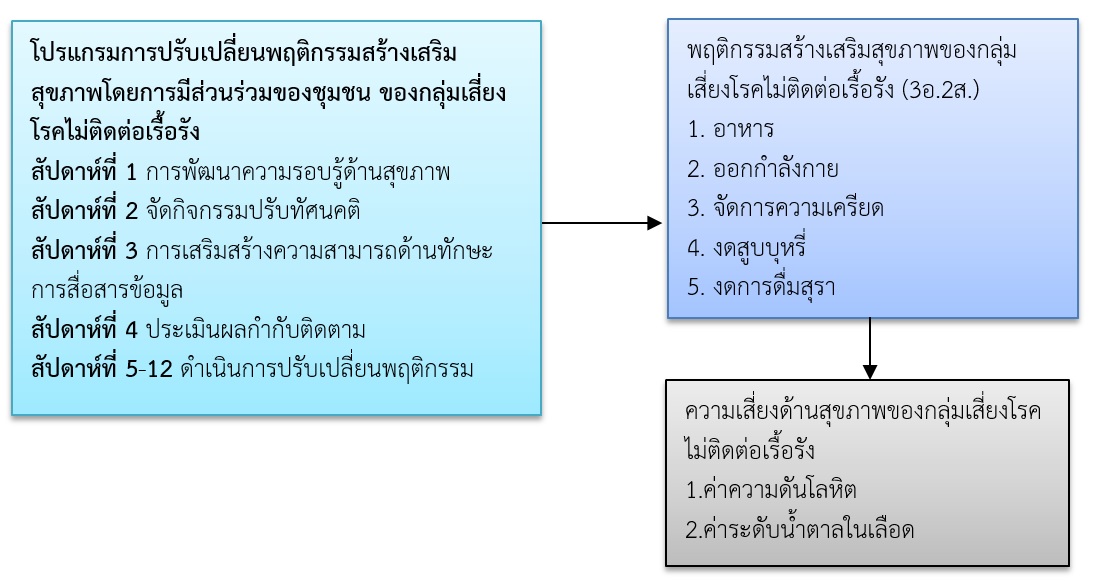
การวิจัยกึ่งทดลองแบบกลุ่มเดียววัดก่อนและหลังการทดลองนี้ มีวัตถุประสงค์เพื่อเปรียบเทียบค่าเฉลี่ยของพฤติกรรมสร้างเสริมสุขภาพและค่าเฉลี่ยความเสี่ยงด้านสุขภาพของกลุ่มเสี่ยงโรคไม่ติดต่อเรื้อรัง ก่อนและหลังได้รับโปรแกรมการปรับเปลี่ยนพฤติกรรมสร้างเสริมสุขภาพโดยการมี ส่วนร่วมของชุมชน กลุ่มตัวอย่าง คือ ประชาชนกลุ่มเสี่ยงโรคความดันโลหิตสูงและหรือโรคเบาหวาน ที่เข้ามารับบริการในโรงพยาบาลส่งเสริมสุขภาพตำบลบ้านคลอง จำนวน 176 คน โดยผู้วิจัยใช้การเลือกกลุ่มตัวอย่างแบบเฉพาะเจาะจง โดยมีเกณฑ์การคัดเข้า คือ 1) ค่าความดันโลหิตตัวบนและตัวล่าง อยู่ระหว่าง 121-139 และ 81-89 mmHg 2) ค่าระดับน้ำตาลในเลือดอยู่ในช่วง 100-125 mg/dl หลังงดน้ำงดอาหารเป็นเวลา 8 ชั่วโมง เครื่องมือที่ใช้ในการรวบรวมข้อมูลประกอบด้วยแบบบันทึกความเสี่ยง ด้านสุขภาพ ได้แก่ ค่าความดันโลหิต และค่าระดับน้ำตาลในเลือด (CBG) และแบบสอบถามพฤติกรรมสร้างเสริมสุขภาพตาม 3อ.2ส. ผ่านการทดสอบ ความเชื่อมั่นด้วยสัมประสิทธิ์แอลฟาของครอนบาร์ค ได้ค่าเท่ากับ .76 วิเคราะห์ข้อมูลใช้สถิติ Paired t-test ผลการวิจัยพบว่า
กลุ่มตัวอย่าง ค่าเฉลี่ยของพฤติกรรมสร้างเสริมสุขภาพสูงขึ้น ภายหลังเข้าร่วมโปรแกรมฯ อย่างมีนัยสำคัญทางสถิติ (p<.05) และความเสี่ยงด้านสุขภาพต่ำลงทุกด้าน ภายหลังเข้าร่วมโปรแกรมฯ อย่างมีนัยสำคัญทางสถิติ (p<.05)
ผลการวิจัยนี้จะเห็นได้ว่า โปรแกรมการปรับเปลี่ยนพฤติกรรมสร้างเสริมสุขภาพของกลุ่มเสี่ยงโรคไม่ติดต่อเรื้อรังโดยการมีส่วนร่วมของชุมชน เป็นการพัฒนาศักยภาพของชุมชนในการดูแลสุขภาพคนในชุมชน ส่งผลในการลดจำนวนกลุ่มเสี่ยงต่อโรคเรื้อรัง และสร้างเสริมให้ประชาชนมีสุขภาพที่ดีอย่างยั่งยืน
เอกสารอ้างอิง
Akepalakorn, V. (2019). Thai Population Health Survey by Physical Examination. May 5, 2021, Retrieved from file:///C:/Users/User/Downloads/ NHES%20V.pdf. (in Thai).
Banklong Sub District Health Promoting Hospital. (2016). Annual Report 2016. Phitsanulok: focus printing. (in Thai).
Department of Disease Control, Minister of Public Health. (2019). Annual NCD Clinic Plus 2019. Nonthaburi: Aksorn Graphic Design. (in Thai).
Health Education Division, Department of Health Service Support, Minister of Public Health. (2018). Strengthening and Assessing Health Literacy and Health Behavior. May 5, 2021, Retrieved from: file:///C:/ Users/ User/ Downloads/220120180914085828_linkhed%20(2).pdf. (in Thai).
HSIEH, F.Y. (1989). Sample Size Tables for Logistic Regression. Statistics in Medicine, 8, 795–802.
Intarakamhang, U. (2017). Health Literacy: Creating and Developing. Bangkok: Sukhumvit Printing. (in Thai).
Jungsathiensap, K. & Suksut, P. (2007). Health Volunteers in the Context of Change: Potential and Developmental Strategies. Public Health System Research Journal, 1(3), 268-279. (in Thai).
Nutbeam, D. (2000). Health Literacy as a Public Health Goal: a Challenge for Contemporary Health Education and Communication Strategies Into Health 21st Century. Health Promotion International, 15(3), 259-267.
Nutbeam, D. (2008). The Evolving Concept of Health Literacy. Social Science and Medicine, 67(1), 2072-2078.
Office of Policy and Strategy Office of the Permanent Secretary, Ministry of Public Health. (2019). Public Health Statistics 2019. Nonthaburi: Information Group Health. (in Thai)
Roma, V., Thanasukarn, C., Thippayamongkolkul, M., Aemyong, N., Neelapaijit, N., Samnuanklang, M et al. (2019). Health Literacy Survey Project for Thai People Aged 15 Years in 2017 (Phase I). (Report). May 5, 2021, Retrieved from http://164.115.27.97/digital/files/original/a6e73814efb58a07991c5be54b1498d1.pdf. (in Thai).
Saentecha, P. & Lamluk, P. (2020). The Effectiveness of a Program for Health Literacy Development in the Patients with Type 2 Diabetes. Thai Journal of Health Education, 43(2), 150-164. (in Thai).
Sarin, S., Moolsart, S. & Chailimpamontree, W. (2019). The Effectiveness of a Health Literacy Development Program in Patients with Type 2 Diabetes Risking to Chronic Kidney Disease. Nursing Journal of The Ministry of Public Health, 29(2), 86-101. (in Thai).
Sawangsri, W. & Intaranongpai, S. (2015). The Development of Health Promotion Model for Prevention New Cases of Diabetes Mellitus in Community. Journal of The Royal Thai Army Nurses, 16(1), 116-122. (in Thai).
Sookdee, S. (2017). The Development of Health Behavior Modification Model in Non-communicable Chronic Diseases Risk by Using Participatory Approach in Knowledge Management of the Community in Tambon Bangklua, Chachoengsao Province. Journal of Health Education, 40(1), 38-52. (in Thai).
Sukolpuk, M., Thanirat, S., Radabutr, M., Dechpoonyachit, P. & Muntraporn, A. (2018). Health Promotion Strategies to Prevent and Control high blood pressure. Journal of The Royal Thai Army Nurses, 19(3), 54-61. (in Thai).
World Health Organization. (2021). Non-ฉommunicable Diseases. May 5, 2021, Retrieved from https://www.who.int/news-room/fact-sheets/detail/noncommunicable-diseases
Wuttiwongchai, P., Thongwandee, P., & Wangnurat, B. (2017). Community Based Intervention for NCDs Controlling: CBI NCDs. Bangkok: Emotion Art. (in Thai).
ดาวน์โหลด
เผยแพร่แล้ว
ฉบับ
ประเภทบทความ
สัญญาอนุญาต
ลิขสิทธิ์ (c) 2022 วารสารการพยาบาลและการศึกษา

อนุญาตภายใต้เงื่อนไข Creative Commons Attribution-NonCommercial-NoDerivatives 4.0 International License.


