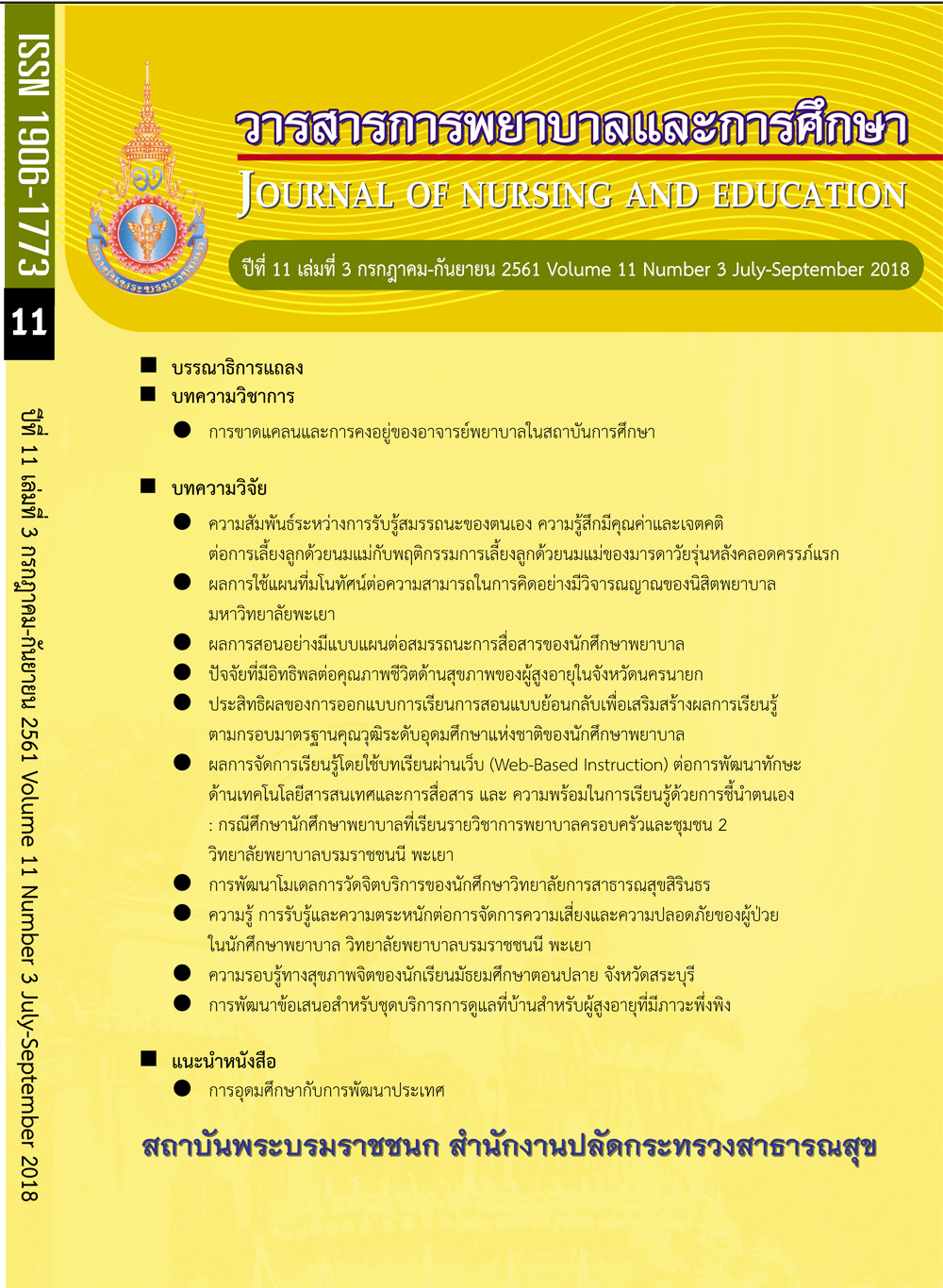
A Development of Measurement Models of Service Mind in the Students of Sirindhorn College of Public Health
การพัฒนาโมเดลการวัดจิตบริการของนักศึกษา วิทยาลัยการสาธารณสุขสิรินธร
Keywords:
Service mind, Measurement modelsAbstract
ABSTRACT
This quantitative research aimed to: 1) synthesize and define the components of
service mind of students of Sirindhorn College of Public Health students by integrating
theories and perspectives of stakeholders, 2) develop and examine a validity of a
measurement model of service mind in the students of Sirindhorn College of Public
Health, 3) to compare the service mind levels displayed by students in each grade.
The samples of phase 1 were 75 stakeholders, collected data period was August, 2017.
The samples of phase 2 were 600 students of Sirindhorn College of Public Health,
Praboromarajchanok Institute in 1st semester of 2017 academic year. The research
instruments were: 1) a questionnaire for analysing and synthesing the components of
service mind among Sirindhorn College of Public Health students, 2) an evaluation form
for assessing the level of service mind rated by the students of Sirindhorn College of
Public Health. Data were analysed by standard statistical analysis, reliability by Cronbach’s
Alpha Coefficient, Confirmatory Factor Analysis (CFA), and Multivariate Analysis of Variance:
MANOVA.
The result was as follows.
1. The service mind of students of Sirindhorn College of Public Health students
consisted of 9 components: 1) having service-minded sense, 2) development of service
quality, 3) responsibility, 4) emotional control and calmness, 5) integrity, 6) having positive
attitude toward the service, 7) having good personality and relationship, 8) understanding
the needs of the customer, and having knowledge in the service work.
2. A measurement model of service mind of students of Sirindhorn College of
Public Health students was consistent with the empirical data, Chi-square was 19.397,
p-value was 0.942, degree of freedom (df) was 15, varied from zero with no statistical
significant, Root Mean Square Error of Approximation (RMSEA) was 0.240, Standardized
Root Mean Square Residual was 0.0123, Norm Fit Index (NFI) was 0.997, Non Norm Fit
Index NNFI was 0.997, Comparative Fit Index (CFI) was 0.999, goodness of fit index (GFI)
was 0.992, adjusted goodness of fit index (AGFI) was 0.975, and Critical Number (CN) was
814.772.
3. The service mind of third-year students was reduced which compared with
the one found in the first year and second year, it slightly increased in their fourth year.
References
1. Human Resource Development Division, Praboromarajchanok Institute. The guide of perform the graduate identity of Praboromarajchanok Institute, Office of the Permanent Secretary Ministry of Public Health. Nontaburi: Yuttarin Printing Ltd, 2013. (in Thai)
2. Macmillan, Thomas. T, The Delphi Technique. Paper presented at the Annual Meeting of the California Junior Colleges Associations Committee on Research and Development. Ca: Monterey, May
3-5, 1971.
3. Comrey, A. L., & Lee, H. B. A first course in factor analysis. 2nd ed. Hillsdale, NJ: Erlbaum, 1992.
4. Thornpannaset, P. The attitude of the social’s employees in the industrial area, central part of Thailand towards the service mind enhancement. Master’s thesis of Social Work, Education Social Welfare Administration and Policy. Bangkok: Thammasat University, 2009. (in Thai)
5. Watcharasing, M. Service mind and work motivation predicting nurse’s service efficiency. Master’s thesis of Industrial and Organizational Psychology Program. Bangkok: King Monkut’s University of Technology, North Bangkok, 2013.
(in Thai)
6. Lueangamnuaysiri, M. A study of working service orientation of professional nurses’ private hospitals. Master’s thesis of Nursing Science Program, Nursing Administration. Bangkok: Chulalongkorn University, 2010. (in Thai)
7. Wan-I, Lee, Cheng-Wu, Chen, Tsung- Hao, Chen, and Chen-Yuan, Chen. The relationship between consumer orientation, service value, medical care service quality and patient satisfaction: the case of a Medical Centre in southern Taiwan. African Journal of Business Management, 2010; 4(4): 448-458.
8. Sangsuwan, R. Factors affecting on responsibility to working of the government officials in the Office of Private Education Commission under Ministry of Education, Bangkok. Master’s thesis of Education, Educational Psychology. Bangkok: Srinakharinwirot University, 2004. (in Thai)
9. Pachana, A. Factors affecting to service mind of the nurses: study case only press Ramathibodi hospital. Master’s thesis of Science Program, Industrial and Organizational Psychology. Bangkok: Ramkhamhaeng University, 2003. (in Thai)
10. Vejasit, S. Holistic approach to health personnel development for quality consciousness. Dissertation of doctoral degree of Philosophy in Vocational Education. Bangkok: Kasetsart University,
2003. (in Thai)
11. Luekietbundit, S. Job burnout: the
definition and measurement of the conceptual development. Songklanakarin Journal of Social Sciences and Humanities,
1999; 5(2): 167-180. (in Thai)
12. Siwakarn, W. Job burnout in the hospitals’pharmacists, Office of the Permanent Secretary of Ministry of Public Health. Master’s thesis of Pharmacy, Consumer Protection in Public Health. Nakorn Prathom: Silpakorn University,
2010. (in Thai)
13. Ruenpae, V. Psycho-social factors affecting organization citizenship behaviour: a case study of personal working at the Faculty of Veterinary Medicine, Kasetsart University Hospital. Master’s thesis of Science Program,Industrial and Organizational Psychology. Bangkok: Ramkhamhaeng University, 2012. (in Thai)
14. Sarakran, P. Acceptance of co-worker and satisfaction with compensation predicting work motivation of Myanmar labours in Bangkok. Master’s thesis of Industrial and Organizational Psychology. Bangkok: King Mongkut’s University of Technology, North Bangkok, 2016. (in Thai)