
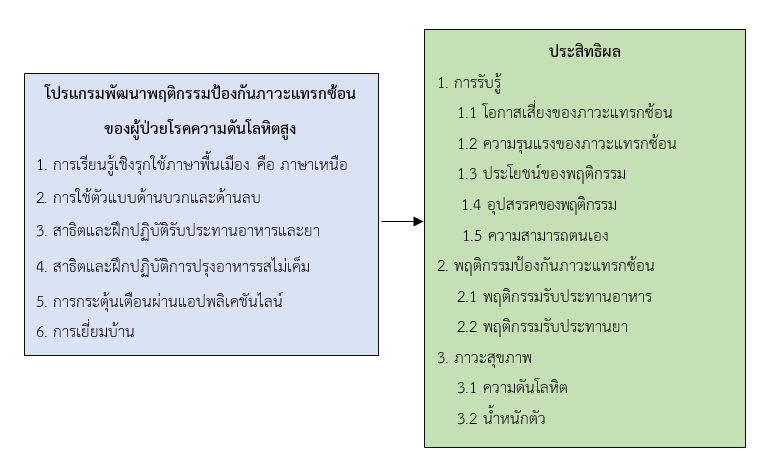
ผลของโปรแกรมพัฒนาพฤติกรรมป้องกันภาวะแทรกซ้อนต่อการรับรู้ พฤติกรรม และภาวะสุขภาพของผู้ป่วยโรคความดันโลหิตสูง อําเภอสันกำแพง จังหวัดเชียงใหม่
คำสำคัญ:
พฤติกรรมป้องกันภาวะแทรกซ้อน , โรคความดันโลหิตสูง , แบบแผนความเชื่อด้านสุขภาพบทคัดย่อ
การวิจัยกึ่งทดลองแบบ 2 กลุ่มวัดผลก่อนและหลังการทดลองนี้มีเพื่อเปรียบเทียบการรับรู้ พฤติกรรมป้องกันภาวะแทรกซ้อน และภาวะสุขภาพของกลุ่มทดลอง และระหว่างกลุ่มทดลองกับกลุ่มควบคุมหลังได้รับโปรแกรม กลุ่มตัวอย่างเป็นผู้ป่วยโรคความดันโลหิตสูงชนิดไม่ทราบสาเหตุ อายุ 35 - 65 ปี ที่ควบคุมความดันโลหิตไม่ได้ คัดเลือกกลุ่มตัวอย่างที่มีคุณสมบัติตามเกณฑ์คัดเข้า ศึกษาจากโรงพยาบาลส่งเสริมสุขภาพตำบลบ้านกอสะเลียมด้วยวิธีการสุ่มอย่างง่ายเป็นกลุ่มทดลอง แล้วเลือกกลุ่มควบคุมจากโรงพยาบาลส่งเสริมสุขภาพตำบลบ้านดอยยาวให้สองกลุ่มมีความดันโลหิตซิสโตลิกและอายุใกล้เคียงกัน กลุ่มละ 30 คน เครื่องมือทดลอง ได้แก่ 1) โปรแกรมพัฒนาพฤติกรรมป้องกันภาวะแทรกซ้อนของโรคความดันโลหิตสูงตามแนวคิดแบบแผนความเชื่อด้านสุขภาพ 2) แบบบันทึก และ 3) แอปพลิเคชันไลน์ เครื่องมือเก็บข้อมูล ได้แก่ 1) แบบสอบถามมี 3 ส่วน ได้แก่ (1) ข้อมูลทั่วไปและข้อมูลสุขภาพ (2) การรับรู้เกี่ยวกับภาวะแทรกซ้อนและพฤติกรรม และ (3) พฤติกรรมป้องกันภาวะแทรกซ้อน แบบสอบถามส่วนที่ 2-3 มีค่าดัชนีความตรงเชิงเนื้อหาเท่ากัน คือ 1.00 มีค่าสัมประสิทธิ์แอลฟาครอนบาค ระหว่าง .82 - .90 2) เครื่องวัดความดันโลหิตและเครื่องชั่งน้ำหนักดิจิทัล วิเคราะห์ข้อมูลด้วยสถิติพรรณนาและสถิติ T -Test, Wilcoxon Matched Pairs Signed Rank Test และ Mann-whitney U Test ผลการวิจัย พบว่า
1. หลังการเข้าร่วมโปรแกรมฯ กลุ่มทดลอง มีคะแนนเฉลี่ยการรับรู้ พฤติกรรมป้องกันภาวะแทรกซ้อนเพิ่มขึ้น ความดันโลหิตซิสโตลิก ไดแอสโตลิก และน้ำหนักตัวลดลง อย่างมีนัยสำคัญทางสถิติที่ระดับ .05
2. หลังการเข้าร่วมโปรแกรมฯ กลุ่มทดลองมีคะแนนเฉลี่ยการรับรู้ พฤติกรรมป้องกันภาวะแทรกซ้อนสูงกว่ากลุ่มเปรียบเทียบ ส่วนความดันโลหิตซิสโตลิกและไดแอสโตลิกต่ำกว่ากลุ่มเปรียบเทียบ อย่างมีนัยสำคัญทางสถิติที่ระดับ .05
ควรพัฒนาโปรแกรมพัฒนาพฤติกรรมป้องกันโรคไม่ติดต่อเรื้อรังอื่น ๆ ที่มีอุบัติการณ์สูงในอำเภอสันกำแพง จังหวัดเชียงใหม่ ได้แก่ โปรแกรมพัฒนาพฤติกรรมป้องกันภาวะแทรกซ้อนโรคเบาหวาน และโรคหลอดเลือดสมอง
เอกสารอ้างอิง
Aekplakorn, W. (2021). The Sixth National Health Examination Survey of Thailand, 2019–2020. Bangkok: Faculty of Medicine Ramathibodi Hospital, Mahidol University. (In Thai).
Ban Kosaliam Subdistrict Health Promoting Hospital. (2024). Annual Performance Report of Ban Kosaliam Subdistrict Health Promoting Hospital, Fiscal Year 2025. Ban Kosaliam Subdistrict Health Promoting Hospital. (in Thai)
Becker, M. H., Drachman, R. H., & Kirscht, J. P. (1974). A new approach to explaining sick role behavior in low-income populations. American Journal of Public Health, 64(3), 205–216. doi: 10.2105/ajph.64.3.205
Bonwell, C. C., & Eison, J. A. (1991). Acitve Learning: Creating Excitement in the Classroom. Washington, D.C.: The George Washington University.
Chanprasit, C., & Senaratana, W. (2023). Nursing and Health Promotion in Nursing Concept and Process (13rd ed). Nonthaburi: Sukhothai Thammathirat Open University. (In Thai).
Hirungerd, S., Vutiso, P., & Srimongkol, M. (2021). The effects of health belief model program on knowledge, stroke prevention behavior and blood pressure levels in hypertensive patients The Responsibility Area of Kaeng Khro Hospital, Chaiyaphum Province. Journal of The Royal Thai Army Nurses, 22(1), 478-487. https://he01.tci-thaijo.org/index.php/JRTAN/article/view/249047 (in Thai)
Kadjumpa, N. (2025). Effects of a health belief model application program on stroke prevention behavior among patients with high blood pressure. Bang Saai Hospital Phra Nakhon Si Ayutthaya Province. Journal of Environmental and Community Health, 10(4), 172-185. https://he03.tci-thaijo.org/index.php/ech/article/view/4602
Loussug, W., Lawang, W., & Homsin, P, (2019). The effects of application of the health belief model with family support program on preventive behaviors against cerebrovascular disease among individual at risk. Journal Nursing and Education, 12(4), 32-45. (in Thai). https://he01.tci-thaijo.org/index.php/JNAE/article/view/240156
Maneesriwongkul, W., (2016). Behavioral Theory for Community Nurse Practitioner. In Health Policy and Health System, Leadership, Concepts in Nursing and Community Nurse Practitioner’s Roles. Nonthaburi: Sukhothai Thammathirat Open University. (in Thai).
Ministry of Public Health. (2022). Health Data Center Report [Internet]. Retrieved June 15, 2023, from https://hdc.moph.go.th/cmi/public/standard-report-detail/6b9af46d0cc1830d3bd34589c1081c68 (in Thai).
Piamsukwilai, P. (2022). The Effect of Belief Modification of Reducing Sodium Consumption on Blood Pressure Level among Persons with Uncontrolled Hypertension [Master's thesis, Chulalongkorn University]. Chulalongkorn University Theses and Dissertations (Chula ETD). https://digital.car.chula.ac.th/chulaetd/6184
Rimsrithong, S., Thanjira, S., Techatsahong, A., & Patiprajak, S. (2013). Pathophysiology for Nursing, Vol. 2 (4th ed.). Ramathibodi School of Nursing, Faculty of Medicine Ramathibodi Hospital, Mahidol University. (in Thai).
Rosenstock, I. M., Strecher, V. J., & Becker, M. H. (1988). Social learning theory and the Health Belief Model. Health Education Quarterly, 15(2), 175–183. https://doi.org/10.1177/109019818801500203
Rotunda, W., Rains, C., Jacobs, S. R., Ng, V., Lee, R., Rutledge, S., et al. (2024). Weight loss in short-term interventions for physical activity and nutrition among adults with overweight or obesity: a systematic review and meta-analysis. Preventing chronic disease, 21, E21. https://doi.org/10.5888/pcd21.230347
Songthong, R., Iamsawasdikul, W., & Pothisapsuk, C. (2023). The effects of an eating behaviors development program on knowledge, health beliefs, eating behaviors, and blood pressure among people at risk of hypertention in rural Nakhon Si Thammarat Province. Journal of Nursing and Education, 16(2), 69-85. https://he01.tci-thaijo.org/index.php/JNAE/article/view/258935/176612 (in Thai)
Srisatitnarakun, B. (2010). Nursing Research Methodology (5th ed.). Bangkok: U&I Intermedia. (in Thai) Thai Hypertension Society. (2019). Thai Hypertension Society: Guidelines in the Treatment of hypertension. Chiang Mai: Trickthink. (in Thai).
Thai Hypertension Society. (2024). Thai Hypertension Society: Guidelines in the Treatment of Hypertension. Chiang Mai: Trickthink. (in Thai).
Wichaiyo, W., Jongsamak, P., Chaithong, S., & Krotbudda, S. (2021). The effect of the applying health belief model program of vascular disease preventive in patients with hypertension and diabetes mellitus at Namon District, Kalasin Province. Journal of Health System Research and Development, 14(2), 25-35. https://www.tci-thaijo.org/articles/health02-253188 (in Thai).
World Health Organization. (2023). Hypertension profiles 2023. Retrieved December 14, 2024 from https://www.who.int/docs/default-source/ncds/ncd-surveillance/hypertension-profiles-2023.
ดาวน์โหลด
เผยแพร่แล้ว
ฉบับ
ประเภทบทความ
สัญญาอนุญาต
ลิขสิทธิ์ (c) 2026 วารสารการพยาบาลและการศึกษา

อนุญาตภายใต้เงื่อนไข Creative Commons Attribution-NonCommercial-NoDerivatives 4.0 International License.


