
ประสิทธิผลของโปรแกรมการเรียนรู้โดยใช้โครงงานเป็นฐานในวิชาการบริหารการพยาบาล ต่อทักษะการคิดอย่างมีวิจารณญาณ และการทำโครงงาน ของนิสิตพยาบาล ชั้นปี 3 มหาวิทยาลัยพะเยา
คำสำคัญ:
การเรียนรู้โดยใช้โครงงานเป็นฐาน , วิชาการบริหารการพยาบาล , การคิดอย่างมีวิจารณญาณ , นิสิตพยาบาลบทคัดย่อ
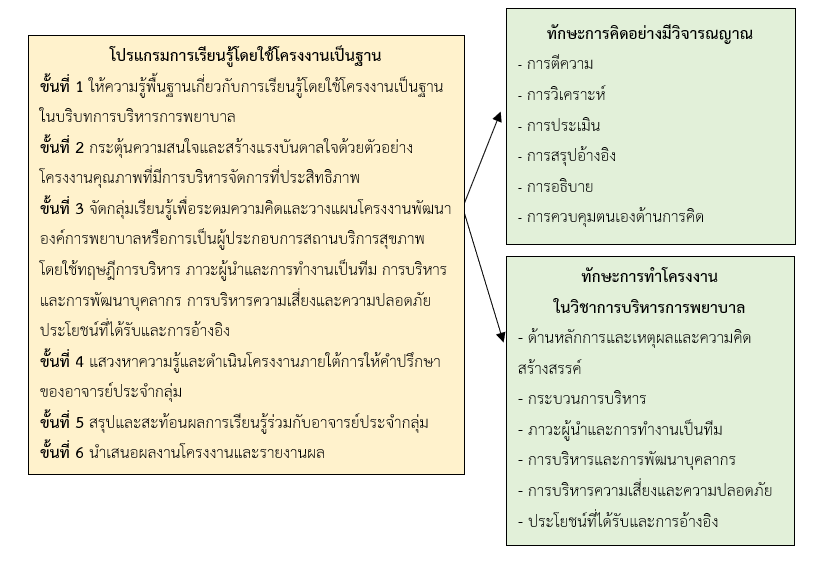
การวิจัยกึ่งทดลองแบบกลุ่มเดียววัดผลก่อนและหลังการทดลองนี้ มีวัตถุประสงค์เพื่อเปรียบเทียบทักษะการคิดอย่างมีวิจารณญาณของนิสิตพยาบาลชั้นปีที่ 3 มหาวิทยาลัยพะเยา ก่อนและหลังการจัดการเรียนการสอน โดยใช้โครงงานเป็นฐานในรายวิชาการบริหารการพยาบาล และเพื่อเปรียบเทียบคะแนนเฉลี่ยทักษะการทำโครงงานหลังการทดลองกับเกณฑ์ร้อยละ 80 กลุ่มตัวอย่างคือ นิสิตพยาบาลชั้นปี 3 จำนวน 109 คน เลือกแบบเฉพาะเจาะจงตามคุณสมบัติที่กำหนด กลุ่มตัวอย่างได้รับโปรแกรมการเรียนรู้โดยใช้โครงงานเป็นฐานในวิชาการบริหารการพยาบาล จำนวน 6 ครั้ง ในระยะเวลา 16 สัปดาห์ เก็บรวบรวมข้อมูลโดยใช้แบบสอบถามข้อมูลทั่วไป โปรแกรมการเรียนรู้ โดยใช้โครงงานเป็นฐาน แบบประเมินทักษะการคิดอย่างมีวิจารณญาณของนิสิตพยาบาล และแบบประเมินทักษะการทำโครงงานในวิชาการบริหารการพยาบาล เครื่องมือทั้งหมดผ่านการตรวจสอบความตรงตามเนื้อหาและความเชื่อมั่นของเครื่องมือ มีค่าสัมประสิทธิ์แอลฟาครอนบาคเท่ากับ .93 และ .81 วิเคราะห์ข้อมูลโดยใช้สถิติเชิงพรรณนา Paired t-test และ One-sample Wilcoxon Signed-ranks Test ผลการวิจัยพบว่า
1. หลังได้รับโปรแกรมค่าเฉลี่ยของคะแนนทักษะการคิดอย่างมีวิจารณญาณโดยรวม และรายด้านการวิเคราะห์ ด้านการประเมิน ด้านการสรุปอ้างอิง และด้านการอธิบาย สูงกว่าก่อนการทดลองอย่างมีนัยสําคัญทางสถิติที่ระดับ .05 อย่างไรก็ตาม ไม่พบความแตกต่างอย่างมีนัยสําคัญทางสถิติของคะแนนทักษะการคิดอย่างมีวิจารณญาณ ด้านการตีความ และด้านการควบคุมตนเองด้านการคิด
2. หลังได้รับโปรแกรมค่าเฉลี่ยของคะแนนทักษะในการทำโครงงานในวิชาการบริหารการพยาบาลของนิสิตพยาบาลชั้นปี 3 มหาวิทยาลัยพะเยา ทั้งโดยรวมและรายด้านสูงกว่าเกณฑ์ร้อยละ 80 อย่างมีนัยสำคัญทางสถิติที่ระดับ .001
ผลการวิจัยครั้งนี้มีข้อเสนอแนะให้รายวิชาการบริหารการพยาบาลนำการเรียนรู้โดยใช้โครงงานเป็นฐานไปใช้เป็นแนวทางหลักโดยออกแบบโครงงานจากสถานการณ์จริง จัดกิจกรรมอภิปรายและสะท้อนคิดอย่างต่อเนื่องและประเมินผลด้วยเกณฑ์ที่ชัดเจน เพื่อส่งเสริมทักษะการคิดอย่างมีวิจารณญาณและเตรียมความพร้อมของนิสิตพยาบาลสู่การปฏิบัติงานวิชาชีพอย่างมีประสิทธิภาพ
เอกสารอ้างอิง
Arif, Y., & Putri, Z. M. (2022). Project-Based Learning (PjBL) Method: Improving Critical Thinking and Problem-Solving Skills for Nursing Students. Advances in Social Science, Education and Humanities Research, 650, 48–52. doi:10.2991/assehr.k.220303.010
Boso, C. M., van der Merwe, A. S., & Gross, J. (2019). Critical thinking skills of nursing students: Observations of classroom instructional activities. Nursing Open, 7(2), 581–588. doi: 10.1002/nop2.426
Chan, Z. C. Y. (2013). Exploring creativity and critical thinking in traditional and innovative problem-based learning groups. Journal of Clinical Nursing, 25(15–16), 2298–2307. https://doi.org/10.1111/jocn.12186
Chantian, P., Nakornchai, T., Jaroenpong, J., Maneerat, S. & Anansupamongkol, D. (2019). The development of critical thinking of nursing science students. Kasem Bundit Journal, 20(2), 168-179. (In Thai)
Facione, N. C. & Facione, P. A. (1996). Externalizing the Critical Thinking in Knowledge Development and Clinical Judgment. Retrieved June 1, 2006 form http://www.insightassessment.com.
Hanklang, S., & Sivasan, S. (2021). Effectiveness of the project-based learning program on Thai nursing student competency for elderly care in the community. Journal of Health Research, 35(2), 132-146.
Kaddoura, M., Van-Dyke, O., & Yang, Q. (2017). Impact of a concept-based curriculum on nursing students’ critical thinking skills. Nurse Education in Practice, 23, 64–70. doi: 10.1111/nhs.12277
Kokotsaki, D., Menzies, V., & Wiggins, A. (2016). Project-based learning: A review of the literature. Improving Schools, 19(3), 267–277. https://doi.org/10.1177/1365480216659733
Liu, Q., & Pásztor, A. (2022). The critical thinking-oriented adaptations of problem-based learning: A meta-analysis. Frontiers in Education, 7, 1139987.
Moore, B. N., & Parker, R. (2001). Critical Thinking (6th ed.). California: Mayfield Publishing Company. Conference on Educational Development and Quality Assurance (ICED-QA 2021).
Mwale, O.G., Mukwato, P. K., & Makkukula, M. K. (2025). Teaching methods for promoting the acquisition of clinical reasoning skills in undergraduate nursing students: A systematic review. Journal of Nursing Advances in Clinical Sciences, 2(5), 271-277. https://doi.org/10.32598/JNACS.2501.1146
Oermann, M. H., De Gagne, J. C., & Phillips, B. C. (2022). Teaching in Nursing and Role of the Educator: The Complete Guide to Best Practice in Teaching, Evaluation, and Curriculum Development (3rd ed.). Springer Publishing.
Piriyasart, J., Pairoh , H., & Che Hasan, M. K. (2025). The effects of using reflective journals on reflective practice behaviors in the nursing administration practicum among fourth-year nursing students. Journal of Nursing and Education, 18(4), e275655. (In Thai)
Rattanajarana, S. (2021). The effect of project-based learning to enhance the 21st century skills of baccalaureate nursing students. Thai Pharmaceutical and Health Science Journal, 16(3), 203-210.
Sacgaca, L., Dagdagui, R., Rashidi, N., Buta, J., Maestro, R., & Villareal, S. (2022). Factors influencing critical thinking skills among nursing students: Reports from a cross-sectional study. Int J Adv Appl Sci, 9, 93-8.
Suvithayasiri, K., Wadyim, N., Techamuanwaiwit, S. Padklan, S. (2020). The effects of project based-learning to create innovation for developing of reflective thinking ability of nursing students. Journal of Health and Nursing Research, 36(3), 164-177. (In Thai)
Sharma, S., Saragih, I. D., Tarihoran, D. E. T. A. U., & Chou, F. H. (2022). Outcomes of problem-based learning in nurse education: A systematic review and meta-analysis. Nurse Education Today, 120, 105631. https://doi.org/10.1016/j.nedt.2022.105631
Shin, H., Ma, H., Park, J., Ji, E. S., & Kim, D. H. (2015). The effect of simulation courseware on critical thinking in undergraduate nursing students: Multi-site pre–post study. Nurse Education Today, 35(4), 537–542. https://doi.org/10.1016/j.nedt.2014.12.004
Srisawad K, Rattana-olarn T, Kiddee K. (2016). Factor analysis of critical thinking among nursing students from private higher education institutions. J Health Res, 30(5), 363-369. DOI: 10.14456/jhr.2016.49
Tafakur, T., Retnawati, H., & Shukri, A. A. M. (2023). Effectiveness of project-based learning for enhancing students' critical thinking skills: A meta-analysis. Jurnal Inovasi Pendidikan, 9(2), e22142. https://doi.org/10.22219/jinop.v9i2.22142
Turner, R. C., & Pitchon, M. A. (2016). Classroom-based assessment of 21st century skills: A primer. Journal of Applied Testing Technology, 17(1), 1–19.
Ulrich, B. T. (2016). Leadership and management competencies in nursing education. Journal of Nursing Administration, 46(4), 194–196. https://doi.org/10.1097/NNA.0000000000000335
Wanchai, A., Kaewsasri, A., Kuljoo, A., & Vichitkaew, N. (2018). The effects of the project-based learning on reflection thinking’s behaviors of nursing students. Songklanagarind Journal of Nursing, 38(2), 11-19.
Wei, B., Wang, H., Li, F., Long, Y., Zhang, Q., Liu, H., et al., (2024). Effectiveness of problem-based learning on development of nursing students’ critical thinking skills: A systematic review and meta-analysis. Nurse Educator, 49(3), e115-e119. https://doi.org/10.1097/NNE.0000000000001548
Xie, Q., Jantharajit, N., & Srikhao, S. (2024). Innovative approaches in nursing education: Enhancing learning efficiency and critical thinking based on cooperative and project-based learning. Asian Education Studies, 4(1), 153–165.
Yolao, D. (2014). A Study of PBL Learning Management from the Project to Create a Knowledge Set to Enhance 21st Century Skills of Children and Youth: From the Successful Experience of Thai Schools. Bangkok: Thipphawisut. (In Thai)
ดาวน์โหลด
เผยแพร่แล้ว
ฉบับ
ประเภทบทความ
สัญญาอนุญาต
ลิขสิทธิ์ (c) 2026 วารสารการพยาบาลและการศึกษา

อนุญาตภายใต้เงื่อนไข Creative Commons Attribution-NonCommercial-NoDerivatives 4.0 International License.


