
สมรรถนะอาจารย์พยาบาลในสถาบันอุดมศึกษาเอกชนไทย
บทคัดย่อ
การวิจัยเชิงพรรณนามีวัตถุประสงค์ เพื่อ 1) ศึกษาระดับสมรรถนะอาจารย์พยาบาล และ 2) วิเคราะห์องค์ประกอบเชิงยืนยันสมรรถนะอาจารย์พยาบาลในสถาบันอุดมศึกษาเอกชนไทย กลุ่มตัวอย่าง คือ อาจารย์พยาบาลที่ปฏิบัติงานในสถาบันอุดมศึกษาเอกชนไทย จำนวน 237 คน สุ่มแบบหลายขั้นตอน เครื่องมือที่ใช้ในการวิจัย ประกอบด้วย 1) แบบสอบถามข้อมูลส่วนบุคคล จำนวน 7 ข้อ และ 2) แบบวัดสมรรถนะอาจารย์พยาบาล จำนวน 113 ข้อ มีค่าความตรงเชิงเนื้อหา (IOC) อยู่ระหว่าง .60 – 1.00 และค่าความเชื่อมั่นเท่ากับ .99 รวบรวมข้อมูลด้วยการตอบแบบสอบถามแบบออนไลน์ ตั้งแต่เดือนกุมภาพันธ์ ถึง เดือนมิถุนายน พ.ศ. 2567 วิเคราะห์ข้อมูลโดยใช้สถิติเชิงพรรณนาและการวิเคราะห์องค์ประกอบเชิงยืนยัน ผลการวิจัย พบว่า
1. สมรรถนะอาจารย์พยาบาลในสถาบันอุดมศึกษาเอกชนไทยในภาพรวมอยู่ในระดับมาก (M = 4.27, SD = 0.46)
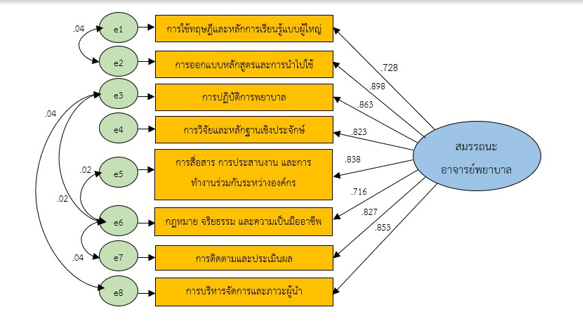
2. ผลการวิเคราะห์องค์ประกอบเชิงยืนยันสมรรถนะอาจารย์พยาบาลในสถาบันอุดมศึกษาเอกชนไทย ประกอบด้วย 8 องค์ประกอบ คือ (1) การใช้ทฤษฎีและหลักการเรียนรู้แบบผู้ใหญ่ (2) การออกแบบหลักสูตรและการนำไปใช้ (3) การปฏิบัติการพยาบาล (4) การวิจัยและหลักฐานเชิงประจักษ์ (5) การสื่อสาร การประสานงาน และการทำงานร่วมกันระหว่างองค์กร (6) กฎหมาย จริยธรรม และความเป็นมืออาชีพ (7) การติดตามและประเมินผล และ (8) การบริหารจัดการและภาวะผู้นำ พบว่า โมเดลสมรรถนะอาจารย์พยาบาลในสถาบันอุดมศึกษาเอกชนไทยมีความสอดคล้องกับข้อมูล พิจารณาได้จากค่าไคสแควร์ (c2) เท่ากับ 22.924 องศาอิสระ (df) เท่ากับ 15 ค่าสถิติไคสแควร์สัมพัทธ์ (c2/df) เท่ากับ 1.528 ค่าโอกาสความน่าจะเป็น (p-value) เท่ากับ .086 ค่ารากของค่าเฉลี่ยกำลังสองของความคลาดเคลื่อนโดยประมาณ (RMSEA) เท่ากับ .047 และค่าดัชนีรากของกำลังสองเฉลี่ยของส่วนที่เหลือ (RMR) เท่ากับ .006 ค่าดัชนีวัดระดับความกลมกลืน (GFI) เท่ากับ .976 และค่าดัชนีระดับความกลมกลืนที่ปรับแก้แล้ว (AGFI) เท่ากับ .943
ดังนั้นผู้บริหารของสถาบันการศึกษาทางการพยาบาลในสถาบันอุดมศึกษาเอกชนไทย สามารถนำผลการวิจัยไปใช้ในการวางแผนการพัฒนาสมรรถนะอาจารย์พยาบาลในด้านการออกแบบหลักสูตรและการนำไปใช้ ด้านการปฏิบัติ
การพยาบาล และด้านบริหารจัดการและภาวะผู้นำ เนื่องด้วยเป็นสมรรถนะที่มีความสำคัญในลำดับต้น ๆ
เอกสารอ้างอิง
Bownes, N. A. and Freeman, M.A. (2020). Clinical nurse instructor competencies: An exploratory study of role requirements. Quality Advancement in Nursing Education, 3(5), 1-13.
Buncham, S. (2017). Basic Research (10th ed.). Bangkok: Suwiriyasarn. Chaonarin, P., Chinatongkul, C., & Chaisirithanya, K. (2021). Administrative skills in 21st century of administrators in faculty of nursing under private higher education institution of Thailand. The Journal of Research and Academics, 5(1), 113-128. (in Thai).
Hababeh, M. O., & Lalithabai, D. S. (2020). Nurse trainees' perception of effective clinical instructor characteristics. International journal of nursing sciences, 7(3), 285–290
Hair, J. F., Black, W.C., Babin B.J., & Anderson, R.E. (2019). Multivariate Data Analysis (8th ed.). Hampshire: Annabel Ainscow.
Hassan, M., N., Mostafa, G. M. A., & Akel, D. T. (2021). Assessment of clinical instructors’ competencies in the nursing field. IOSR Journal of Nursing and Health Science, 10(2), 36–41.
Kerdbanchan, C. & Jarujittipant, P. (2019). Factors affecting the quality of Thai private university instructors. Journal of Social Sciences Srinakharinwirot University, 22(1), 13-27. (in Thai)
Kitphan, P. (2018). Aging society in Thailand. Thai Food and Drug Journal, 25(3), 4–8. (in Thai)
Kwanmueang N. (2021). The Development of Thai Private University’s Management According to the Concept of Entrepreneurial University. A dissertation submitted in partial fulfillment of the requirement for the Doctor of Philosophy in Leadership and Innovation in Educational Administration, Siam University. (in Thai)
Ministry of Higher Education, Science, Research, and Innovation. (2023). The Number of Lecturers in Higher Education Institutions for the Academic Year 2022, Second Semester, Categorized by Institution/Faculty/Group of Institutions. Retrieved December 10, 2023 from https://info. mhesi.go.th/stat_stf.php?search_year=2564& download=7086&file_id=202210121454.xlsx. (in Thai)
Mohamed, D. L. A., Shazly M., M., & Saad, N. F. (2018). Core competencies of nurse educator at technical institutes of nursing. Egyptian Journal of Health Care, 9(4), 110-119.
Park, H., Choi, E., Kim, G., Kim, Y., Jeon, M., & Hwang, H. (2022). Development of core competency scale for clinical nursing student educators. J Korean Academic Society Nursing Education, 28(4), 345-356.
Phaktoop, M., Suvanarak, T., & Bungum, R. (2019). Job retention of nurse educators in private education institute, Bangkok metropolitan region. Journal of Nursing and Education, 12(2). 97-110. (in Thai).
Potchana, R., Sanrattana. W, & Suwannoi, P. (2020). Adaptive leadership for teachers in Boromarajonani college of nursing under Boromarachanok institute. Journal of Nursing and Health Care, 38(1), 187-195 (in Thai).
Professional and Organizational Development Network of Thailand Higher Education. (2025). A Request for the Assessment of Nursing Faculty Competencies Aligned with Faculty Development Guidelines Aimed at Promoting the Achievement of Learning Outcomes in Accordance with the Thai Qualifications Framework for Higher Education 2023. Retrieved April 10, 2025 from https://surl.li/rdtfdy. (in Thai).
Roongruangsri, S., & Sngounsiritham, U. (2015). Nursing faculty: Challenging the personal competency. Nursing Journal CMU, 42, 214–220. (in Thai)
Rugmai, S. (2015). Development and Trends of Private Higher Education Institutions. A dissertation submitted in partial fulfillment of the requirement for the Doctor of Philosophy Program in Higher Education, Chulalongkorn University. (in Thai).
Saraketrin, A., Rongmuang, D. & Chantra, R. (2019). Nursing education in the 21st century: Competencies and roles of nursing instructors. Journal of The Royal Thai Army Nurses. 20(1), 12-20.
Sebach. A.M., (2022). Psychometric testing of a tool assessing nurse practitioner clinical educator competence. The Journal for Nurse Practitioners, 18, 217-220.
Supradith, B. (2019). Job performance of nursing instructors under the public educational institutions. The Journal of Boromarajonani College of Nursing Suphanburi. 2(2). 45-61. (in Thai).
Thailand Nursing and Midwifery Council. (2018). Announcement from the Nursing Council Regarding the Core Competencies of Graduates with a Bachelor's Degree, Master's Degree, and Doctoral Degree in Nursing, as well as the Advanced Nursing Training Program Leading to Certification/Authorization Demonstrating Specialized Knowledge and Expertise in Nursing and Midwifery, and Nursing in the Field of Nursing Science. Retrieved April 24, 2025 from https://www.tnmc.or.th/images/userfiles/files/112.pdf.
Turner, K., Charoensuk, S., Bormann, S. V., & Sawaengdee, K. (2019). Nurse competencies and associated factors in the context of nursing education institutions in Thailand. Journal of Nursing Division, 46(3), 1-19.
Tuzazon, C.M. (2016). Level of competencies of Clinical Instructors of the College of Nursing in a State University in the Philippines: An Assessment. RET Academy for international Journals of Multidisciplinary Research, 5(12), 27-34.
Wanchai, A., Phrompayak, D., & Prompuk, B. (2022). A needs assessment for competency development of nurse educators. Nursing Forum, 57(6), 1445–1451.
World Health Organization. (2016). Nurse Educator Core Competencies. Geneva: WHO Document Production Services.
Whittaker, T. A., & Schumacker, R. E. (2022). A Beginner’s Guide to Structural Equation Modelling (5th ed.). NY: Routledge.
ดาวน์โหลด
เผยแพร่แล้ว
ฉบับ
ประเภทบทความ
สัญญาอนุญาต
ลิขสิทธิ์ (c) 2025 วารสารการพยาบาลและการศึกษา

อนุญาตภายใต้เงื่อนไข Creative Commons Attribution-NonCommercial-NoDerivatives 4.0 International License.


