
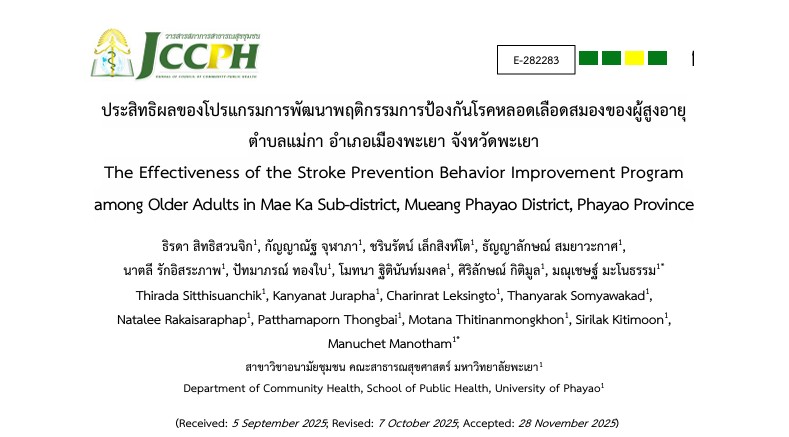
The Effectiveness of the Stroke Prevention Behavior Improvement Program among Older Adults in Mae Ka Sub-district, Mueang Phayao District, Phayao Province
Keywords:
Older adult, Stroke, Stroke prevention programAbstract
This research was a quasi-experimental study with two groups, pretest-posttest design, aimed to examine the effectiveness of a behavioral development program for stroke prevention among older adults in Mae Ka Subdistrict, Mueang Phayao District, Phayao Province. The sample consisted of 56 older adults, divided equally into an experimental group (n = 28) and a control group (n = 28). Data collection was conducted between June and July 2025, covering a total period of two months. The research instruments included: (1) an eight-week behavioral development program for stroke prevention among older adults, and (2) a questionnaire composed of four parts: personal information, knowledge, attitude, and preventive behaviors toward stroke. The questionnaire was validated for content validity, appropriateness, and linguistic clarity. Reliability testing was performed with 30 individuals who shared similar characteristics to the study sample. The knowledge section demonstrated a reliability coefficient of 0.68 using the Kuder-Richardson method, while the attitude and behavior sections yielded Cronbach’s alpha coefficients of 0.86 and 0.94, respectively. Data were analyzed using descriptive and inferential statistics, including the Paired t-test and Independent t-test.
The results revealed that, within the experimental group, mean scores for knowledge, attitude, and preventive behaviors toward stroke significantly increased after the intervention (p < 0.05), while no significant differences were observed in the control group. Moreover, when comparing between groups, the experimental group showed significantly higher posttest mean scores for knowledge, attitude, and preventive behaviors than the control group (p < 0.05)
The findings suggest that public health agencies can apply this program as a practical guideline for promoting health among older adults in communities. The emphasis on behavioral modification for stroke prevention may effectively and sustainably reduce the risk of stroke among older populations.
References
ปิยนุช จิตตนูนท์, อาภรณ์ทิพย์ บัวเพ็ชร์, พิมพิศา ศักดิ์ดอนเมือง, วิชัย อารับ, สุวนิตย์ วงศ์ยงค์ศิลป์, & ญนัท วอลเตอร์. (2564). ความรู้เรื่องโรคหลอดเลือดสมองและพฤติกรรมป้องกันของกลุ่ม เสี่ยงโรคหลอดเลือดสมอง: กรณีศึกษาตำบลห้วยนาง จังหวัดตรัง. วารสารพยาบาลสงขลาสงขลานครินทร์, 41(2), 13–25.
เพียงเดือน สันวงค์, บุศรินทร์ ผัดวัง, & ศิริรัตน์ ผ่านภพ. (2567). ประสิทธิผลของการปรับเปลี่ยนพฤติกรรมการป้องกันโรคหลอดเลือดสมองในกลุ่มเสี่ยงโรคความดันโลหิตสูงตำบลไหล่หิน อำเภอเกาะคา จังหวัดลำปาง. วารสารวิทยาศาสตร์และเทคโนโลยีนอร์ทเทิร์น, 5(2), 105–106.
เทศบาลตำบลแม่กา. (2567, 28 พฤศจิกายน). ข้อมูลแสดงจำนวนประชากรตำบลแม่กา อำเภอเมืองพะเยา จังหวัดพะเยา. http://www.maekalocal.go.th/.
ระบบคลังข้อมูลด้านการแพทย์และสุขภาพ Health Data Center (HDC). (2567, 3 ธันวาคม). ร้อยละอัตราตายของผู้ป่วยโรคหลอดเลือดสมอง และระยะเวลาที่ได้รับการรักษาที่เหมาะสม. https://hdc.moph.go.th/pyo/public/kpi/1/2022
โรงพยาบาลพญาไท. (2567, 4 ธันวาคม). รู้ทัน 10 ปัจจัยเสี่ยงโรคหลอดเลือดสมอง (Stroke) เพื่อการป้องกันและรีบรักษา. https://www.phyathai.com/th/article/understanding-the-10-risk-factorsfor-stroke-prevention-and-early-treatment
วรางคณา วสุรัตน์. (2567). ประสิทธิผลของโปรแกรมป้องกันโรคหลอดเลือดสมองในผู้สูงอายุ อำเภอเมือง จังหวัดสุโขทัย. วารสารวิชาการป้องกันควบคุมโรค สคร.2 พิษณุโลก, 11(2), 48–59.
เสาวภา เล็กวงษ์, อรพรรณ บุญลือ, นิศารัตน์ รวมวงษ์, & นุชนาถ โรจนธรรม. (2565). การพัฒนารูปแบบการจัดการตนเองเพื่อป้องกันโรคหลอดเลือดสมองในผู้ป่วยกลุ่มเสี่ยงโรคหลอดเลือดสมอง. วารสารวิทยาลัยพยาบาลพระปกเกล้า จันทบุรี, 33(2), 175–189.
สายสุนีย์ เจริญศิลป์. (2564). ปัจจัยที่มีอิทธิพลต่อพฤติกรรมการป้องกันโรคหลอดเลือดสมองในผู้ป่วยความดันโลหิตสูง อำเภอเมือง จังหวัดนครสวรรค์. [วิทยานิพนธ์ปริญญาสาธารณสุขศาสตรมหาบัณฑิต ไม่ได้ตีพิมพ์]. มหาวิทยาลัยนเรศวร.
สํานักงานเขตสุขภาพที่ 10. (2566). แนวทางจัดระบบชุมชนจัดการตนเองเพื่อผู้สูงอายุ สำหรับโรคหลอดเลือดสมอง (Stroke) ภาวะหัวใจขาดเลือดเฉียบพลันชนิด STEMI และกระดูกสะโพกหัก (Hip Fracture) (ฉบับปรับปรุง ปี 2566). อุบลราชธานี: อัลทิเมท พริ้นติ้ง จำกัด.
อรนลิน ไทยเจริญ, นภาเพ็ญ จันทขัมมา, & วันเพ็ญ แวววีรคุปต์. (2568). ผลของโปรแกรมการจัดการตนเองเพื่อป้องกันโรคหลอดเลือดสมองของผู้ป่วยวัยทำงานกลุ่มเสี่ยง จังหวัดสระบุรี. วารสารพยาบาลทหารบก, 26(1), 120–128.Best, J. W. (1997).
Research in education. Prentice-Hall.Bloom, B. S., Madaus, G. F., & Hastings, J. T. (1971). Handbook on formative and summative evaluation of student learning. McGraw-Hill.
Cohen, J. (1988). Statistical power analysis for the behavioral sciences (2nd ed.). Routledge.
Cronbach, L. J. (1970). Essentials of psychological testing. Harper & Row.
Feigin, V. L., Brainin, M., Norrving, B., Martins, S. O., Pandian, J., Lindsay, P., Grupper, M. F., & Rautalin, I. (2025). World Stroke Organization: Global Stroke Fact Sheet 2025. International Journal of Stroke, 20(2), 132–144.
Lorig, K. R., & Holman, H. (2003). Self-management education: History, definition, outcomes, and mechanisms. Annals of Behavioral Medicine, 26(1), 1–7.
Kang, H. (2021). Sample size determination and power analysis using the G*Power software. Journal of Educational Evaluation for Health Professions, 18(17). https://doi.org/10.3352/jeehp.2021.18.17
Kuder, G. F., & Richardson, M. W. (1937). The theory of the estimation of test reliability. Psychometrika, 2(3), 151–160.
Rajati, F., Merghati-Khoei, E., Shabani, M., & Rashidian, A. (2023). Prevalence of stroke in the elderly: A systematic review and meta-analysis. Ageing Research Reviews, 92, 102602
Ryan, P., & Sawin, K. J. (2009). The individual and family self-management theory:Background and perspectives on context, process, and outcomes. Nursing Outlook, 57(4), 217225.
Samuthpongtorn, C., Kaewkum, C., Mathattanagul, W., & Ponglikitmongkol, P. (2021). Stroke risk factors, subtypes and outcome in elderly Thai patients. BMC Neurology, 21:322,1-6.
Suanrueang, P. (2024). A comparison of the disease occurrence of cerebrovascular diseases, diabetes mellitus, hypertensive diseases, and ischaemic heart diseases among hospitalized older adults in Thailand. Scientific Reports, 14:123, 1-11.
Suwanwela, N. C. (2014). Stroke epidemiology in Thailand. J Stroke, 16(1), 1-7.
Downloads
Published
Issue
Section
License
Copyright (c) 2025 Journal of Council of Community Public Health

This work is licensed under a Creative Commons Attribution-NonCommercial-NoDerivatives 4.0 International License.
- บทความหรือข้อคิดเห็นใด ๆ ที่ปรากฏในวารสารสภาการสาธารณสุขชุมชน ที่เป็นวรรณกรรมของผู้เขียน บรรณาธิการ ไม่จำเป็นต้องเห็นด้วย
- บทความที่ได้รับการตีพิมพ์ถือเป็นลิขสิทธิ์ของ วารสารสภาการสาธารณสุขชุมชน


