
Self-esteem and Guidelines for Developing Self-esteem among the Elderly, Yala City Municipality, Yala Province
Keywords:
Self-esteem, Guideline for developing, ElderlyAbstract
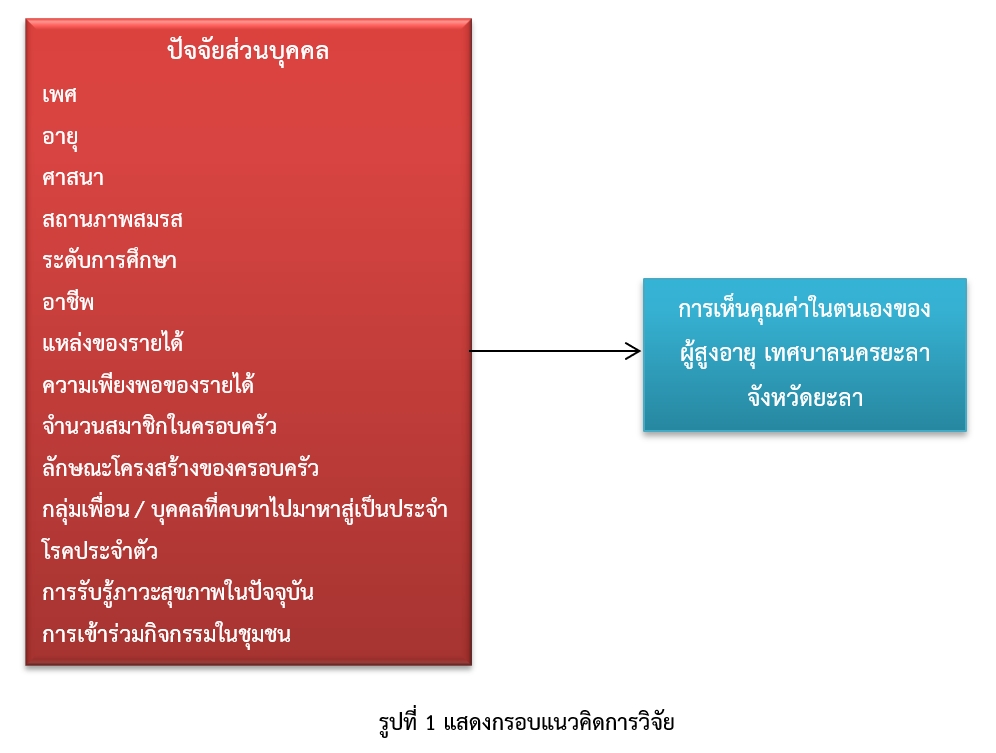
This mixed-method research aimed to study the levels of self-esteem, personal factors associated with self-esteem and implications for improving self-esteem among elderly people. The two processes were performed simultaneously comprised: 1) studying the levels and personal factors associated with the self-esteem. 368 participants were recruited by using utilizing stratified and simple random sampling methods. Personal information and self-esteem levels were collected through survey questionnaire as the research instrument. The reliability of the instrument was 0.82. The collected data were analyzed using percentage, frequency distribution, and Chi – Square test 2) studying the implications for developing the level of self-esteem among elderly. The data was collected from 10 elderly in Yala municipality, Yala province, and 10 health personnel working in the field of elderly health promotion. These participants were selected based on purposive sampling method. In-depth interview was used for data collection and analyzed using content analysis. The results of the study found that
- The level of self-esteem was high (M=3.70, SD=0.52). Also, educational level, source of income, sufficient income, and awareness of the current health status were significantly associated with the level of self-esteem among elders.
- Self-esteem among elderly could be improved with physical, mental, social, and environmental supports. These supports, nevertheless, need to be suited according to the types of elderly people and their personal, cultural, as well as social contexts.
Finally, authorities should take an action on promoting health, and adequate household incomes. The relevant activities should be appropriated with the personal, cultural, and social contexts of the elderly.
References
กรมอนามัย. (2561). สร้างจิตใจที่แจ่มใสให้ผู้สูงอายุด้วยกิจกรรมทางสังคม. สืบค้น 2 ตุลาคม 2566 จาก
https://multimedia.anamai.moph.go.th/help-knowledgs/social-activities-for-elders.
กองยุทธศาสตร์ และงบประมาณเทศบาลนครยะลา. (2566). ข้อมูลพื้นฐานเทศบาลนครยะลา ประจำปี
ยะลา. เทศบาลนะครยะลา.
ดวงพร ภาคหาญ. ( 2560). การศึกษาความสัมพันธ์ระหว่างการเห็นคุณค่าในตนเองกับระดับคุณค่าใน
ตนเอง กับระดับสุขภาพจิตของผู้สูงอายุในโรงเรียนผู้สูงอายุเขตรับผิดชอบศูนย์สุขภาพชุมชนเมือง รพ.
แพร่ (ร่องซ้อ). วารสารโรงพยาบาลแพร่, 25(2), 13 – 23.
เทศบาลนครยะลา. ( 2565). เล่าขาน นครยะลา. ยะลา: บริษัท เอสพริ้นท์ (2004) จำกัด.
พิสิษฐ์ จารุศิริพจน์. (2562). การเห็นคุณค่าในตนเองของผู้สูงอายุ สมาคมผู้สูงอายุเทศบาลเมืองนครปฐม
(วิทยานิพนธ์).มหาวิทยาลัยศิลปากร วิทยาเขตพระราชวังสนามจันทร์, นครปฐม.
มาธุรี อุไรรัตน และมาลี สบายยิ่ง. (2560). การเห็นคุณค่าในตนเองของผู้สูงอายุ: กรณีศึกษามูลนิธิ
สงเคราะห์คนชราอนาถาแห่งหนึ่งในจังหวัดสงขลา. RUSAMILAE JOURNAL, 38(1), 29–44.
วัชรินทร์ เสมามอญ. (2556). การมีส่วนรวมในการพัฒนารูปแบบการจัดกิจกรรมนันทนาการสำหรับ
ผู้สูงอายุในจังหวัดพระนครศรีอยุธยาและจังหวัดอ่างทอง. มหาวิทยาลัยราชภัฏพระนครศรีอยุธยา.
สืบค้น 1 พฤษภาคม 2564 จาก http://rdi.aru.ac.th/e_journal/pdf/158.pdf.
สำนักสาธารณสุข และสิ่งแวดล้อม เทศบาลนครยลา. (2565). รายงานการคัดกรองผู้สูงอายุ เทศบาลนครยะลา. ยะลา : เทศบาลนครยะลา.
สมิทธิ์ เจือจินดา และวรรณนภา โพธิ์ผล. (2562). การพัฒนาโปรแกรมเสริมสร้างการเห็นคุณค่าของ
ตนเองสำหรับผู้สูงอายุในชุมชนเขตธนบุรี. มหาวิทยาลัยราชภัฎธนบุรี :กรุงเทพมหานคร
สำนักงานคณะกรรมการพัฒนาการเศรษฐกิจและสังคมแห่งชาติ. (2562). การคาดประมาณประชากรของ
ประเทศไทย พ.ศ. 2553-2583 (ฉบับปรับปรุง). กรุงเทพฯ: สำนักงานคณะกรรมการพัฒนาการ
เศรษฐกิจและสังคมแห่งชาติ.
สํานักงานสถิติแห่งชาติ. (2559). การสำรวจสุขภาพจิต (ความสุขคนไทย) พ.ศ.2558. กรุงเทพฯ : สํานัก
สถิติพยากรณ์ สํานักงานสถิติแห่งชาติ.
สถาบันวิจัยประชากรและสังคม มหาวิทยาลัยมหิดล. (2565). Research Brief การเข้าถึงระบบบริการทาง
สังคมของประชากรในครัวเรือนก่อนวัยสูงอายุและผู้สูงอายุที่มีรูปแบบการอยู่อาศัยต่างกันเพื่อ
นำไปสู่แนวทางการสนับสนุนการบริการที่เหมาะสม. กรุงเทพฯ : มหาวิทยาลัยมหิดล.
สุรางค์ เชื้อวณิชชากร, พูนสุข ช่วยทอง และเปรมวดีคฤหเดช. (2561). ปัจจัยที่เกี่ยวข้องกับความรู้สึกมีคุณค่าใน
ตนเองของผู้สูงอายุในตำบลบางนางลี่ จังหวัดสมุทรสงคราม. จุฬาลงกรณ์เวชสาร. 62(1): 119 – 33.
ฤทัย พานิช และพรสวรรค์ มณีทอง. (2564). การเสริมสร้างสุนทรียภาพเพื่อสร้างคุณค่าในตนของผู้สูงอายุ.
มนุษยศาสตร์สังคมศาสตร์ปริทัศน์, 9(3), 28 – 39.
อุบลทิพย์ ไชยแสง และนิวัติ ไชยแสง. (2566). การศึกษาความสัมพันธ์ระหว่างการเห็นคุณค่าในตนเอง
แรงสนับสนุนทางสังคม กับสุขภาวะทางจิตของผู้สูงอายุกลุ่มติดบ้าน ในเขตอำเภอเมือง จังหวัดยะลา.วารสารวิชาการสาธารณสุขชุมชน, 9(1), 160 -169.
อุไรวรรณ อมรนิมิตร, ณัฐสินี แสนสุข และ ธนูศักดิ์ รังสีพรหม. (2565). การศึกษาความสุขในชีวิตของผู้สูงอายุ.
วารสารสังคมศาสตร์. 11(1), 116 -127.
Coopersmith, S. (1984). SEI : Self-Esteem Inventories. California : Consulting
Psychologist Press,Inc.
Crabtree, Benjamin F., & Miller, William L. (1992). Doing qualitative research. London,
UK: Sage.
Cronbach, L.J. (1990). Essentials of psychological testing. (5th ed.). New York: Harper &
Row.
Weiers, Ronald M. (2005). Introduction to Business Statistics. International Student
Edition.Fifth Edition.Pennsylvania, USA. Duxbury Press, Thomson –
Brooks/cole.
Downloads
Published
Issue
Section
License
Copyright (c) 2023 Journal of Council of Community Public Health

This work is licensed under a Creative Commons Attribution-NonCommercial-NoDerivatives 4.0 International License.
- บทความหรือข้อคิดเห็นใด ๆ ที่ปรากฏในวารสารสภาการสาธารณสุขชุมชน ที่เป็นวรรณกรรมของผู้เขียน บรรณาธิการ ไม่จำเป็นต้องเห็นด้วย
- บทความที่ได้รับการตีพิมพ์ถือเป็นลิขสิทธิ์ของ วารสารสภาการสาธารณสุขชุมชน


