
การพัฒนารูปแบบการบริการวัคซีนคลินิกหมอครอบครัว โรงพยาบาลสะเดา
The development of a family doctor clinic vaccination service model Sadao Hospital
Keywords:
Vaccination service, Family doctor clinic, Vaccination coverageAbstract
This research and development aimed to study situation of vaccination service, develop a vaccination service model and evaluate the developed model provided by family doctor clinic at Sadao hospital. There were 3 steps of development: Step 1: Studying the situation of vaccination service provided by family doctor clinic at Sadao hospital by analyzing the related documents; Step 2: Creating and developing a vaccine service model drafted by 5 practitioners and validated by 3 experts; and Step 3: Studying the effectiveness of the vaccine service model using quasi-experimental research as one-group pretest post-test design. The populations were 261 children aged 0 - 5 years old. The instrumental tools were the vaccination service model provided by family doctor clinic, vaccine register and vaccine coverage register. Data were analyzed using frequencies and percentage. The results found that:
- 1. The situation of vaccination service found that more than 65% of children missed the vaccine appointments in the first half year of 2022 and the vaccine coverage rates of children aged 1, 2, 3 and 5 years old illustrated as 26%, 61%, 50% and 49% respectively which were lower than the criterion.
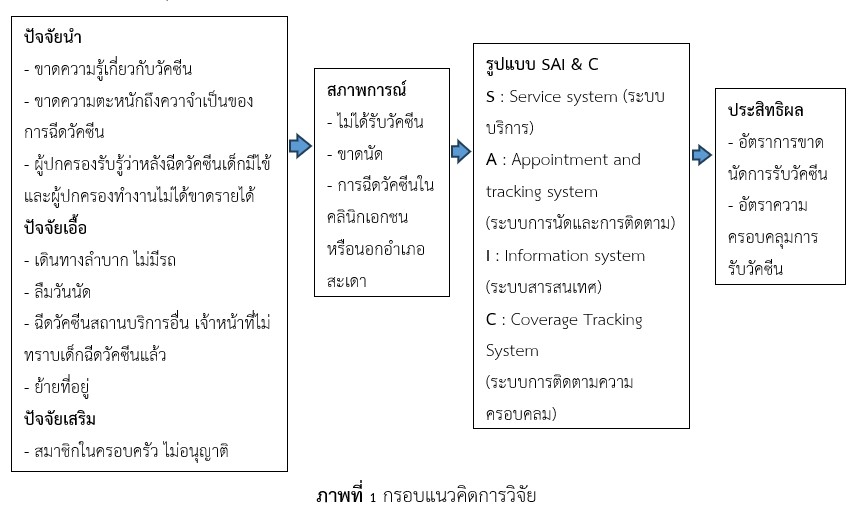
- 2. The model of vaccination service at Sadao hospital provided by family doctor clinic was SAI & C which consisted of: 1) service system; 2) appointment and follow-up system; 3) information system; and 4) coverage monitoring system.
- 3. After applying the model, the missing rate of vaccination appointments decreased from 65% to 20% per month. In addition, the vaccination coverage rates for children aged 1, 2, 3 and 5 years old increased from 26%, 61%, 50% and 49% to 90%, 83%, 72% and 83% respectively.
Therefore, the developed vaccination service model should be applied to reduce the problem of vaccination service in the target group to be consistent with the way of life and the context of the community.
References
กุลกัญญา โชคไพบูลย์กิจ, ชนเมธ เตชะแสนศิริ, วีระชัย วัฒนวีรเดช, อัจฉรา ตั้งสถาพรพงษ์, และฤดีวิไล สามโกเศศ. (2562). ตําราวัคซีนและการสร้างเสริมภูมิคุ้มกันโรค ปี 2562. กรุงทพ: กองโรคป้องกันด้วยวัคซีน กรมควบคุมโรค กระทรวงสาธารณสุข.
ซำซูดิน ดายะ, นิรัชรา ลิลละฮ์กุล และเจษฎากร โนอินทร์. (2561). ประสบการณ์ของผู้ปกครองเด็กชาวไทยมุสลิมต่อการปฏิเสธการรับบริการสร้างเสริมภูมิคุ้มกันโรคด้วยวัคซีนในเด็กอายุ 0 - 5 ปี. วารสารกรมการแพทย์. 43(5): 137-141.
ณปภา ประยูรวงษ์ และมารุต ภู่เพนียด. (2562). ปัจจัยที่มีอิทธิพลต่อการได้รับวัคซีนครบตามเกณฑ์อายุของเด็กปฐมวัย ตำบลกระจัน อำเภออู่ทอง จังหวัดสุพรรณบุรี. วารสารTJPHS. 2(2): 43-53.
นครินทร์ สุวรรณแสง และภราดร ยิ่งยวด. (2563). คลินิกหมอครอบครัว: แนวคิดและการจัดการตามบทบาทพยาบาล วิชาชีพ. วารสารสภาการพยาบาล. 35(1): 5-17.
นรลักขณ์ เอื้อกิจ และลัดดาวัลย์ เพ็ญศร. (2562). การประยุกต์ใช้แนวคิด PRECEDE MODEL ในการสร้างเสริมสุขภาพ. วารสารพยาบาลสภากาชาดไทย. 12(1): 38-48.
บุษกร พันธ์เมธาฤทธิ, ลักขณา คงแสง, จุฑารัตน์ คงเพ็ชร, ปราณี คำจันทร์, ลดาวัลย์ ประทีปชัยกูร และพรทิพย์ พูลประภัย. (2562). ปัจจัยทำนายพฤติกรรมการดูแลเด็กของผู้ปกครองในการป้องกันควบคุมโรคติดต่อที่บ้าน. วารสารพยาบาลสงขลานครินทร์. 39(2): 23-36.
รุสนา ดอแม็ง และฐปนรรฆ์ ประทีปเกาะ. (2562). ปัจจัยที่มีผลต่อผู้ปกครองในการนำเด็กอายุ 0 - 5 ปีรับการสร้างเสริมภูมิคุ้มกันโรคพื้นฐานของจังหวัดปัตตานี. วารสารวิชาการสาธารณสุข 28(2): 224-235.
ศุภานิช ธรรมทินโน. (2561). การพัฒนาระบบติดตามความครอบคลุมในการรับวัคซีนของเด็ก 0-5 ปีในอำเภอสะเดา จังหวัดสงขลา. วารสารสาธารณสุขและวิทยาศาสตร์สุขภาพ. 1(3): 62-69.
อมรรัตน์ นธะสนธิ์. (2559). เอกสารประกอบการสอนรายวิชาแนวคิดพื้นฐานและทฤษฏีทางการพยาบาลปีการศึกษา 2559. อุบลราชธานี: คณะพยาบาลศาสตร์ มหาวิทยาลัยอุบลราชธานี.
อภิชญา หิมมา และวัลลภา เชยบัวแก้ว. (2565). การพัฒนาตัวแบบการสร้างเสริมภูมิคุ้มกันโรค ศูนย์สุขภาพชุมชนพิมาน. Thaksin University Online Journal 2022; 2022(1): EHST-29(89): 1-17.
อีระฟาน หะยีอีแต และประภาภรณ์ หลังปูเต๊ะ. (2563). รูปแบบการส่งเสริมความครอบคลุมของวัคซีนในเด็ก 0-5 ปี จังหวัดยะลา. วารสาร อัล-ฮิกมะฮฺ มหาวิทยาลัยฟาฏอน. 10(20): 137-148.
สุเมธ ตันติเวชกุล. (2559). แนวพระราชดำริ การพัฒนาที่ยั่งยืน นำประโยช์สุขสู่ประชาชน. วารสารสถาบัน พระปกเกล้า. 14(3): 51-64.
Green, l. W., Kreuter, M. W. (2005). Health program planning: An educational and ecological approach. (4th ed) .New York: Emily Barrosse.
Green, L. W., & Kreuter, M. W. (1999). Health promotion planing third edition aneducational and ecological approach (3rd ed.). California: Mayfield publishing company.
Downloads
Published
Issue
Section
License
Copyright (c) 2024 Journal of Council of Community Public Health

This work is licensed under a Creative Commons Attribution-NonCommercial-NoDerivatives 4.0 International License.
- บทความหรือข้อคิดเห็นใด ๆ ที่ปรากฏในวารสารสภาการสาธารณสุขชุมชน ที่เป็นวรรณกรรมของผู้เขียน บรรณาธิการ ไม่จำเป็นต้องเห็นด้วย
- บทความที่ได้รับการตีพิมพ์ถือเป็นลิขสิทธิ์ของ วารสารสภาการสาธารณสุขชุมชน


