
Effectiveness of Cooling Activity Herbal Sprays Comparing to Mixing Herbs and Tiliacora Triandra Leaf for Jub-Pong-Num-Kao Treatment
Keywords:
cool herbal spray formulation, cool herbal spray single, jub-pong-Num-kao, effectivenessAbstract
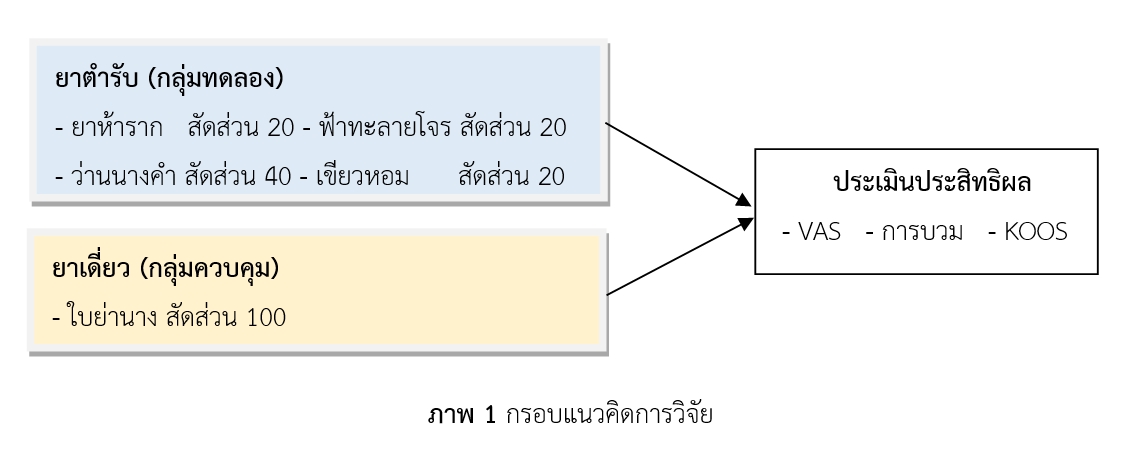
This experimental research aimed to study the effectiveness of cooling activity herbal sprays comparing to mixing herbs and Tiliacora Triandra leaf formulation for Jub-Pong-Num-Kao treatment. Samples were 20 patients, using a purposive selection method according to the inclusion criteria, and were randomly entered into two groups by simple random sampling, a group of 10 using 10 mixing herbs spray and a group of 10 using 10 Tiliacora triandra leaf formulations. The samples in each group were received treatment by spraying every day, 2 times a day in the morning and at night, for 12 weeks. The study instruments included personal records, visual analog scale (VAS), and also swelling assessment form and KOOS. Data were analyzed by percentage, mean, standard deviation, paired samples t-test and independent samples t-test.
The results found that after treatment, the mixing herbs group had statistically significant decrease scores of pain levels, swelling symptoms and knee assessment (P<0.05). On the one hand, in the Tiliacora triandra leaf group had statistically significant decrease scores of pain levels, swelling symptoms and knee assessment in terms of pain, daily activities, exercise movement and other activities (P<0.05), but knee assessment scores in terms of symptoms and quality of life were not statistically significant. When comparing between groups, it was found that pain levels and knee assessment scores were statistically significant difference (P<0.05), but swelling symptoms was not statistically significant difference.
It could be concluded that the mixing herbs spray has more effective than the Tiliacora triandra leaf formulation. Therefore, the mixing herbs spray should be recommended to use for Jub-Pong-Num-kao patients.
References
กรกฎ ไชยมงคล. (2562). ประสิทธิผลของการใช้ยาสมุนไพรตำรับพอกเข่าในการรักษาโรคข้อเข่าเสื่อม
โรงพยาบาลพระปกเกล้า จังหวัดจันทบุรี. วารสารช่อพะยอม, 30(1), 119-128.
กรมการแพทย์, กระทรวงสาธารณสุข. (2558). คู่มือการคัดกรอง/การประเมินผู้สูงอายุ ฉบับที่ 2. นนทบุรี:
สำนักงานกิจการโรงพิมพ์สงเคราะห์องค์การทหารผ่านศึก.
กานดา ชัยภิญโญ วรกานต์ ขอประเสริฐ วิชุดา ลิขิตพิทักษ์ และอลิสา เภรีพล. (2561). ความน่าเชื่อถือในการวัด
ซ้ำของแบบประเมิน Modified Lower Extremity Functional Scale (Modified LEFS) ฉบับ
ภาษาไทย และความสัมพันธ์กับ Knee Osteoarthritis Outcome Scores (KOOS) ฉบับภาษาไทย,
Self-Pace Walk Test และ Timed Up and Go Test ในผู้ที่มีข้อเข่าเสื่อม. วารสารกายภาพบำบัด,
(3), 134-145.
เจษฎา อุดมพิทยาสรรพ์ วินัย สยอวรรณ วรายุส คตวงค์ ณัฐสุดา แก้ววิเศษ และอิศรา ศิรมณีรัตน์. (2562).
การศึกษาเปรียบเทียบประสิทธิผลของการพอกเข่าด้วยตำรับยาพอกสูตรที่ 1 กับยาพอกสูตรที่ 2 ต่อ
อาการปวดเข่าและการเคลื่อนไหวข้อเข่าในผู้ป่วยโรคข้อเข่าเสื่อม โรงพยาบาลบางใหญ่ อำเภอบางใหญ่
จังหวัด นนทบุรี. วารสารมหาวิทยาลัยนราธิวาสราชนครินทร์, 11(1), 64-72.
ชุตินันท์ ขันทะยศ และกนกพร ปัญญาดี. (2560). ผลของถุงยาสมุนไพรประคบข้อเข่าในผู้ป่วย โรคข้อเข่าเสื่อม.
วารสารสุขภาพภาคประชาชน, 12(4), 43-49.
ปิยะพล พูลสุข สุชาดา ทรงผาสุข เมริษา จันทา เนตรยา นิ่มพิทักษ์พงศ์ และกิตรวี จิรรัตน์สถิต. (2561).
ประสิทธิผลของยาพอกสมุนไพรเพื่อบรรเทาอาการปวดเข่า ในผู้ป่วยโรคข้อเข่าเสื่อม.
ธรรมศาสตร์เวชสาร, 18(1), 104-111.
โรงเรียนอายุรเวทธำรง สถานการแพทย์แผนไทยประยุกต์ คณะแพทยศาสตร์ศิริราชพยาบาล
มหาวิทยาลัยมหิดล. (2557). หัตถเวชกรรมแผนไทย (การนวดไทยแบบราชสำนัก) ตอนที่ 2 : การ
นวดกดจุดสัญญาณ. กรุงเทพมหานคร: ศุภวนิชการพิมพ์.
ศิลดา การะเกตุ นิชกานต์ สุยะราช พัชรินทร์ ใจดี สมบัติ กาศเมฆ สุนทร พรมเผ่า และผณิตา ประวัง. (2560).
การศึกษาเปรียบเทียบระดับความเจ็บปวดก่อนและหลังจากการรักษาโคลนสมุนไพรพอกเย็นร่วมกับ
การนวดแผนไทยในผู้สูงอายุที่มีอาการปวดเข่า. เชียงรายเวชสาร, 9(2), 115-24.
สำนักงานสถิติแห่งชาติ. (2564). การสำรวจอนามัยและสวัสดิการ พ.ศ. 2564. กรุงเทพ: กองสถิติพยากรณ์
สำนักงานสถิติแห่งชาติ.
อรสา สารพันโชติวิทยา. (2564). การวิจัยและพัฒนายาสมุนไพร: สมุนไพรกระตุ้นภูมิคุ้มกันและต้านอักเสบ
(พิมพ์ครั้งที่ 2). พิษณุโลก: สำนักพิมพ์มหาวิทยาลัยนเรศวร.
อาวุธ หงษ์ศิริ ศศิชา มูลทองคำ ศุภรัตน์ ดวนใหญ่ เพชรน้ำผึ้ง รอดโพธิ์ และอัจฉรา แก้วน้อย. (2565).
ประสิทธิผลเจลพอกเข่าต่อระดับความปวดของเข่าในผู้สูงอายุที่มารับบริการ ณ ช่อชงโคคลินิก
การแพทย์แผนไทย มหาวิทยาลัยราชภัฏบ้านสมเด็จเจ้าพระยา. วารสารสถาบันวิจัยและพัฒนา
มหาวิทยาลัยราชภัฏบ้านสมเด็จเจ้าพระยา, 7(1), 77-86.
Cross, M., Smith, E., Hoy, D., Nolte, S., Ackerman, I., Fransen, M., et al. (2014). The global
burden of hip and knee osteoarthritis: estimates from the global burden of disease
study. Ann Rheum Dis, 73(7), 1323-1330.
Cui, A., Li, H., Wang, D., Zhong, J., Chen, Y., Lu, H., (2020). Global, regional prevalence,
incidence and risk factors of knee osteoarthritis in population-based studies,
E Clinical Medicine, 29–30: 100587.
Hall, J., Laslett, LL., Martel-Pelletier, J., Pelletier, JP., Abram, F., Ding, CH., et al. (2016).
Change in knee structure and change in tibiofemoral joint space width: a five year
longitudinal population-based study. BMC Musculoskelet Disord. 17:25.
Jiang, X.L., Wang, L., Wang, E.J., Zhang, G.L., Chen, B., Wang, M.K. & Li, F. (2018). Flavonoid
glycosides and alkaloids from the embryos of Nelumbo nucifera seeds and their
antioxidant activity. Fitoterapia, 125, 184-190.
Kaewpiboon, C., Winayanuwattikun, P., Yongvanich, T., Phuwapraisirisan, P & Assavalapsakul, W.
(2014). Effect of three fatty acids from the leaf extract of Tiliacora triandra on
P-glycoprotein function in multidrug-resistant A549RT-eto cell line. Pharmacognosy
Magazine, 10(3), 549-56.
Katisart, T., & Rattana, S. (2017). Hypoglycemic activity of leaf extract from Tiliacora triandra in
normal and streptozotocin-induced diabetic rats. Pharmacogn. J, 9(5), 621-625.
Oboh, G., Ogunruku, O.O., Oyeleye, S.I., Olasehinde, T.A., Ademosun, A.O. & Boligon, A.A. (2017).
Phenolic extracts from Clerodendrum volubile leaves inhibit cholinergic and
monoaminergic enzymes relevant to the management of some neurodegenerative
diseases. Journal of Dietary Supplements, 14(3), 358-371.
Pan, Q., O’Connor, MI., Coutts, RD., Hyzy, SL., Olivares-Navarrete, R., Schwartz, Z., et al. (2016).
Characterization of osteoarthritic human knees indicates potential sex differences.
Biol. Sex. Differ. 7, 27. doi:10.1186/s13293-016-0080-z
Torres Castaneda, H.G., Colmenares Dulcey, A.J. & Isaza Martinez, J.H. (2016). Flavonoid
glycosides from Siparuna gigantotepala leaves and their antioxidant activity.
Chemical and Pharmaceutical Bulletin (Tokyo), 64(5), 502-506.
Suebsasana, S., Pongnaratorn, P., Sattayasai, J., Arkaravichien, T., Tiamkao, S., Aromdee C.
(2009). Analgesic, antipyretic, anti-in-flammatory and toxic effects of andrographolide
derivatives in experimental animals. Arch Pharm Res, 32(9), 1191-200.
Xiang, H., Zhang, L., Yang, Z., Chen, F., Zheng, X. & Liu, X. (2017). Chemical compositions,
antioxidative, antimicrobial, anti-inflammatory and antitumor activities of Curcuma
aromaticaSalisb. essential oils. Industrial Crops and Products, 108, 6-16.
Zheng, H., Chen, C. (2015). Body mass index and risk of knee osteoarthritis: systematic review
and meta-analysis of prospective studies. BMJ Open, 5(12): e007568
Downloads
Published
Issue
Section
License
Copyright (c) 2024 Journal of Council of Community Public Health

This work is licensed under a Creative Commons Attribution-NonCommercial-NoDerivatives 4.0 International License.
- บทความหรือข้อคิดเห็นใด ๆ ที่ปรากฏในวารสารสภาการสาธารณสุขชุมชน ที่เป็นวรรณกรรมของผู้เขียน บรรณาธิการ ไม่จำเป็นต้องเห็นด้วย
- บทความที่ได้รับการตีพิมพ์ถือเป็นลิขสิทธิ์ของ วารสารสภาการสาธารณสุขชุมชน


