
Development of Incidence and Adverse Event Management Model Under 9 standards for the Safety of Patients and Public Health Personnel
Keywords:
Development model, Incidence, Adverse events, 9 key standards, SafetyAbstract
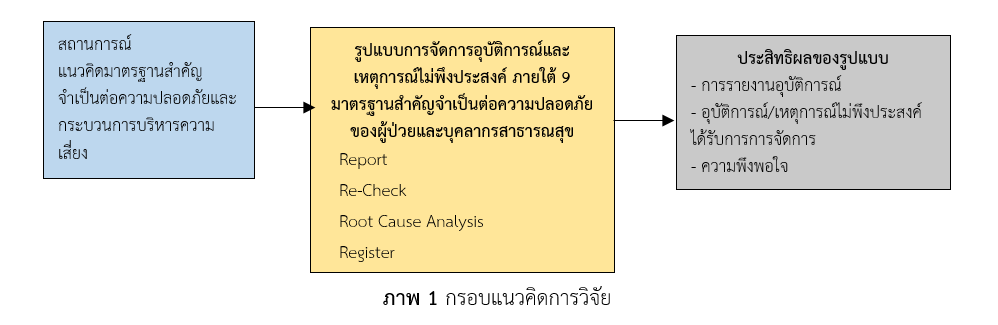
This research and development aimed to study situation, develop a model and evaluate the effectiveness of managing incident and adverse events under 9 standards for the safety of patients and public health personnel. This study consisted of 3 steps: Step 1: Studying the situation of problems using qualitative research to investigate the incidence data from health care facility risk management information system during fiscal year 2018-2020 and document analysis; Step 2: Developing the incident and adverse event management model under 9 key standards necessary for safety by using the P-D-C-A principle verified by experts and evaluated with the highest suitable and consistent level (M=4.71, SD=0.26); and Step 3: Evaluating the effectiveness of a developed model employing quasi-experimental research, one group pre-post design, to implement with 30 personnel in Naradhiwasrajanagarindra hospital. Descriptive statistics, frequency and percentage, were used to analyze the data. The results revealed that:
1. The situations of incidence and adverse event management were recorded in notebook by the hospital personnel and reporting the information during the shift works, not immediately reported in the Healthcare Risk Management Information System. The incidents of E-F levels were not reviewed, while the G-H-I levels were reviewed. The results of the reviews were not included in the incidence risk list from 2018 to 2020. Medication error and drug adverse events were the most common, followed by the major infections of hospitals in Ventilator-Associated Pneumonia (VAP).
2. The incident and adverse event management 4R Model included: 1) Report: reporting the incident and adverse events within 24 hours: 2) Re-Check: verifying the incidence and adverse event data in the health care facility risk management information system: (1) clinical level A-D and non-clinical level 1-2 within 10 days; and (2) clinical level E-I and non-clinical level 3-5 within 5 days; 3) Root cause analysis: reviewing clinical level E-I and non-clinical level 3-5 within 7 days; and 4) Register: bringing the results from the causal analysis (RCA) into the risk management account Risk Register.
3. Regarding the effectiveness, a number of incidents were reported and their root cause analysis (RCA) were reviewed increasing in 2020 (46.23%) at a high level of satisfaction.
This study leads to develop a system to prevent and monitor risks and also prevent adverse events in patients. In addition, the system can help increase quality of the services.
References
จิราวรรณ รุ่งเรืองวารินทร์, พรพิมล พลอยประเสริฐ, และสมทรง บุตรชีวัน. (2560). การพัฒนาระบบการจัดการความเสี่ยง กลุ่มการพยาบาล โรงพยาบาลพระนครศรีอยุธยา. วารสารสมาคมเวชศาสตร์ป้องกันแห่งประเทศไทย, 7(1), 24-36.
บังอร เขื่อนคำ, สมใจ ศิระกมล, และบุญพิชชา จิตต์ภักดี. (2563). การวิเคราะห์สถานการณ์การรายงาน อุบัติการณ์ความเสี่ยงในหอผู้ป่วยหนักอายุรกรรม 1 โรงพยาบาลนครพิงค์ จังหวัดเชียงใหม่. พยาบาลสาร, 47(1), 337-349.
ปฤษณา เปล่งอารมณ์. (2564). การพัฒนารูปแบบการจัดการทางการพยาบาลเพื่อความปลอดภัยจากการบริหารยาความเสี่ยงสูง โรงพยาบาลเจ้าพระยายมราช จังหวัดสุพรรณบุรี. วารสารแพทย์เขต 4-5, 40(1), 137-150.
สำรี ชมบริสุทธิ์, เพชรสุนีย์ ทั้งเจริญกุล, และอภิรดี นันท์ศุภวัฒน์. (2563). การวิเคราะห์สถานการณ์การจัดการความปลอดภัยของผู้ป่วย หอผู้ป่วยศัลยกรรมชาย โรงพยาบาลพุทธชินราช พิษณุโลก. พยาบาลสาร, 47(2), 453-462.
สถาบันรับรองคุณภาพสถานพยาบาล (องค์การมหาชน). (2561). เป้าหมายความปลอดภัยของผู้ป่วยของประเทศไทย Patient Safety Goals: SIMPLE Thailand (พิมพ์ครั้งที่ 2). สำนักพิมพ์ เฟมัส แอนด์ ซัคเซ็สฟูล.
สถาบันรับรองคุณภาพสถานพยาบาล (องค์การมหาชน). (2563). HA UPDATE 2020 (พิมพ์ครั้งที่ 1). สำนักพิมพ์ บริษัท หนังสือวันดี จำกัด.
Bowel P. Building a safety and improvement culture in primary care practice. Nurses 2010, 5:156.
Jirapaet, W., & Jirapaet, K. (2012). Patient safety management, concept, process, clinical safety guidelines. Bangkok: Eleven Glasses Color.
World Health Organization (WHO). The patient Safety: Forward programmed 2006.
Downloads
Published
Issue
Section
License
Copyright (c) 2023 Journal of Council of Community Public Health

This work is licensed under a Creative Commons Attribution-NonCommercial-NoDerivatives 4.0 International License.
- บทความหรือข้อคิดเห็นใด ๆ ที่ปรากฏในวารสารสภาการสาธารณสุขชุมชน ที่เป็นวรรณกรรมของผู้เขียน บรรณาธิการ ไม่จำเป็นต้องเห็นด้วย
- บทความที่ได้รับการตีพิมพ์ถือเป็นลิขสิทธิ์ของ วารสารสภาการสาธารณสุขชุมชน


