
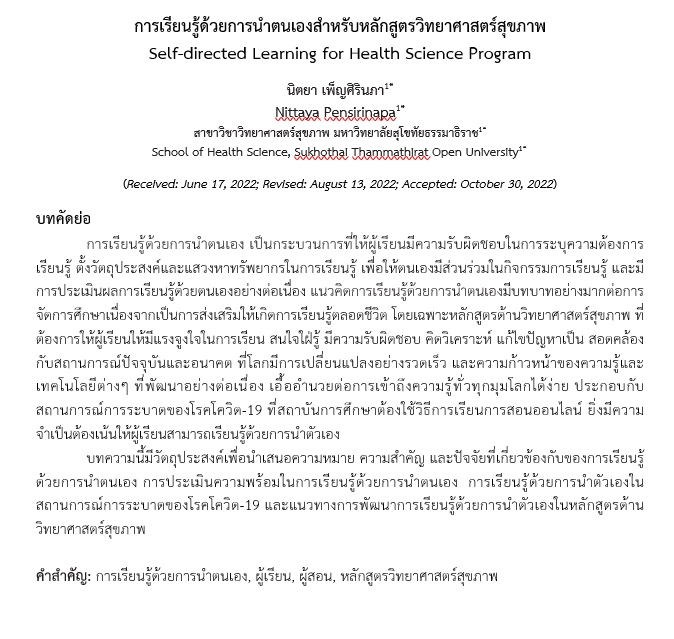
Self-directed Learning for Health Science Program
Keywords:
Self-directed learning, Learner, Teacher, Health science programAbstract
Self-directed learning (SDL) is a process to drive individual responsibility to identify learning needs, devise individual learning objectives and seek learning resources in order to engage in self-learning activities and continuously self-evaluated learning. SDL is the essential attribute of a lifelong learning. Students of the health science programs are expected to be more learning motivation, curiosity, interest, responsibility, and capability in critical thinking and problem solving. These are relevant to the present and also future world which is changing rapidly. The advancement and continuing development of knowledge and technology enable an easy access of new knowledge in anywhere of the world. Moreover, the COVID-19 pandemic challenges education institutes to transform their conventional teaching to online learning. These situations are crucial to fostering the learners to be self-directed.
This article aims to present the definition, importance and factors associated with SDL, the SDL readiness assessment, SDL during the COVID-19 pandemic, and how to develop SDL in health science programs.
References
กองโรคติดต่อทั่วไป กรมควบคุมโรค. (2564). สถานการณ์โรคติดเชื้อไวรัสโคโรนา 2019 (COVID-19) มาตรการสาธารณสุข และปัญหาอุปสรรคการป้องกันควบคุมโรคในผู้เดินทาง. 14 มกราคม 2564. Retrieved from:.https://ddc.moph.go.th/uploads/ckeditor2//files/.pdf.
เขมกร อานุภาพ. (2560). การใช้การเรียนรู้แบบนำตนเองเพื่อพัฒนาการเรียนรู้วิชาคอมพิวเตอร์ของนักเรียนชั้นมัธยมศึกษาปีที่ 4. วิทยานิพนธ์ปริญญาศึกษาศาสตรมหาบัณฑิต สาขาวิชาหลักสูตรและการสอน วิทยาลัยครุศาสตร์ มหาวิทยาลัยธุรกิจบัณฑิต.
ชฎาภรณ์ จันทร์ประเสริฐ และเสาวภา วิชาดี. (2555). การปรับวิธีเรียนเปลี่ยนวิธีสอนเพื่อเสริมสร้างทักษะการเรียนรู้ด้วยการนำตนเองของผู้เรียน. วารสารนักบริหาร, 32(2), 143-149.
ชณวรรต ศรีลาคำ และพัฒนา สอดทรัพย์. (2526). ทิศทางการเรียนรู้ด้วยตนเองตามนโยบายประเทศไทย 4.0. วารสารมนุษยศาสตร์ ฉบับบัณฑิตศึกษา มหาวิทยาลัยรามคำแหง, 8(1), 49-62.
ธีระ รามสูต. (2554). การพัฒนาสู่นักสาธารณสุขมืออาชีพในยุคโลกาภิวัฒน์. วารสารสมาคมเวชศาสตร์ป้องกันแห่งประเทศไทย, 1(1), 1-4.
เมธาสิทธิ์ ธัญรัตนศรีสกุล. (2562). การตรวจสอบความตรงเชิงทฤษฎีของแบบวัดความพร้อมในการเรียนรู้แบบชี้นำตนเองสำหรับนักเรียนชั้นมัธยมศึกษาปีที่ 6. วารสารวิจัยและพัฒนา มหาวิทยาลัยราชภัฎบุรีรัมย์, 14(1), 100-111.
รังสรรค์ โฉมยา. (2561). การศึกษาพฤติกรรมการเรียนรู้ด้วยตนเองของนิสิตมหาวิทยาลัยมหาสารคาม. วารสารศึกษาศาสตร์ มหาวิทยาลัยมหาสารคาม, 12(3), 309-317.
วิภาดา วัฒนนามกุล, สุลัดดา ลอยฟ้า, สุภาสินี สุภธีระ และชัยยง พรหมวงศ์. (2545). การพัฒนาระบบการเรียนด้วยตนเองสำหรับนักศึกษาสาขาวิชาชีพสาธารณสุข. วารสารวิจัย มข. (บศ.), ฉบับพิเศษ, 140-148.
วีรพล แก้วพันธ์อ่ำ, จิระวรรณ ยืนยั่ง และพรชัย พันธุ์วิเศษ. (2564). การศึกษาความสามารถในการเรียนรู้แบบนำตนเองในแต่ละช่วงอายุของนักศึกษาวิทยาลัยชุมชนสระแก้วผ่านการเรียนรู้แบบออนไลน์ในสถานการณ์โรคติดเชื้อไวรัสโคโรนา 2019. Journal of Roi Kaensarn Academi, 6(1), 98-112.
อุไรวรรณ ชินพงษ์. (2555). คุณลักษณะการเรียนรู้ด้วยการนำตนเองของนักศึกษาวิทยาลัยชุมชน. วารสารศึกษาศาสตร์ มหาวิทยาลัยทักษิณ, 13(1), 141-153.
Abd-El-Fattah, S. M. (2010). Garrison’s Model of Self-Directed Learning: Preliminary Validation and Relationship to Academic Achievement. Span J Psychol, 13(2), 586–596.
Elshami, W. (2022). Factors That Affect Student Engagement in Online Learning in Health Professions Education. Nurse Education Today, 110(2022)105261, 1-17. https://doi.org/10.1016/j.nedt.2021.105261.
Garrison, D. R. (1997). Self-Directed Learning: Toward a Comprehensive Model. Adult Education Quarterly, 48(1), 18-33.
Guglielmino, L. M. (1977). Development of the Self-Directed Learning Readiness Scale, Doctoral Dissertation. Athens, Georgia: University of Georgia.
Knowles, M. S. (1975). Self-Directed Learning: A Guide for Learner and Teachers. Chicago: Association Press.
Mahlaba, S. C. (2020). Reasons Why Self-Directed Learning is Important in South Africa during the COVID-19 Pandemic. South African Journal of Higher Education, 34(6), 120-136. https://dx.doi.org/10.20853/34-6-4192.
Morris, T. H. (2019). Self-Directed Learning: A Fundamental Competence in a Rapidly Changing World. International Review of Education, 65(4), 633–653. doi:10.1007/s11159-019-09793-2.
Shen, W., Chen, H. & Hu, Y. (2014). The Validity and Reliability of the Self-Directed Learning Instrument (SDLI) in Mainland Chinese Nursing Students. BMC Medical Education, 14(108), 1-7. doi:10.1186/1472-6920-14-108.
Shion, K. B., Aris, B. & Tasir, Z. (2009). The Level of Self-Directed Learning among Teacher Training Institute Students-An Early Survey. Journal Technology, 50(E), 101–111.
Singaram, V. S., Naidoo, K. L., & Singh, S. (2022). Self-Directed Learning During the COVID-19 pandemic: perspectives of South African final-year health professions students. Adv Med Educ Pract, 6(13), 1-10. doi: 10.2147/AMEP.S339840.
Wong, F. M., Tang, A. C. & Cheng, W. L. (2021). Factors Associated with Self-Directed Learning among Undergraduate Nursing Students: A Systematic Review. Nurse Education Today, 104(2014), 104998, 1-21. https://doi.org/10.1016/j.nedt.2021.104998.
Yuan, H. B., Williams, B. A., Fang, J. B., & Pang, D. (2012). Chinese Baccalaureate Nursing Students' Readiness for Self-Directed Learning. Nurse Education Today, 32(2012), 427-431. doi:10.1016/j.nedt.2011.03.005.
Published
Issue
Section
License
Copyright (c) 2022 Journal of Council of Community Public Health

This work is licensed under a Creative Commons Attribution-NonCommercial-NoDerivatives 4.0 International License.
- บทความหรือข้อคิดเห็นใด ๆ ที่ปรากฏในวารสารสภาการสาธารณสุขชุมชน ที่เป็นวรรณกรรมของผู้เขียน บรรณาธิการ ไม่จำเป็นต้องเห็นด้วย
- บทความที่ได้รับการตีพิมพ์ถือเป็นลิขสิทธิ์ของ วารสารสภาการสาธารณสุขชุมชน


