
Burnout Syndrome among Health Personal during Pandemic of Covid-19
Keywords:
Burnout, Health Personnel, COVID-19 PandemicAbstract
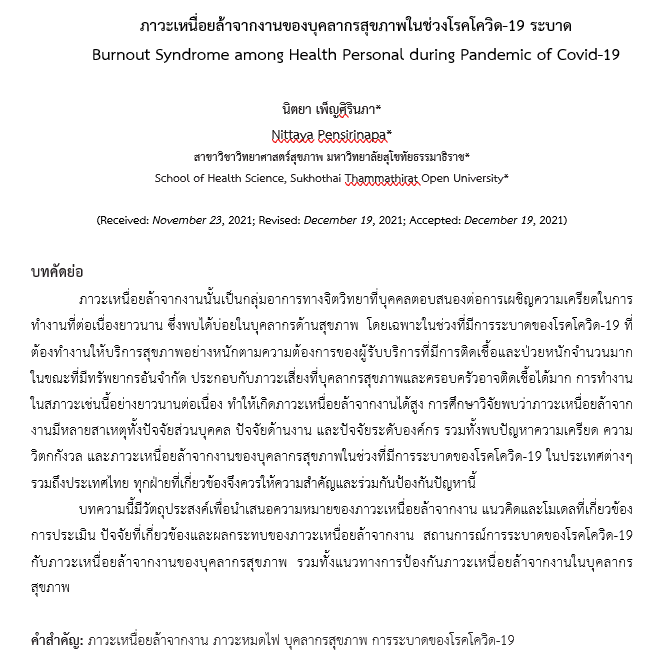
Burnout is a psychological syndrome emerging as a prolonged response to chronic interpersonal stressors on the job. It is a common problem among health personnel, especially during the Coronavirus Disease 2019 (COVID-19) pandemic. Facing this critical situation, health personnel are directly involved in the overload of health care services regarding increasing number of infected cases and COVID-19 patients, while having limited resources. In addition, there is a high risk that health personnel and their families might be infected. Working in such conditions for a long time leads to be burnout of health personnel. Studies found causes of burnout related to individual, job and organizational factors. Stress, anxiety and burnout among health personnel during the COVID-19 outbreak were found in different countries including Thailand. All related parties should therefore focus on and work together to prevent this burnout problem in health personnel.
This article aims to present the definition of burnout, concept and models, assessment, related factors and impacts on burnout among health personnel during the COVID-19 pandemic and also guidelines for preventing burnout of health personnel.
References
กรมควบคุมโรค. (2564). กรมควบคุมโรค ติวเข้ม “บุคลากรด่านหน้า” ในโรงพยาบาลทั่วไทยทั้งรัฐและเอกชน ป้องกันการติดเชื้อโควิด-19. Retrieved 4 สิงหาคม 2564. from: https://ddc.moph.go.th/brc/news.php?news=19925&deptcode=brc.
กรมสุขภาพจิต. (2563). การดูแลจิตใจบุคลากรทางการแพทย์และสาธารณสุข. Retrieved 16 มิถุนายน 2563. from: https://www.dmh.go.th/covid19/pnews/view.asp?id=64
กระทรวงสาธารณสุข. (2564). สถานการณ์ผู้ติดเชื้อ COVID-19 อัพเดทรายวัน. Retrieved 23 พฤศจิกายน 2021. from: https://ddc.moph.go.th/covid19-dashboard/?dashboard=main.
กองโรคติดต่อทั่วไป กรมควบคุมโรค. (2564). สถานการณ์โรคติดเชื้อไวรัสโคโรนา 2019 (COVID-19) มาตรการสาธารณสุข และปัญหาอุปสรรคการป้องกันควบคุมโรคในผู้เดินทาง. Retrieved 14 มกราคม 2564. from: https://ddc.moph.go.th/uploads/ckeditor2//files/1)
งานโรคติดต่ออุบัติใหม่ กลุ่มพัฒนาวิชาการโรคติดต่อ. (2564). สถานการณ์โรคติดเชื้อไวรัสโคโรนา 2019 (COVID-19) มาตรการสาธารณสุขและปัญหาอุปสรรคการป้องกันควบคุมโรคในผู้เดินทาง. Retrieved 8 สิงหาคม 2564. from: https://ddc.moph.go.th/uploads/files/2017420210820025238.pdf.
ไทยโพสต์. (2563). สรุปจุดเริ่มต้นโควิดระบาดรอบ 3. Retrieved 13 เมษายน 2564. Available from: https://www.thaipost.net/main/detail/99304.
นฤมล สุธีรวุฒิ. (2558). ภาวะหมดไฟ: ปัจจัยที่เกี่ยวข้องและแนวทางในการป้องกัน. วารสารการวัดผล การศึกษา. 32(91). มกราคม-มิถุนายน 2558. 16-25.
นิตยา เพ็ญศิรินภา. (2563). หน่วยที่ 11 สุขภาพจิตในการทำงาน. ใน เอกสารการสอนชุดวิชา 54134 การยศาสตร์และจิตวิทยาอุตสาหกรรม. หน่วยที่ 8-15 (น. 11-1 -11-66). นนทบุรี: สาขาวิชาวิทยาศาสตร์สุขภาพ มหาวิทยาลัยสุโขทัยธรรมาธิราช.
Apisarnthanarak, A. Apisarnthanarak, P., Siripraparat, C., Saengaram, P., Leeprechanon, N. and Weber, DJ. (2020). Impact of anxiety and fear for COVID-19 toward infection control practices among Thai healthcare workers. Infection Control & Hospital Epidemiology (2020), 1–2. doi:10.1017/ice.2020.280.
Bakker, AB, Demerouti, E. (2007). The Job Demands-Resources model: state of the art. J Manag Psychol, 22:309-28.
Borgogni, L, Consiglio, C, Alessandri, G. et al. (2012). “Don’t throw the baby out with the bathwater!” Interpersonal strain at work and burnout. Eur J Work Organizat Psychol, 21:875-98.
Cheng, Y., Chen, I., Chen, C., Burr, H., & Hasselhorn, H. (2013). The influence of age on the distribution of self-rated health, burnout and their associations with psychosocial work conditions. Journal of Psychosomatic Research, 74, 213–220.
Cherniss, C. (1980). Staff burnout: job stress in the human services. Beverly Hills: Sage.
Harrington, R. (2013). Stress, Health, and Well-being Thriving in the 21st Century. International Edition. USA: Wadsworth, Cengage Learning.
Hu, D., Kong, Y., Li, w., Hand, Q., Zhang, X., Zhuf, LZ. Et al. Frontline nurses’ burnout, anxiety, depression, and fear statuses and their associated factors during the COVID-19 outbreak in Wuhan, China: A large-scale cross-sectional study. EClinicalMedicine, 24(2020).100424.
Gabriel, K.P. & Aguinis, H. (2021). How to Prevent and Combat Employee Burnout and Create Healthier Workplaces During Crises and Beyond Business Horizons, https://doi.org/10.1016/j.bushor.2021.02.037
Harrington, R. (2013). Stress, Health, and Well-being Thriving in the 21st Century. International Edition. USA: Wadsworth, Cengage Learning.
Kim, H., Shin, K., & Swanger, N. (2009). Burnout and engagement: A comparative analysis using the Big Five personality dimensions. International Journal of Hospitality Management, 28, 96–104.
Lai, J. et al (2020). Factors Associated With Mental Health Outcomes Among Health Care Workers Exposed to Coronavirus Disease 2019. JAMA Network Open. 2020; 3(3):e203976. doi:10.1001/jamanetworkopen.2020.3976
Lizano, E., & MorBarak, M. (2012). Workplace demands and resources as antecedents of job burnout among public child welfare workers: A longitudinal study. Children and Youth Services Review, 34, 1769–1776.
Maslach C, P. Leiter M. (2016). Understanding the burnout experience: recent research and its implications for psychiatry. World Psy¬chiatry, 15(2):103-11.
Maunder, RG. et al. (2021) Psychological impact of the COVID-19 pandemic on hospital workers over time: Relationship to occupational role, living with children and elders, and modifiable factors. General Hospital Psychiatry. Available online 5 May 2021. https://doi.org/10.1016/j.genhosppsych.2021.04.012
Pereira, J.M., Silva, C., Freitas, D., Salgado, A. (2021) Burnout among Portuguese radiographers during the COVID-19 pandemic. Radiography. https://doi.org/10.1016/j.radi.2021.05.001
Prasad, K. et al. (2021) Prevalence and correlates of stress and burnout among U.S. healthcare workers during the COVID-19 pandemic: A national cross-sectional survey study. EClinicalMedicine, 35 (2021) 100879 https://doi.org/10.1016/j.eclinm.2021.100879 online 16 May 2021.
Rossi, A., Cetrano, G., Pertile, R., Rabbi, L., Donisi, V., Grigoletti, L., Curtolo, C., Tansella, M., Thornicroft, G., & Amaddeo, F. (2012). Burnout, compassion fatigue, and compassion satisfaction among staff in community-based mental health services. Psychiatry Research, 200, 933–938.
Thatrimontrichai, A., Weber, DJ. & Apisarnthanarak, A. Mental health among healthcare personnel during COVID-19 in Asia: A systematic review. Journal of the Formosan Medical Association, 120(2021): 1296-1304.
Saragih, ID., Tonapa, SI., Saragih, IS., Advani, S., Batubara, SO., Suarilah, I., Lin, C. (2021). Global Prevalence of Mental Health Problems among healthcare workers during The Covid-19 Pandemic: A Systematic Review and Meta-Analysis, International Journal of Nursing Studies, doi: https://doi.org/10.1016/j.ijnurstu.2021.104002
Shanafelt, T. Ripp, J., Trockel, M. (2020). Understanding and Addressing Sources of Anxiety Among Health Care Professionals During the COVID-19 Pandemic. JAMA. June 2, 2020 Volume 323, Number 21, Downloaded From: https://jamanetwork.com/ on 11/03/2021
Vassos, M., & Nankervis, K. (2012). Investigating the importance of various individual, interpersonal, organizational and demographic variables when predicting job burnout in disability support workers. Research in Developmental Disabilities, 33, 1780–1791.
Downloads
Published
Issue
Section
License
- บทความหรือข้อคิดเห็นใด ๆ ที่ปรากฏในวารสารสภาการสาธารณสุขชุมชน ที่เป็นวรรณกรรมของผู้เขียน บรรณาธิการ ไม่จำเป็นต้องเห็นด้วย
- บทความที่ได้รับการตีพิมพ์ถือเป็นลิขสิทธิ์ของ วารสารสภาการสาธารณสุขชุมชน


