
Development and Evaluation of Disease Control Behavior Model among Chronic Kidney Disease Patients in Ongphrapathomchedee Health Community Center Networking of Nakhonpathom Hospital’s Contracted Unit of Primary Care
Keywords:
Keyword :. disease control behavior, Chronic Kidney Disease, Health Community CenterAbstract
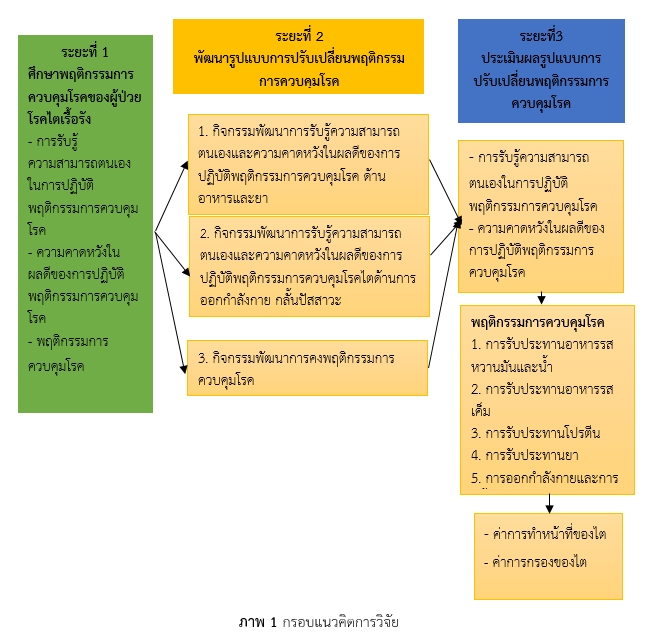
The purposes of this research development study were to develop and evaluate a disease control behavior model for chronic kidney disease in Ongphrapathomchedee Health Community Center networking of Nakhonpathom Hospital’s Contracted Unit of Primary Care. The research procedure consisted of 3 phases including: 1) analysis of behavior in 35 chronic kidney disease patients by using questionnaires and in-depth interviews; 2) development of the model based upon the outcomes of phase 1 using self-efficacy theory; and 3) testing and evaluating the model for 34 patients in the experimental group. The instruments used in this study were questionnaires and in-depth interviews. The data were analyzed by descriptive statistics and paired sample t-test.
The results showed that; 1) most of the participants had the middle level of perceived self-efficacy of disease control behavior, outcome expectations of disease control behavior and disease control behavior; 2) the development of disease control behavior model among chronic kidney disease patients included 3 stages: firstly, development of perceived self-efficacy and outcome expectations of food and drug intake; secondly, development of perceived self-efficacy and outcome expectations of exercise and holding bladder or urinary continence; and finally, development of maintenance of disease control behavior; and 3) the results of the model implementation revealed that the average scores of perceived self-efficacy of disease control behavior, outcome expectations of disease control behavior, and disease control behavior were significantly higher than before model implementation (p-value<0.001). In addition, eGFR had significantly higher rate than before intervention (p-value<0.05), while Cr had significantly lower rate than before intervention (p-value<0.05).
The findings of this study demonstrated that the disease control behavior model can improve perceived self-efficacy, outcome expectations and disease control behavior among chronic kidney disease patients. Therefore, this model should be continued and expanded in other communities.
References
กระทรวงสาธารณสุข. (2560). การจัดการโรคไตเรื้อรังนำสู่การจัดการโรคไม่ติดต่อเรื้อรังการประชุมประจำปีสมาคมโรคไตแห่งประเทศไทย. สืบค้นเมื่อ 24 ตุลาคม 2562, จาก http://www.hfocus.org/content/2017/08/14351.
กังสดาล หาญไพบูลย์. (2560). ปัจจัยที่มีผลต่อพฤติกรรมสุขภาพเพื่อชะลอไตเสื่อมของผู้ป่วยโรคไตเรื้อรังระยะที่ 3-4 โรงพยาบาลคลองขลุง จังหวัดกำแพงเพชร วิทยานิพนธ์ ส.ม. สาขาวิชาสาธารณสุขศาสตร์ มหาวิทยาลัยนเรศวร.
กัลปังหา โชสิวสกุล, นพวรรณ เปียซื่อ และสุรวิทย์ ศักดานุภาพ. (2560). ผลของโปรแกรมบูรณาการดูแลโดยทีมสหวิชาชีพร่วมกับการจัดการตนเองในผู้ป่วยโรคไตเรื้อรังที่มีปัญหาซับซ้อน. วารสารการพยาบาล.32(4), 79-93.
เบญจมาศ เรืองดิษฐ์, เสาวลักษณ์ อุไรรัตน์ และชูลันดา สะมะแอ. (2559). การพัฒนาพฤติกรรมการดูแลตนเองสำหรับผู้ป่วยโรคไตเรื้อรังในเครือข่ายบริการสุขภาพระดับปฐมภูมิโรงพยาบาลสงขลา.วารสารเครือข่ายวิทยาลัยพยาบาลและการสาธารณสุขภาคใต้, 3(3), 194-207.
ประเสริฐ ธนกิจจารุ. (2558). สถานการณ์ปัจจุบันโรคไตเรื้อรังในประเทศไทย. วารสารกรมการแพทย์, 40(5), 5-18.
พิมพ์สุภัค ปานเพียรกุลภัค. (2559). ผลของโปรแกรมการควบคุมอาหารสำหรับผู้ป่วยโรคไตเรื้อรังในคลินิกชะลอไตเสื่อม โรงพยาบาลพระนครศรีอยุธยา.วารสารสมาคมเวชศาสตร์ป้องกันแห่งประเทศไทย, 6(3), 205-215.
รัตตินันท์ สิงห์ประเสริฐ, นิโรบล กนกสุนทรรัตน์ และวรวรรณ ชัยลิมปมนตรี. (2561). ผลของโปรแกรมการปรับเปลี่ยนพฤติกรรมโดยพยาบาลปฏิบัติการขั้นสูงต่อผลลัพธิ์ทางคลินิกในผู้ป่วยโรคไตเรื้อรังก่อนได้รับการบำบัดทดแทนไต. วารสารการปฏิบัติพยาบาลและการผดุงครรภ์ไทย, 5(1), 57-73.
วัชราพร สนิทผล,นันธิดา จาระธรรม และจันทร์เพ็ญ ประยงค์. (2560). ผลของโปรแกรมการส่งเสริมสมรรถนะแห่งตนต่อพฤติกรรมการควบคุมโรคในผู้ป่วยไตวายเรื้อรังระยะที่ 3 และ 4 ที่แผนกไตเทียม โรงพยาบาลลำพูน. วารสารสาธารณสุขล้านนา, 13(2), 48-63.
อติเทพ ผาติอภินันท์. (2560). ผลของโปรแกรมการจัดการตนเองของผู้ป่วยความดันโลหิตสูงที่มีโรคไตเรื้อรังระยะที่ 3 ต่อพฤติกรรมการจัดการตนเองและความดันโลหิตสูง ที่โรงพยาบาลทุติยภูมิแห่งหนึ่งในจังหวัดราชบุรี วิทยานิพนธ์ปริญญาพยาบาลศาสตร์บัณฑิต บัณฑิตวิทยาลัย มหาวิทยาลัยคริสเตียน.
Bloom, B. S. (1971). Handbook on Formative and Summative Evaluation of Student Learning. NewYork: McGraw-Hill.
Moktan, S., Leelacharas, S. & Prapaipanich. W. (2019). Knowledge, Self-Efficacy, Self-Management Behavior of the Patient With Predialysis Chronic Kidney Disease. Rammathibodi Medical Journal, 42(2), 38-48.
Downloads
Published
Issue
Section
License
Copyright (c) 2022 Journal of Council of Community Public Health

This work is licensed under a Creative Commons Attribution-NonCommercial-NoDerivatives 4.0 International License.
- บทความหรือข้อคิดเห็นใด ๆ ที่ปรากฏในวารสารสภาการสาธารณสุขชุมชน ที่เป็นวรรณกรรมของผู้เขียน บรรณาธิการ ไม่จำเป็นต้องเห็นด้วย
- บทความที่ได้รับการตีพิมพ์ถือเป็นลิขสิทธิ์ของ วารสารสภาการสาธารณสุขชุมชน


