
The Caring System Development of Uncontrolled Hypertension at Tumbol Health Promoting Hospital, Bo Phloi District, Kanchanaburi Provinc
Keywords:
caring system, hypertension, self care behavior, uncontrolled blood pressureAbstract
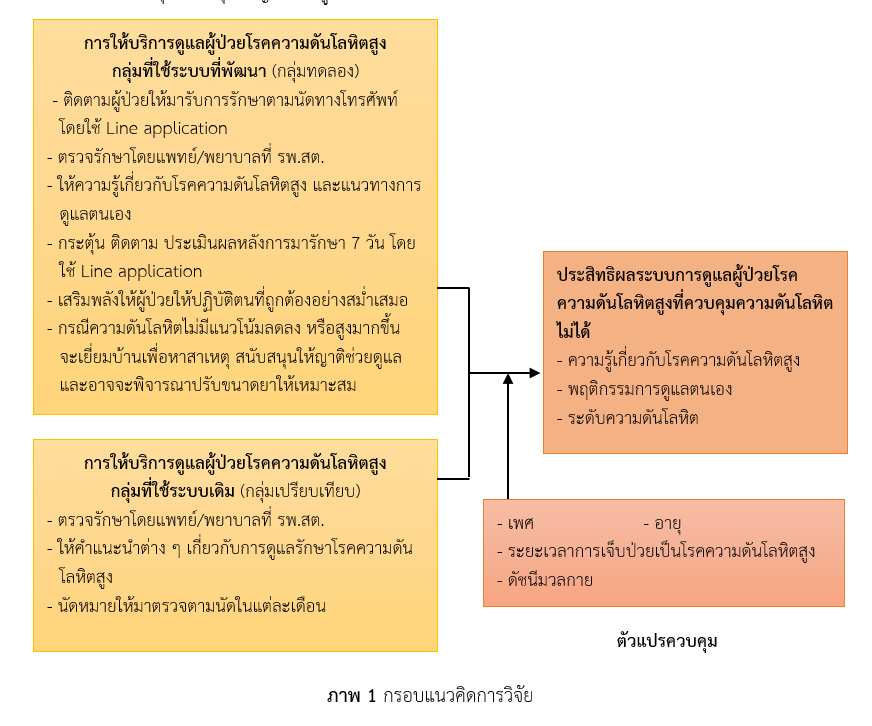
The objectives of this research and development were to develop caring system for uncontrolled blood pressure patients, study effectiveness of caring system for hypertension patient, and to study satisfaction with hypertension caring system that has been developed of Tumbol Health Promoting Hospital (THPH), Bo Phloi District, Kanchanaburi Province. The samples were unknown cause of hypertension patients who couldn't control blood pressure level, had no complication with hypertension, and agreed to cooperate in research, amount 80 people, which were divided into 2 group; a used developed system group and original system group (treatment, gave advice on the condition of the patient, gave medicine, and made appointments to check), each group consisted of 40 people. Research tools were hypertension caring system, questionnaire , pre and post test, and blood pressure level record. Data was analyzed by descriptive statistic, Independent t-test and Paired sample t-test.
The developed caring system was to followed up patients for an appointment with line application, educate and evaluate self-care behaviors, gave medicine, provide advice on self-care practices, and follow up with line application by THPH staffs after 7 days of treatment during the first 2 months, In the third month, if the patient was not able to control blood pressure, It would be visit home to find the cause and encourage relatives to help take care and consider adjusting the drug appropriately. The results of developed system found that after using the developed system, it made uncontrolled blood pressure patients to improve knowledge about hypertension disease and self care behavior and blood pressure level decreased (both systolic and diastolic blood pressure) by statistical significance (p-value < 0.001). The comparison of developed system and original system revealed that developed system group had more hypertension knowledge and had better self care behavior than original system group, and blood pressure level more decreased than original system group (both systolic and diastolic blood pressure) by statistical significance (p-value < 0.001). Moreover, 97.5% of users had satisfaction regarding to developed caring system at high level.
According to the results showed that the developed caring system had good effectiveness and high patient satisfied. So there should be used in other THPHs.
References
Binibbroheng, J., Niyomdecha, S., Nualpakdee, A. (2012). Efficacy of Behavior Program with Telephone Follow-Up for Hypertension Patients. Research Report. (in Thai).
Blood Pressure Association of Thailand. (2015). Guidelines for the Treatment of Hypertension in General Practice 2012, Revised Version 2015. Retrieved April 12, 2020 Available from: http://www. pharcpa.com/files/
Bo Phloi District Public Health Office. (2019). Statistics of Non-Communicable Disease Patients in Bo Phloi District, Kanchanaburi Province. Report paper.
Burbank, P. M., Reibe, D., C. A. & Nigg, C. (2002). Exercise and Older Adults: Changing Behavior with the Transtheoretical Model. Orthopedic Nursing, 21(4), 51-63.
Center for Continuing Pharmaceutical Education. (2020). The 1st Academic Conference of Pharmacy Society of Thailand 2020, on "High Blood Pressure: What to Know and Need to Know". Retrieved August 2, 2020 Available from: https://ccpe.pharmacy council.org/ index.php?option =seminar_detail& subpage=seminar_detail&id=3115
Department of Disease Control. (2011). Risk Behavior Survey, Non-Communicable Diseases and Injuries. Retrieved April 12, 2020 Available from: http://thaincd.com/information statistic/injureddata. Php
Dey, K. P., & Hariharan, S. (2006). Integrated Approach to Healthcare Quality Management: A Case Study. The TQM Magazine, 18(6), 583-605.
Jone, H. (2013). Changes in Diabetes Self-Care Behaviors Make a Difference in Glycemic Control : the Diabetes Stages of Change (DiSC) Study. Diabetes Care, 26, 732-737.
Kanchanaburi Public Health Office. (2019). Hypertension Patients Report. Kanchanaburi: kanchanaburi Public Health Office.
La-ongphon, B. (1990). The Relationship Between Perceived Self-Efficacy and Outcome Expectancy, and Health Practices in Patients with Opened Fracture of Lower Extremities After Receiving External Fixator. Master of Nursing Science Thesis in Adult Nursing, Prince of Songkla University.
Orem. D. E. (1995). Nursing Concepts of Practice. In K. M. Renpenning & S. G.Taylor (Eds.), (5th ed). St.Louis: Mosby Year Book.
Panatoop, S. (2019). The Caring System Development of Miss Appointment Diabetes Mellitus Patients. Research report. (in Thai).
Prochaska, J. O. Johnson, S. & Lee, P. (2009). The Transtheoretical Model of Behavior Change. in Shumaker, S A., Ockkrne, J. K. and Riekert, K. A. (ed), The Handbook of Health Behavior Change, 3rd ed. New York: Springer.
Puangpetch L. (2009). Self-Care Behavirors and Complications of Patients with Hypertentionospital. Region 6 Medical J, 23, 141-51.
Supimol, W. (2014). Health Behavior. Chon Buri: Faculty of Public Health, Burapha University.
Thai Hypertension Society. (2019). 2019 Thai Guidelines on The Treatment of Hypertension. Chiang Mai: trickthink
Thai Hypertension Society. (2020). 18th Annual Symposium, Thai Hypertension Society. Retrieved September 12, 2020 Available from: http://thaihypertension.org/files/452_1. Thai% 20Hypertension%20Conference%202020.pdf
Voraharn, A. (2018). The Self Care Model Development of Diabetes Mellitus Patients at Lao Khwan Hospital. Research Report. (in Thai).
Downloads
Published
Issue
Section
License
- บทความหรือข้อคิดเห็นใด ๆ ที่ปรากฏในวารสารสภาการสาธารณสุขชุมชน ที่เป็นวรรณกรรมของผู้เขียน บรรณาธิการ ไม่จำเป็นต้องเห็นด้วย
- บทความที่ได้รับการตีพิมพ์ถือเป็นลิขสิทธิ์ของ วารสารสภาการสาธารณสุขชุมชน


