
Validity and Reliability of Self-Efficacy Questionnaire among Public Health Professionals for Perinatal Depressive Symptom Prevention in Women
Keywords:
Health Professional, Reliability, Self-Efficacy, Thailand, ValidityAbstract
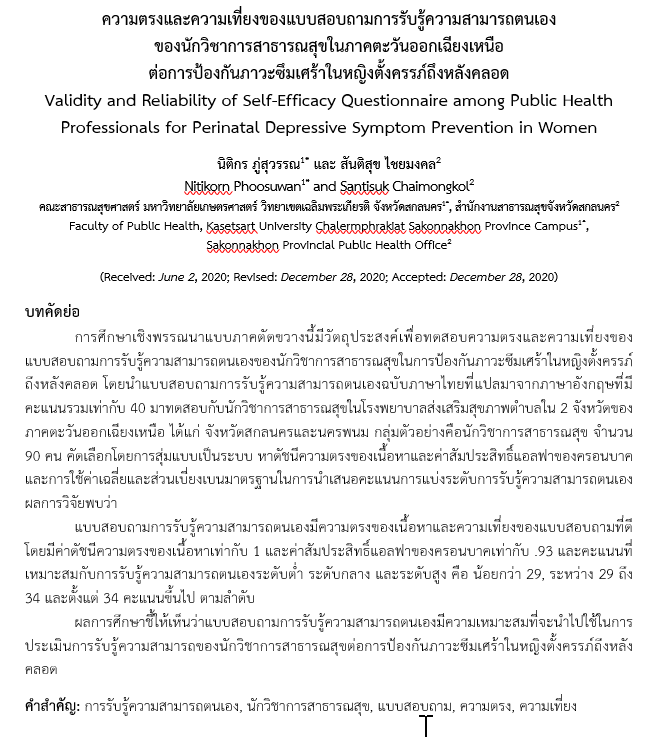
This cross-sectional descriptive study aimed to examine validity and reliability of self-efficacy questionnaire among public health professionals in the Northeast of Thailand for preventing perinatal and postpartum depression in women. The English version of the questionnaire (General Self-Efficacy Scale: GSE) was translated to Thai language as a Thai version with a total score of 40. The Thai version was then tested by 90 public health professionals, recruited by systematic random sampling, working at health promoting hospitals in two provinces, Sakonnakhon and Nakhonphanom. Content validity and reliability (Cronbach’s alpha coefficient) were employed to test the quality of the questionnaire. Mean and standard deviation were used to classify the levels of the self-efficacy scale.
The results demonstrated that the Thai version of questionnaire had the score of content validity index (CVI) =1 and Cronbach’s alpha coefficient for the whole questionnaire = 0.93. In addition, the suggested scores to classify the self-efficacy levels of low, middle and high were <29, 29-34 and >34 respectively.
It could be seen that the Thai version questionnaire is appropriate to be used for measuring self-efficacy of public health professionals for preventing perinatal and postpartum depression in women
References
Bandura, A. (1986). The explanatory and predictive scope of self-efficacy theory. Journal of Social and Clinical Psychology, 4, 359-373.
Brummelte, S., & Galea, L. A. (2016). Postpartum depression: Etiology, treatment and consequences for maternal care. Hormones and Behavior, 77, 153-166.
Davis, L. L. (1992). Instrument review: Getting the most from a panel of experts. Applied Nursing Research, 5, 194-197.
Kamiru, H. N., Ross, M. W., Bartholomew, L. W., McCurdy, S. A., & Kline, M. W. (2009). Effectiveness of a training program to increase the capacity of health care providers to provide HIV/AIDS care and treatment in Swaziland. Aids Care, 21(11), 1463-1470.
Mutamba, B. B., Van Ginneken, N., Smith, P. L., Wandiembe, S., & Schellenberg, D. (2013). Roles and effectiveness of lay community health workers in the prevention of mental, neurological and substance use disorders in low and middle income countries: a systematic review. BMC Health Services Research, 13, 412.
Phoosuwan, N., Eriksson, L., & Lundberg, P. C. (2018). Antenatal depressive symptoms during late pregnancy among women in a North-eastern province of Thailand: prevalence and associated factors. Asian Journal of Psychiatry, 36, 102-107.
Pusuwan, P., Phoosuwan, N., Phoosuwan, N., Loekdee, C., & Nildasri, P. (2019). A cross-sectional study on the prevalence and factors related to anxiety among pregnant women in north-eastern province of Thailand. In: The International conference on psychology, language and teaching (ICPLT) 2019, London, United Kingdom.
Schwarzer R, & Jerusalem M. (1995). Generalized Self-Efficacy Scale. In J. Weinman, S. Wright & M. Johnston (Ed.), Measures in health psychology: A user’s portfolio. Causal and control beliefs. Windsor, UK: Nfer-Nelson.
Sukmak, V., Sirisoonthon, A., & Meena, P. (2001). Validity of the General Perceived Self-efficacy scale. Journal of Psychiatry Association of Thailand, 47(1), 31-17.
United Nations. (2017). Health - United Nations Sustainable Development. Retrieved 16 November 2018, from http://www.un.org/sustainabledevelopment/health/
Ministry of Public Health. (2016). Guideline on primary care cluster of health service units. Nonthaburi: Strategic and planning division.
Kraiwan, Y. (2008). Appropriate statistics selection. Bangkok: Bangkok Media Support Center.
International Health Policy Program Foundation. (2017). Disease burden and injuries in Thai population report. Nonthaburi: The graphico system.
Downloads
Published
Issue
Section
License
- บทความหรือข้อคิดเห็นใด ๆ ที่ปรากฏในวารสารสภาการสาธารณสุขชุมชน ที่เป็นวรรณกรรมของผู้เขียน บรรณาธิการ ไม่จำเป็นต้องเห็นด้วย
- บทความที่ได้รับการตีพิมพ์ถือเป็นลิขสิทธิ์ของ วารสารสภาการสาธารณสุขชุมชน


