
Potential development model of the elderly's caregivers with participation of the community network Pa Sao, Muang, Uttaradit
Keywords:
Caregivers, Potential development model, Community NetworkAbstract
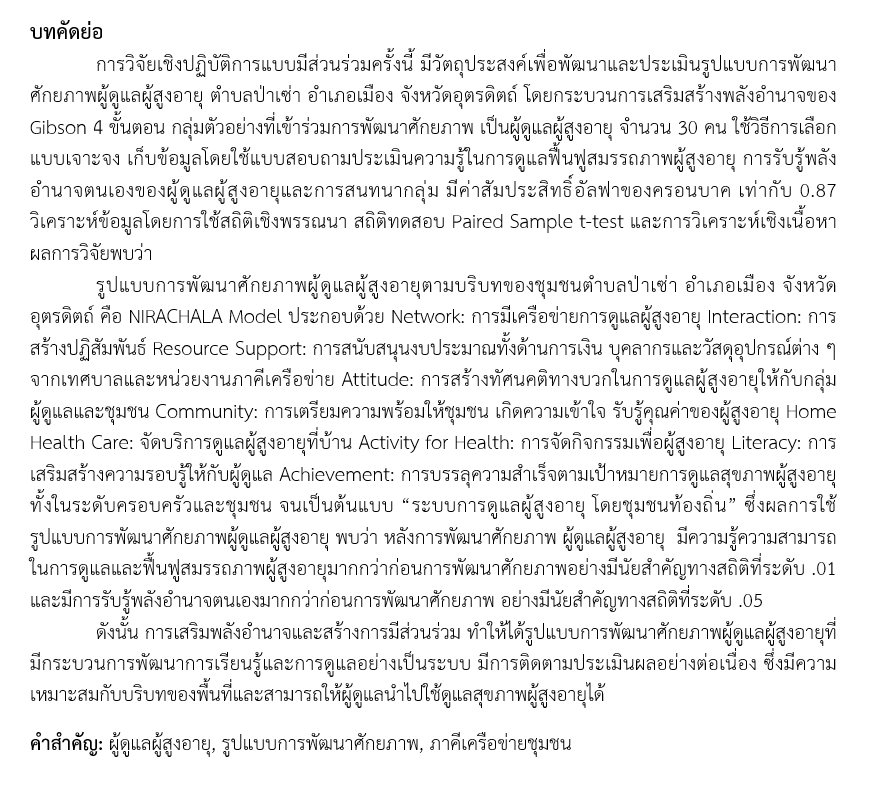
This participatory action research (PAR) aimed to develop and evaluate the potential development model of the elderly caregivers at Pa Sao sub-district, Muang district, Uttaradit province by using Gibson’s four empowerment procedures. Participants were 30 elderly caregivers recruited by purposive sampling. Quantitative data were collected in 2 parts; 1) caregivers’ knowledge and rehabilitation skills of the elderly; and 2) caregivers’ self-efficacy (Cronbach's alpha coefficient=0.87), while qualitative data were collected by focus groups. Descriptive statistics and paired t-test were used to analyze quantitative data and content analysis was used to analyze qualitative data.
The results revealed that the potential model developed according to the community context of Pa Sao sub-district, Muang district, Uttaradit province was called “NIRACHALA Model” standing for Network (having the elderly care networks), Interaction (having the interaction within networks), Resource support (having budget, personnel and material support from municipalities and associated networks), Attitude (creating positive attitudes of the elderly caregivers and community), Community (preparing knowledge and value awareness of the community), Home Health Care (organizing the elderly home care services), Activity for Health (organizing activities for enhancing elderly health), Literacy (enhancing knowledge of the caregivers), and Achievement (achieving the ultimate goals set of the elderly care in both family and community leading to be role model of the elderly care system participated by local community). The evaluation of the model showed that after using the model, the elderly caregivers improved their knowledge and rehabilitation skills to take care of the elderly, and also enhanced their self-efficacy significantly higher than before using the model (p<0.01 and p<0.05 respectively)
Consequently, the empowerment procedure and community participation employing to develop the effective and systematic model for improving potential of the elderly caregivers, and also continuous monitoring and evaluation of the caregivers’ potential according to the community context can be appropriate and practical to use as the area-based for taking care of the elderly health.
References
ช่วยเหลือตนเองไม่ได้ ตำบลหนองหัวแรด อำเภอหนองบุญมาก จังหวัดนครราชสีมา.
วิทยานิพนธ์สาธารณสุขศาสตรมหาบัณฑิต สาขาการพัฒนาสุขภาพชุมชน. มหาวิทยาลัยราชภัฏ
นครราชสีมา.
เนตรนิภา จันตระกูลชัย. 2557. ผลลัพธ์ของการใช้โปรแกรมการเสริมสร้างพลังอำนาจในผู้ป่วยโรค
ความดันโลหิตสูงที่ควบคุมไม่ได้. วิทยานิพนธ์ พย.ม., มหาวิทยาลัยคริสเตียน: กรุงเทพมหานคร.
ปราโมทย์ ประสาทกุล. (2559). สถานการณ์ผู้สูงอายุไทย ผู้สูงอายุโลกกับการเตรียมการรับมือสังคม
ผู้สูงอายุของประเทศไทย. สถาบันวิจัยประชากรและสังคม มหาวิทยาลัยมหิดล.
วิพรรณ ประจวบเหมาะ. (2558). รายงานคณะกรรมการปฏิรูประบบรองรับการเข้าสู่สังคมผู้สูงอายุของ
ประเทศไทย. กรุงเทพมหานคร. วิทยาลัยประชากรศาสตร์ จุฬาลงกรณ์มหาวิทยาลัย.
สำนักงานสถิติจังหวัดอุตรดิตถ์. (2558). รายงานการสำรวจประชากรผู้สูงอายุในประเทศไทย พ.ศ.
2556-2558 จังหวัดอุตรดิตถ์. กรุงเทพฯ : สำนักงานสถิติพยากรณ์ สำนักงานสถิติแห่งชาติ.
Gibson, C. H. (1991). A concept analysis of empowerment. Journal of Advanced
Nursing, 16 : 354-361
Downloads
Published
Issue
Section
License
- บทความหรือข้อคิดเห็นใด ๆ ที่ปรากฏในวารสารสภาการสาธารณสุขชุมชน ที่เป็นวรรณกรรมของผู้เขียน บรรณาธิการ ไม่จำเป็นต้องเห็นด้วย
- บทความที่ได้รับการตีพิมพ์ถือเป็นลิขสิทธิ์ของ วารสารสภาการสาธารณสุขชุมชน


