
The Relationship between Personal Factors and Health Literacy in Preventing Renal Function Decline among patients with Chronic Kidney Disease
Keywords:
Health literacy, Chronic kidney disease, Chronic kidney disease prevention/controlAbstract
Introduction: Renal function deterioration is often caused by a lack of health knowledge and preventive awareness.
Objective: This correlational research aimed to examine the relationship between personal factors and health literacy for chronic kidney disease (CKD) prevention.
Methods: The study involved 122 patients with CKD stages 1–3, selected based on clinical diagnosis, glomerular filtration rate (GFR), or urine microalbumin levels. Research instruments included a personal information questionnaire and a 6-domain Health Literacy Scale. The tools were validated by experts, with Cronbach’s alpha ranging from .75 to .95 and a KR–20 of .74 Data were analyzed using descriptive statistics and the Chi-square test.
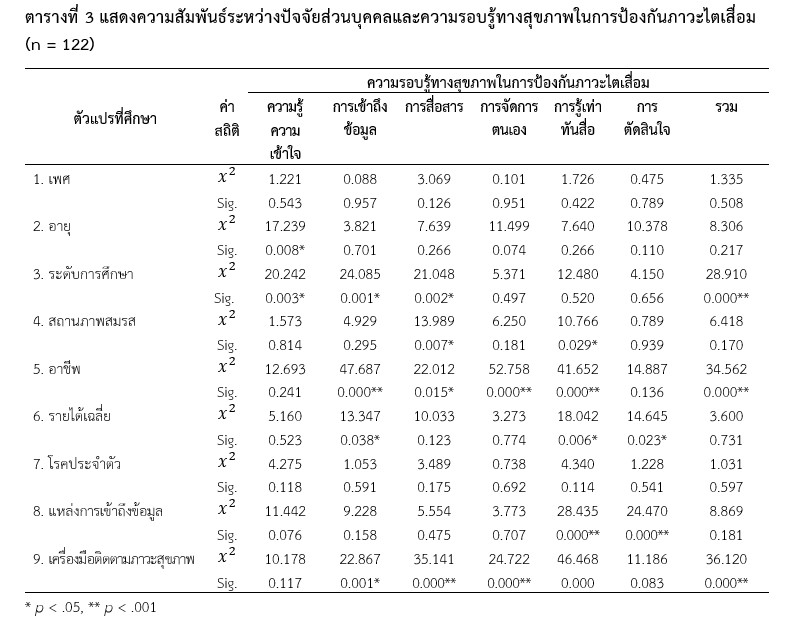
Results: Overall health literacy was at a low level (58.20%). The functional literacy domain had the lowest score (56.56%), followed by media literacy (63.11%), while the decision-making domain was mostly at a high level (62.30%). Personal factors significantly related to overall health literacy (p < .001) included educational level, occupation, and the use of health monitoring devices.
Conclusion: Enhancing health literacy should prioritize patients with low educational and income levels. Interventions should focus on developing skills for using health monitoring devices to effectively delay the progression of kidney disease.
References
จักรกฤษณ์ วังราษฎร์, กิตติพันธุ์ ฤกษ์เกษม, สุวินัย แสงโย, ศศิณัฏฐ์ พงษ์ธรรม, และนิภาภรณ์ ปิ่นมาศ. (2561). ปัจจัยทำนายพฤติกรรมการบริโภคอาหารของผู้ป่วยโรคไตวายเรื้อรังระยะสุดท้ายที่ได้รับการฟอกเลือดด้วยเครื่องไตเทียม ณ โรงพยาบาลมหาราชนครเชียงใหม่. วารสารวิจัยระบบสาธารณสุข, 12(4), 625–635.
ณิชมน หลำรอด, เอนกพงศ์ ฮ้อยคำ, วดีรัตน์ ศรีวงศ์วรรณ, เสน่ห์ คล้ายบัว, และ ธนะวัฒน์ รวมสุก. (2566). ความสัมพันธ์ระหว่างปัจจัยส่วนบุคคลและปัจจัยทางสังคมกับความรอบรู้ด้านสุขภาพในการป้องกันโรคหลอดเลือดสมองของกลุ่มเสี่ยงโรคหลอดเลือดสมองอายุ 35 ปีขึ้นไปในจังหวัดนนทบุรี. วารสารการพยาบาลและการศึกษา, 16(2), 28–39.
ปนัดดา สวัสดี, นัทธมน วุทธานนท์, และ ประทุม สร้อยวงค์. (2565). ปัจจัยที่เกี่ยวข้องกับการเลือกวิธีการรักษาของผู้เป็นโรคไตเรื้อรังระยะก่อนการบำบัดทดแทนไต. พยาบาลสาร มหาวิทยาลัยเชียงใหม่, 49(4), 151–162.
Cohen, J. (1988). Statistical power analysis for the behavioral sciences (2nd ed.). Lawrence Erlbaum Associates.
Coughlin, S. S., Vernon, M., Hatzigeorgiou, C., & George, V. (2020). Health literacy, social determinants of health, and disease prevention and control. Journal of Environment and Health Sciences, 6(1), 30–61.
Gonçalves-Fernández, M. L., & Pino-Juste, M. (2025). Health literacy in healthy adults: A systematic review of recent evidence. Atención Primaria, 57(11), 103300. https://doi.org/10.1016/j.aprim.2025.103300
Nutbeam, D. (2008). The evolving concept of health literacy. Social Science & Medicine, 67(12), 2072–2078. https://doi.org/10.1016/j.socscimed.2008.09.050
World Health Organization. (2021, September 16). Noncommunicable diseases. https://www.who.int/news-room/fact-sheets/detail/noncommunicable-diseases
Downloads
Published
How to Cite
Issue
Section
License
Copyright (c) 2025 Journal of Nursing, Siam University

This work is licensed under a Creative Commons Attribution-NonCommercial-NoDerivatives 4.0 International License.
Content and information published in the Journal of Nursing, Siam University is the comment and responsibility of the authors.
Articles, information, images, etc. published in the Journal of Nursing. Siam University is the copyright of the Journal of Nursing, Siam University. If any person or entity wants to take all or part of it for publication for any purposes, please reference the Journal of Nursing, Siam University.

