
Effects of a Dietary Control Program on Eating Behavior and Blood Sugar Levels among Uncontrolled Type 2 Diabetic Patients in Khok Charoen District, Lopburi Province
Keywords:
Type 2 diabetes mellitus, diet control, glycemic controlAbstract
This study aimed to examine the effects of a dietary control program on eating behaviors and blood glucose levels among patients with uncontrolled type 2 diabetes mellitus in Khok Charoen District, Lopburi Province. A quasi-experimental design with two groups was employed. The sample consisted of 60 patients with uncontrolled type 2 diabetes mellitus selected using simple random sampling and equally assigned to an experimental group (n = 30) and a control group (n = 30). The intervention was implemented over a 12-week period. Data were collected using questionnaires administered before and after the intervention. Descriptive statistics, including frequency, percentage, mean, and standard deviation, were used for data analysis. The independent t-test was used to compare mean scores between groups, while the paired t-test was used to compare mean scores within groups.
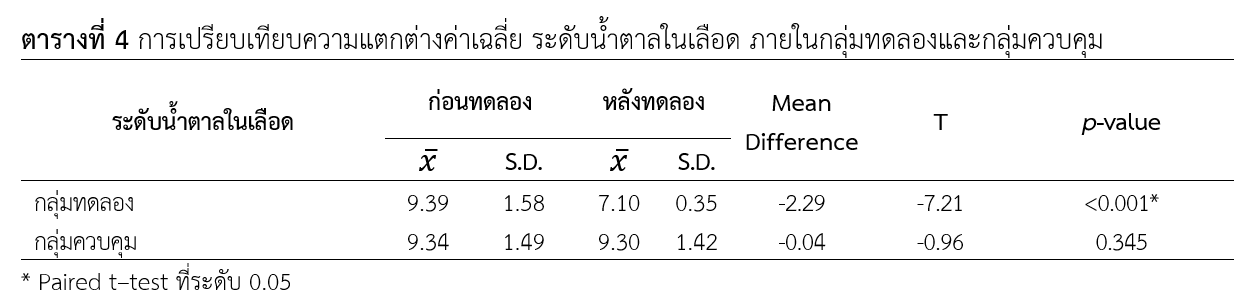
The results showed that the majority of participants in the experimental and control groups were female, accounting for 73.33% and 70.00%, respectively. The mean ages were 59.33 ± 9.31 years and 62.87 ± 8.79 years, respectively. After the intervention, the experimental group demonstrated significantly higher eating behavior scores compared to both baseline and the control group (p < 0.05). In addition, blood glucose levels in the experimental group were significantly lower than both pre-intervention levels and those of the control group (p < 0.05). In conclusion, the dietary control program effectively improved eating behaviors and enhanced glycemic control among patients with uncontrolled type 2 diabetes mellitus. Therefore, provincial and regional public health agencies should support the continuous implementation of such programs and integrate them into existing diabetes care services to promote patients’ knowledge and self-management skills.
References
กฤตกร หมั่นสระเกษ, ทัศนีย์ รวิวรกุล และสุนีย์ ละกำปั่น. (2562). ผลของโปรแกรมการจัดการตนเองต่อการควบคุมระดับน้ำตาลในเลือด ของผู้ป่วยเบาหวานชนิดที่ 2 ที่ใช้อินซูลิน. วารสารสุขภาพและการศึกษาพยาบาล, 25(2), 87–103.
ดวงมณี วิยะทัศน์ และอุไร ศิลปะกิจโกศล. (2561). ผลของโปรแกรมการจัดกิจกรรมกลุ่มเรียนรู้ต่อพฤติกรรมสุขภาพ และระดับน้ำตาลสะสมในเลือดของผู้ป่วยโรคเบาหวานชนิดที่ 2 ที่ไม่สามารถควบคุมระดับน้ำตาลในเลือดได้ในคลินิกโรคเบาหวาน โรงพยาบาลพนมสารคาม. วารสารการปฏิบัติการพยาบาลและการผดุงครรภ์ไทย, 5(2), 39–54.
ทรงกรฎ ศฤงคาร, มยุรี นิรัตธราดร และปรีย์กมล รัชนกุล. (2563). ผลของโปรแกรมส่งเสริมการจัดการตนเองและครอบครัวต่อพฤติกรรมการควบคุมระดับน้ำตาลและระดับน้ำตาลในเลือดของผู้ป่วยโรคเบาหวานชนิดที่ 2 [วิทยานิพนธ์ปริญญามหาบัณฑิต]. มหาวิทยาลัยธรรมศาสตร์.
ธมภร โพธิรุด, สุมิตรา พรานฟาน และกวิสรา สงเคราะห์. (2563). ผลของโปรแกรมสนับสนุนการจัดการตนเองต่อพฤติกรรมการจัดการตนเอง และระดับฮีโมโกลบินเอวันซีของผู้เป็นเบาหวานชนิดที่ 2 โรงพยาบาลเชียงกลาง จังหวัดน่าน. วารสารพยาบาล, 6(2), 11–20.
พงเดษ์เดช สารการ. (2558). ชีวสถิติพื้นฐานและการวิเคราะห์ข้อมูล: STATA10. พิมครั้งที่ 1. โรงพิมพ์มหาวิทยาลัยขอนแก่น.
วรางคณา บุตรศรี, รัตนา บุญพา และชาญณรงค์ สิงห์บรรณ. (2564). ผลของโปรแกรมการให้ความรู้ต่อพฤติกรรมการดูแลตนเองและการควบคุมระดับน้ำตาลในเลือดในผู้ป่วยเบาหวานชนิดที่ 2 ที่ควบคุมระดับน้ำตาลในเลือดไม่ได้. วารสารวิชาการ มหาวิทยาลัยการจัดการและเทคโนโลยีอีสเทิร์น, 18(1), 13–25.
วัชราภรณ์ นาฬิกุล, ลำไพร แทนสา และสุรภา พิลาออน. (2563). ผลของโปรแกรมสนับสนุนการจัดการตนเองต่อการควบคุม ระดับน้ำตาลในเลือดของผู้ป่วยเบาหวานที่ควบคุมระดับน้ำตาลไม่ได้ โรงพยาบาลเปือยน้อย จังหวัดขอนแก่น. วารสารสำนักงานสาธารณสุขจังหวัดขอนแก่น, 2(1), 77–90.
วีรชัย ศรีวณิชชากร. (2566). การป้องกันโรคเบาหวานสำหรับประเทศไทย. วารสารวิชาการสาธารณสุข, 31(2), 363–375.
ศิริมา ลีละวงศ์, ธีรพร สถิรอังกูร และยุรีพรรณ วณิชโยบล. (2564). รูปแบบการพยาบาลในการสร้างเสริมการจัดการสุขภาพตนเองของกลุ่มผู้ป่วยที่ต้องการการดูแลแบบระยะยาวและผู้ดูแล (พิมพ์ครั้งที่ 1). กองการพยาบาล กระทรวงสาธารณสุข.
อติญาณ์ ศรเกษตริน, จินตนา ทองเพชร, จุไรรัตน์ ดวงจันทร์ และนงณภัทร รุ่งเนย. (2566). ประสิทธิผลของโปรแกรมสร้างเสริมสุขภาพร่วมกับ การสนับสนุนการจัดการตนเอง ต่อพฤติกรรมการจัดการ ตนเอง และผลลัพธ์ทางคลินิกของผู้ป่วยโรคเบาหวาน ชนิดที่ 2 ร่วมกับความดันโลหิตสูงที่ควบคุมไม่ได้. วารสารวิชาการสาธารณสุข, 32(2), 299–311.
อ้อมฤทัย มั่นในบุญธรรม. (2562). ผลของโปรแกรมปรับเปลี่ยนพฤติกรรมโดยการเสริมสร้างความรอบรู้ด้านสุขภาพในการควบคุมระดับน้ำตาลในเลือดและชะลอไตเสื่อม ของผู้ป่วยเบาหวานชนิดที่ 2 โรงพยาบาลส่งเสริมสุขภาพตำบลสำราญ. วารสารสำนักงานสาธารณสุขจังหวัดขอนแก่น, 1(2), 121–132.
Aboelnasr, M. S., Shaltout, A. K., AlSheikh, M. R., Abdelhameed, A. H., & Elrefaey, W. (2020). Diabetic kidney disease in patients newly diagnosed with type-2 diabetes mellitus: Incidence and associations. Saudi Journal of Kidney Diseases and Transplantation, 31(1), 191–199.
Albargawi, M., Snethen, J., Al Gannass, A., & Kelber, S. (2017). Relationship between person’s health beliefs and diabetes self-care management regimen. Journal of Vascular Nursing, 35(4), 187–192.
American Diabetes Association. (2019). 16. Diabetes advocacy: Standards of medical care in diabetes—2019. Diabetes Care, 42(Supplement_1), S182–S183.
American Diabetes Association. (2022). Standards of medical care in diabetes—2022 abridged for primary care providers. Clinical Diabetes, 40(1), 10–38.
Angkana sateintavon. (2023). Factors Associated with Health Promotion Behaviors of Diabetes Risk Groupsin Phak Than Subdistrict. STOU Academic Journal of Research and Innovation (Humanities and Social Science)(Online), 3(1), 56–67.
Health Data Center. (2567). อัตราการป่วยด้วยโรคเบาหวาน ปีงบประมาณ 2564-2566. https://hdcservice.moph.go.th/
International Diabetes Federation. (2021). Diabetes around the world in 2021. https://diabetesatlas.org/
Kanfer, R., Ackerman, P. L., & Heggestad, E. D. (1996). Motivational skills & self-regulation for learning: A trait perspective. Learning and Individual Differences, 8(3), 185–209.
Nejhaddadgar, N., Darabi, F., Rohban, A., & Solhi, M. (2019). The effectiveness of self-management program for people with type 2 diabetes mellitus based on PRECEDE-PROCEDE model. Diabetes & Metabolic Syndrome: Clinical Research & Reviews, 13(1), 440–443.
Pamungkas, R. A., & Chamroonsawasdi, K. (2020). Self-management based coaching program to improve diabetes mellitus self-management practice and metabolic markers among uncontrolled type 2 diabetes mellitus in Indonesia: A quasi-experimental study. Diabetes & Metabolic Syndrome: Clinical Research & Reviews, 14(1), 53–61.
Wu, J., Lin, Z., Liu, Z., He, H., Bai, L., & Lyu, J. (2020). Secular trends in the incidence of eating disorders in China from 1990 to 2017: A joinpoint and age–period–cohort analysis. Psychological Medicine, 1–11. Cambridge Core. https://doi.org/10.1017/S0033291720002706
Zhao, L., Ciallella, H. L., Aleksunes, L. M., & Zhu, H. (2020). Advancing computer-aided drug discovery (CADD) by big data and data-driven machine learning modeling. Drug Discovery Today, 25(9), 1624–1638.
Downloads
Published
How to Cite
Issue
Section
License
Copyright (c) 2026 Journal of Nursing, Siam University

This work is licensed under a Creative Commons Attribution-NonCommercial-NoDerivatives 4.0 International License.
Content and information published in the Journal of Nursing, Siam University is the comment and responsibility of the authors.
Articles, information, images, etc. published in the Journal of Nursing. Siam University is the copyright of the Journal of Nursing, Siam University. If any person or entity wants to take all or part of it for publication for any purposes, please reference the Journal of Nursing, Siam University.

