
ผลของสื่อการเรียนรู้เชิงโต้ตอบเรื่องการพยาบาลผู้ที่มีภาวะแพนิคต่อความรู้ ประสิทธิภาพการเรียนรู้ และความพึงพอใจของนักศึกษาพยาบาล
คำสำคัญ:
การเรียนรู้เชิงโต้ตอบ, การพยาบาลผู้ที่มีภาวะแพนิค, นักศึกษาพยาบาล, ความรู้, ประสิทธิภาพการเรียนรู้บทคัดย่อ
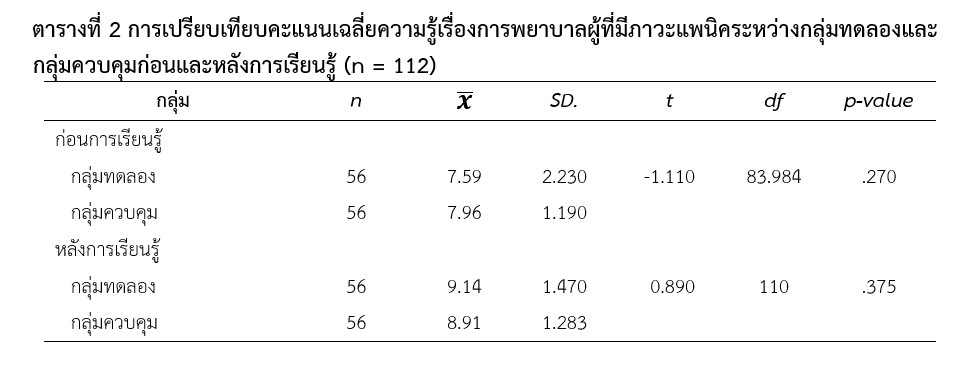
การวิจัยกึ่งทดลองครั้งนี้ มีวัตถุประสงค์เพื่อศึกษาผลของสื่อการเรียนรู้เชิงโต้ตอบเรื่องการพยาบาลผู้ที่มีภาวะแพนิคต่อความรู้ ประสิทธิภาพการเรียนรู้และความพึงพอใจของนักศึกษาพยาบาล กลุ่มตัวอย่างเป็นนักศึกษาพยาบาลชั้นปีที่ 4 จำนวน 112 คน แบ่งเป็นกลุ่มทดลองและกลุ่มควบคุมกลุ่มละ 56 คน เครื่องมือวิจัยประกอบด้วย สื่อการเรียนรู้เชิงโต้ตอบเรื่องการพยาบาลผู้ที่มีภาวะแพนิค แบบประเมินความรู้เกี่ยวกับการพยาบาลผู้ที่มีภาวะแพนิค และ แบบสอบถามประสิทธิภาพและความพึงพอใจในการเรียนรู้ วิเคราะห์ข้อมูลโดยใช้สถิติพรรณาและการทดลองทีแบบก่อนและหลัง และระหว่างกลุ่ม ผลการวิจัยพบว่า กลุ่มทดลอง (M = 9.14, SD = 1.47) และกลุ่มควบคุม (M = 8.91, SD = 1.28) มีคะแนนความรู้หลังการเรียนรู้สูงกว่าก่อนเรียนรู้อย่างมีนัยสำคัญทางสถิติ (p < .001) แต่คะแนนความรู้หลังการเรียนรู้ทั้งสองกลุ่มแตกต่างกันอย่างไม่มีนัยสำคัญทางสถิติ กลุ่มตัวอย่างมีความคิดเห็นต่อประสิทธิภาพและความพึงพอใจในการเรียนรู้โดยรวมอยู่ในระดับมาก (M = 4.67, SD = 0.36; M = 4.59, SD = 0.55) แสดงให้เห็นว่าสื่อการเรียนรู้เชิงโต้ตอบมีประสิทธิผลในการส่งเสริมประสิทธิภาพการเรียนรู้ และสร้างความพึงพอใจในการเรียนรู้ของนักศึกษาพยาบาล อันเป็นแนวทางในการพัฒนาสื่อการเรียนรู้ที่ตอบสนองการเรียนการสอนด้านการพยาบาลในศตวรรษที่ 21
เอกสารอ้างอิง
กรมสุขภาพจิต. (2567). รายงานประจำปีกรมสุขภาพจิต ปีงบประมาณ 2567. นนทบุรี: กรมสุขภาพจิต.
ก้องเกียรติ หิรัญเกิด, ณัฐปคัลภภ์ กิตติสุนทรพิศาล, และพรสวรรค์ อมรศักดิ์ชัย. (2566). การพัฒนาสื่อเทคโนโลยีความจริงเสริมเพื่อพัฒนาทักษะการคิดของนักศึกษาระดับอุดมศึกษา. วารสารสังคมศาสตร์และมนุษยศาสตร์แห่งรัตนโกสินทร์, 5(3), 10–24.
จีราภรณ์ ชื่นฉ่ำ, ประไพ กิตติบุญถวัลย์, และดวงดาว อุบลแย้ม. (2563). ผลของการใช้บทเรียนอีเลิร์นนิงแบบปฏิสัมพันธ์ เรื่องการตรวจสุขภาพนักเรียนต่อผลสัมฤทธิ์ทางการเรียนของนักศึกษาพยาบาล. วารสารวิจัยสุขภาพและการพยาบาล, 36(2), 234–242.
ตรีนุช พุ่มมณี, จุฑามาศ สุวรรณวัฒน์, กรวิกา บวชชุม, อรวรรณ หนูแก้ว, พิเชษฐ์ สุวรรณจินดา, และภัทราภรณ์ วรสิรินารา. (2566). ผลของสื่อวีดิทัศน์การสอนเรื่องการตรวจสภาพจิตร่วมกับการเรียนรู้โดยใช้กรณีศึกษาต่อความรู้ ความมั่นใจ และความพึงพอใจของนักศึกษาพยาบาลหลักสูตรพยาบาลศาสตรบัณฑิตในรายวิชาปฏิบัติการพยาบาลสุขภาพจิตและจิตเวช. วารสารวิจัยทางการพยาบาล การผดุงครรภ์และวิทยาศาสตร์สุขภาพ, 43(1), 67–79.
ทศา ชัยวรรณวรรต. (2560). บทบาทของพยาบาลจิตเวชในการส่งเสริมสุขภาพจิตและการป้องกันการเจ็บป่วยทางจิต. วารสารการพยาบาลสุขภาพจิตและจิตเวช, 31(2), 16–30.
ธณัชช์นรี สโรบล, นิตยา บุญลือ, สมพร สิทธิสงคราม, และ สุมิตรพร จอมจันทร์. (2563). การพัฒนาสื่อมัลติมีเดียเรื่องการสื่อสารเพื่อการบำบัดทางการพยาบาลจิตเวช. วารสารมหาจุฬานาครทรรศน์, 7(12), 253–263.
มาณี น้าคณาคุปต์, และพิไลวรรณ ใจชื้น. (2565). ผลของการใช้สื่อวีดิทัศน์แบบมีปฏิสัมพันธ์เรื่องการทำคลอด ต่อความรู้ความมั่นใจ ทักษะปฏิบัติการทำคลอด และความพึงพอใจต่อสื่อวีดิทัศน์ของนักศึกษาพยาบาลศาสตรบัณฑิต. วารสารสภาการพยาบาล, 37(2), 82–94.
รัญชนา หน่อคำ, จุฑามาศ กิติศรี, และญาณวุฒิ ไชยโย. (2562). ความคิดเห็นของนักศึกษาต่อการใช้ระบบโต้ตอบในชั้นเรียนผ่านเว็บไซต์คณะพยาบาลศาสตร์ วิทยาลัยเชียงราย. วารสารอิเล็กทรอนิกส์ Veridian มหาวิทยาลัยศิลปากร (มนุษยศาสตร์ สังคมศาสตร์ และศิลปะ), 12(5), 790–810.
วัลลภา ทรงพระคุณ, นุชยงค์ เยาวพานนท์, และกาญจนา ใจจ้อย. (2567). การจัดการเรียนรู้เชิงรุกสำหรับนักศึกษาพยาบาล Generation ใหม่สู่สมรรถนะพยาบาลจบใหม่. วารสารพยาบาลทหารบก, 26(1), 1–9.
สภาการพยาบาล. (2563). ประกาศสภาการพยาบาล เรื่อง สมรรถนะหลักของผู้สำเร็จการศึกษาระดับปริญญาตรี ปริญญาโท ปริญญาเอก. สภาการพยาบาล.
Alharbi, A., Nurfianti, A., Mullen, R. F., McClure, J. D., & Miller, W. H. (2024). The effectiveness of simulation-based learning (SBL) on students’ knowledge and skills in nursing programs: A systematic review. BMC Medical Education, 24(1099). https://doi.org/10.1186/s12909-024-06080-z
American Psychiatric Association. (2022). Diagnostic and statistical manual of mental disorders (5th ed., text rev.; DSM-5-TR). American Psychiatric Association. https://doi.org/10.1176/appi.books.9780890425787
Cho, M.-K., & Kim, M. Y. (2024). The effect of virtual reality simulation on nursing students’ communication skills: A systematic review and meta-analysis. Frontiers in Psychiatry, 15, 1351123. https://doi.org/10.3389/fpsyt.2024.1351123
Faul, F., Erdfelder, E., Lang, A. G., & Buchner, A. (2007). G*Power 3: A flexible statistical power analysis program for the social, behavioral, and biomedical sciences. Behavior Research Methods, 39(2), 175–191. https://doi.org/10.3758/BF03193146
Fosnot, C. T. (2005). Constructivism: Theory, perspectives, and practice (2nd ed.). Teachers College Press
McIntosh, J. T. P. (2021). Emergency department nurses’ care of psychiatric patients: A scoping review. International Emergency Nursing, 54, 100929. https://doi.org/10.1016/j.ienj.2020.100929
Papola, D., Ostuzzi, G., Tedeschi, F., Gastaldon, C., Purgato, M., Del Giovane, C., & Barbui, C. (2023). CBT treatment delivery formats for panic disorder: A systematic review and network meta-analysis of randomized controlled trials. Psychological Medicine, 53(3), 614–624. https://doi.org/10.1017/S0033291721003669
Valdes, B., Salani, D., King, B., & De Oliveira, G. C. (2021). Recognition and treatment of psychiatric emergencies for health care providers in the emergency department: Panic attack, panic disorder, and adverse drug reactions. Journal of Emergency Nursing, 47(3), 459–468. https://doi.org/10.1016/j.jen.2021.01.004
Yıldız, E. (2021). What do nursing students tell us about their communication with people with mental illness? A qualitative study. Journal of the American Psychiatric Nurses Association, 27(6), 471–482. https://doi.org/10.1177/1078390319892311
ดาวน์โหลด
เผยแพร่แล้ว
รูปแบบการอ้างอิง
ฉบับ
ประเภทบทความ
สัญญาอนุญาต
ลิขสิทธิ์ (c) 2025 วารสารพยาบาลศาสตร์ มหาวิทยาลัยสยาม

อนุญาตภายใต้เงื่อนไข Creative Commons Attribution-NonCommercial-NoDerivatives 4.0 International License.
เนื้อหาและข้อมูลที่เผยแพร่ในวารสารพยาบาลศาสตร์ มหาวิทยาลัยสยามถือเป็นข้อคิดเห็นและความรับผิดชอบของผู้นิพนธ์บทความโดยตรง
บทความ เนื้อหา ข้อมูล รูปภาพ ฯลฯ ที่ได้รับการเผยแพร่ในวารสารพยาบาลศาสตร์ มหาวิทยาลัยสยาม ถือเป็นลิขสิทธิ์ของวารสารพยาบาลศาสตร์ มหาวิทยาลัยสยาม หากบุคคลหรือหน่วยงานใดต้องการนำทั้งหมดหรือส่วนหนึ่งส่วนใดไปเผยแพร่หรือเพื่อกระทำการใด ๆ จะต้องอ้างอิงวารสารพยาบาลศาสตร์ มหาวิทยาลัยสยามทุกครั้ง

