
Development of a Care Model for Patients with Chronic Kidney Disease Stages 3 in Chonnabot Hospital, KhonKaen Province
Keywords:
stage 3 chronic kidney disease, care model, chronic care model, Chonnabot hospitalAbstract
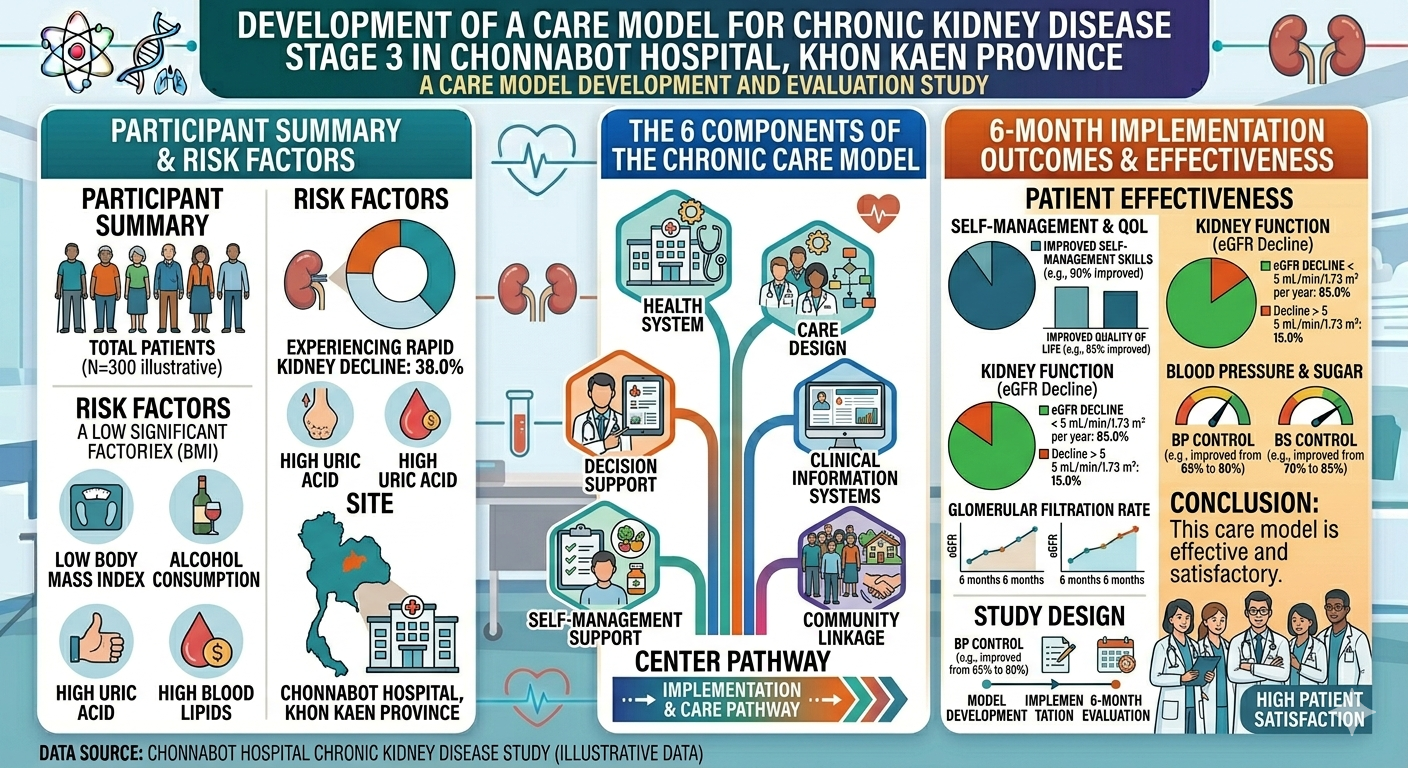
Background: Inadequate care of stage 3 chronic kidney disease patients leads to end-stage renal failure, affecting their quality of life and burdening the healthcare system. This study's objectives were: 1) to examine the current situation and factors related to kidney deterioration; 2) to develop a care model for stage 3 chronic kidney disease patients; and 3) to evaluate this model's implementation at a rural hospital in Khon Kaen Province.
Methods: The research and development occurred in four phases: Phase 1 involved situational assessment via interviews, focus groups, and medical record analysis; Phase 2 involved developing the care model; Phase 3 involved implementing the model and evaluating pre- and post-intervention outcomes; and Phase 4 involved assessing and validating model quality. The study sample included a multidisciplinary healthcare team, stage 3 chronic kidney disease patients, caregivers, and patient medical records. Quantitative data were analyzed using descriptive and inferential statistics, and qualitative data through content analysis.
Results: 38.0% of patients experienced rapid kidney function decline. Significant factors included low body mass index, alcohol consumption, high uric acid, and blood lipid levels. The model comprised six components based on the Chronic Care Model: health system, care design, decision support, clinical information systems, self-management support, and community linkage. Six months after implementation, patients showed improved self-management skills and quality of life. Glomerular filtration rate increased, with 85.0% of patients experiencing annual eGFR decline of less than 5 mL/min/1.73 m². Blood pressure and blood sugar control improved, and patient satisfaction was high.
Conclusion: The chronic care model effectively slows kidney disease progression and enhances patients’ quality of life. It can be applied to community hospitals in similar contexts.
References
Francis A, Harhay MN, Ong ACM, Tummalapalli SL, Ortiz A, Fogo AB, et al. Chronic kidney disease and the global public health agenda: an international consensus. Nat Rev Nephrol 2024;20:473-85. doi: 10.1038/s41581-024-00820-6..
Shrestha N, Gautam S, Mishra SR, Virani SS, Dhungana RR. Burden of chronic kidney disease in the general population and high-risk groups in South Asia: A systematic review and meta-analysis. PLoS One 2021;16:e0258494.
Luyckx VA, Cherney DZ, Bello AK. Preventing CKD in developed countries. Kidney Int Rep. 2020;5:263-77.
กมลทิพย์ วิจิตรสุนทรกุล. ระบาดวิทยาและการทบทวนมาตรการป้องกันโรคไตเรื้อรัง [อินเทอร์เน็ต]. 2566 [เข้าถึงเมื่อ 15 มี.ค. 2566]. เข้าถึงได้จาก: https://ddc.moph.go.th/uploads/publish/1308820220905025852.pdf
ระบบคลังข้อมูลด้านการแพทย์และสุขภาพ (HDC) สำนักงานสาธารณสุขจังหวัดขอนแก่น. สถิติผู้ป่วยโรคไตเรื้อรัง โรงพยาบาลชนบท จังหวัดขอนแก่น [อินเทอร์เน็ต]. 2567 [เข้าถึงเมื่อ 7 ม.ค. 2569]. เข้าถึงได้จาก: https://hdc.moph.go.th/center/public/main
James MT, Hemmelgarn BR, Tonelli M. Early recognition and prevention of chronic kidney disease. Lancet 2010;375:1296-309.
ชลาภัทร คำพิมาน, พัฒนชัย รัชอินทร์. ผลของโปรแกรมปรับเปลี่ยนพฤติกรรมชะลอไตเสื่อมของผู้ป่วยเบาหวาน ความดันโลหิตสูง ที่มีภาวะไตเสื่อมระยะที่ 1 ถึง 3 ตำบลดงขวาง อำเภอเมือง จังหวัดนครพนม. วารสารโรงพยาบาลนครพนม 2560;4:42-49.
วสันต์ พนธารา. ผลการชะลอความเสื่อมของไตในผู้ป่วยโรคไตเรื้อรังระยะที่ 3 และระยะที่ 4ในคลินิกโรคไตเรื้อรัง โรงพยาบาลตากฟ้า. สวรรค์ประชารักษ์เวชสาร 2563;17:43-51.
สมคิด สุภาพันธ์. การพัฒนารูปแบบการชะลอไตเสื่อมในผู้ป่วยโรคเบาหวานและโรคความดันโลหิตสูงด้วยการจัดการรายกรณีโรงพยาบาลภูสิงห์ จังหวัดศรีสะเกษ. วารสารวิชาการสาธารณสุข 2562;28:857-66.
Allen AS, Forman JP, Orav EJ, Bates DW, Denker BM, Sequist TD. Primary care management of chronic kidney disease. J Gen Intern Med 2011;26:386-92.
Sequist TD, Fitzmaurice GM, Marshall R, Shaykevich S, Marston A, Safran DG, et al. Cultural competency training and performance reports to improve diabetes care for black patients: a cluster randomized, controlled trial. Ann Intern Med 2010;152:40-6.
Abdel-Kader K, Greer RC, Boulware LE, Unruh ML. Primary care physicians' familiarity, beliefs, and perceived barriers to practice guidelines in non-diabetic CKD: a survey study. BMC Nephrol 2014;15:64.
Wagner EH. The role of patient care teams in chronic disease management. BMJ. 2000;320:569.
จรูญ บุญธกานนท์. ปัจจัยที่มีความสัมพันธ์กับการลดลงของอัตราการกรองของไตอย่างรวดเร็ว ในผู้ป่วยโรคไตเรื้อรังระยะ 3-4 โรงพยาบาลเกษตรสมบูรณ์ จังหวัดชัยภูมิ. วารสารศูนย์อนามัยที่ 9 2566;17:13-27.
Ingsathit A, Thakkinstian A, Chaiprasert A, Sangthawan P, Gojaseni P, Kiattisunthorn K, et al. Prevalence and risk factors of chronic kidney disease in the Thai adult population: Thai SEEK study. Nephrol Dial Transplant 2010;25:1567-75.
Kazancioğlu R. Risk factors for chronic kidney disease: an update. Kidney Int Suppl. 2013;3:368-71.
Levin A, Stevens PE, Bilous RW, Coresh J, de Francisco ALM, de Jong PE, et al. Kidney disease: Improving Global Outcome (KDIGO) CKD Work Group. KDIGO 2012 clinical practice guideline for the evaluation and management of chronic kidney diseases. Kidney Int Suppl 2013;3:1-150.
อนุชา ไทยวงษ์, อัจฉรา มีนาสันติรักษ์, กัญญาพัชร บัณฑิตถาวร, ปรียาภัทร์ ชนะผลชัยภักดิ์. ความสัมพันธ์ระหว่างปัจจัยส่วนบุคคล ความรอบรู้ทางสุขภาพ และพฤติกรรมการดูแลตนเองเพื่อชะลอไตเสื่อมในผู้ป่วยโรคไตเรื้อรัง ระยะก่อนการบำบัดทดแทนไต. วารสารการพยาบาลและการดูแลสุขภาพ.2565;40:44-53.
อริสรา สิทธิจันทร์เสน, อนุชา ไทยวงษ์, นันท์ชญาน์ นฤนาทธนาเสฏฐ์, อุไรวรรณ ประเสริฐสังข์, มะรีวัล ไหลหาโคตร์, โชติรส ฤกษ์ดี และคณะ. การพัฒนารูปแบบของหลักสูตรโรงเรียนรักษ์ไตวิทยา โรงพยาบาลมหาสารคาม. วารสารวิทยาลัยพยาบาลบรมราชชนนี สุพรรณบุรี 2568;8:5-24.
ปฐมพร ศิรประภาศิริ, สันติ ลาภเบญจกุล. คู่มือการจัดบริการคลินิกเบาหวาน ความดันโลหิตสูงวิถีใหม่แบบยึดประชาชนเป็นศูนย์กลาง (สำหรับระดับผู้ปฏิบัติงาน) [อินเทอร์เน็ต]. 2563 [เข้าถึงเมื่อ 7 ม.ค. 2569]. เข้าถึงได้จาก: https://www.dms.go.th/backend/Content/Content_File/Practice_guidelines/Attach/25630715154231PM_new%20normal%20integrated%20people%20health%20service%20in%20DM%20HT(final%2030.6.63).pdf
Downloads
Published
How to Cite
Issue
Section
License
Copyright (c) 2026 Boromarajonani College of Nursing Sunpasitthiprasong

This work is licensed under a Creative Commons Attribution-NonCommercial-NoDerivatives 4.0 International License.
บทความที่ได้รับการตีพิมพ์เป็นลิขสิทธิ์ของวารสารวิทยาศาสตร์สุขภาพ วิทยาลัยพยาบาลบรมราชชนนี สรรพสิทธิประสงค์ ข้อความที่ปรากฏในบทความแต่ละเรื่องเป็นความคิดเห็นส่วนตัวของผู้เขียนแต่ละท่านไม่เกี่ยวข้องกับวิทยาลัยพยาบาลบรมราชชนนี สรรพสิทธิประสงค์ และคณาจารย์ท่านอื่นๆ ในวิทยาลัยพยาบาลฯ ความรับผิดชอบเกี่ยวกับบทความแต่ละเรื่องผู้เขียนจะรับผิดชอบของตนเอง