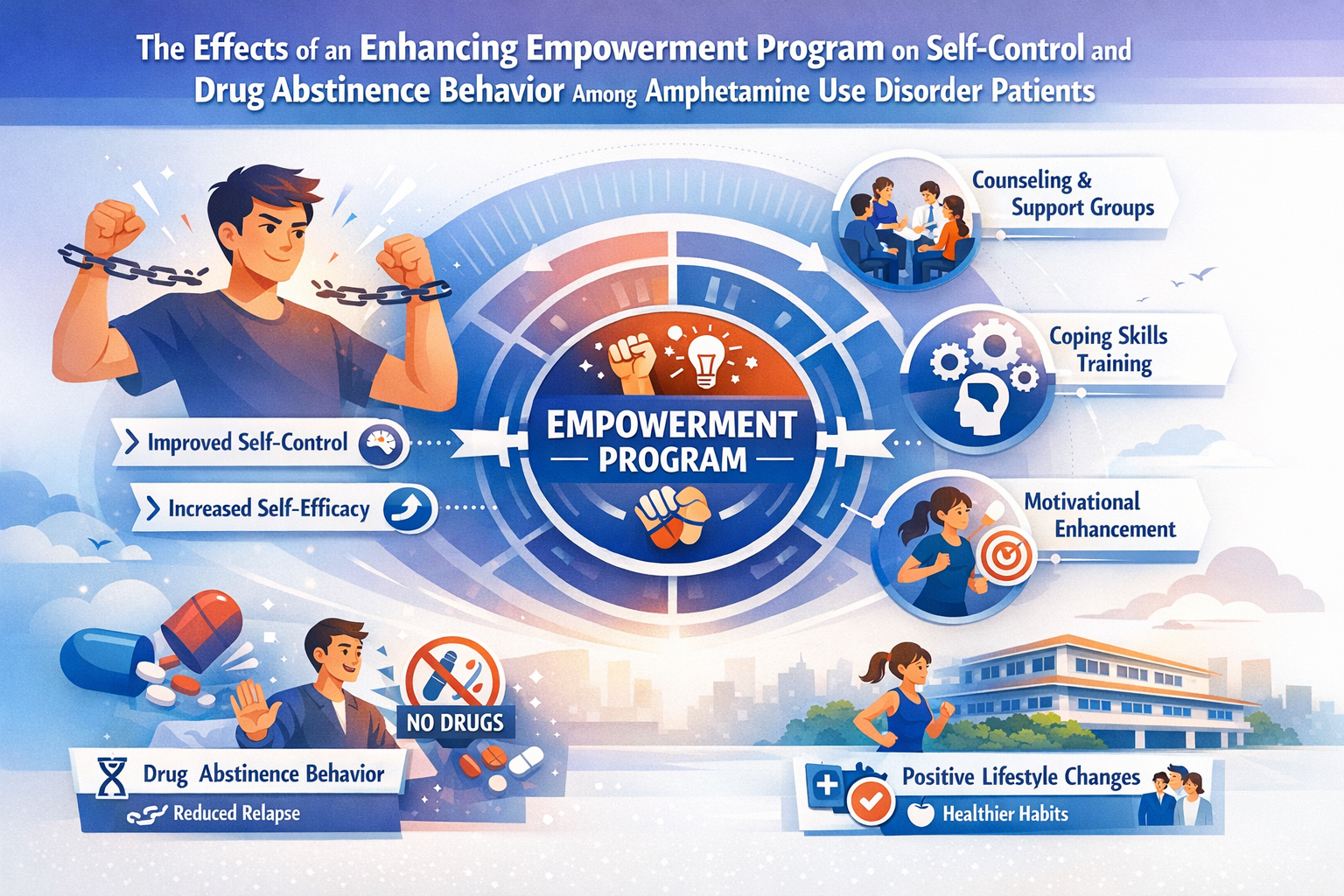
The effects of an Enhancing Empowerment Program on self-control and Drug Abstinence Behavior among Amphetamine Use Disorder Patients
Keywords:
empowerment program, self-control, drug abstinence behavior, amphetamine use disorder patientsAbstract
Background: The issue of drug abuse, particularly with amphetamines, is becoming increasingly severe. Despite a growing number of individuals undergoing treatment, the rate of relapse remains high. This research aims to compare self-control behaviors before and after participation in an empowerment program, as well as to evaluate self-control behaviors and drug abstinence between the group receiving the empowerment program and the group receiving standard care.
Methods: A quasi-experimental research design involving two groups, with pre- and post-experiment phases, was implemented. The sample comprised 44 patients addicted to amphetamines, all receiving outpatient treatment at the drug rehabilitation clinic of Thoen Hospital. Participants were divided into an experimental group and a control group, each consisting of 22 individuals. The research instruments included an empowerment program with 10 activities conducted over 5 weeks, a self-control questionnaire, and a methamphetamine urine test kit. These instruments were evaluated for content validity by three experts, and the self-control questionnaire demonstrated a reliability score of 0.906. Data analysis was performed using descriptive statistics, t-test, chi-square, and Fisher's exact test.
Results: Following their participation in the empowerment program, the experimental group exhibited a significantly higher mean self-control score compared to their pre-program scores (t = 4.58, p < .001, Cohen’s d = 0.98). Additionally, the mean self-control score of the experimental group was notably higher than that of the control group (t = 4.58, p < .001, Cohen’s d = 1.43). Moreover, at week 12, drug abstinence behavior was significantly more prevalent in the experimental group than in the control group (p < .05).
Conclusion: The research results indicate that the empowerment program is effective in enhancing self-control among amphetamine users undergoing rehabilitation, which leads to successful cessation of amphetamine use.
References
United Nations Office on Drugs and Crime. World Drug Report 2023 [Internet]. New York: United Nations; 2023 [cited 2025 Mar 8]. Available from: https://www.unodc.org/unodc/en/data-and-analysis/world-drug-report-2023.html
สำนักงานเลขานุการคณะกรรมการบำบัดรักษาและฟื้นฟูผู้ติดยาเสพติด กระทรวงสาธารณสุข. ระบบข้อมูลการบำบัดรักษาและฟื้นฟูผู้ติดยาเสพติดของประเทศ 2564–2566 [อินเทอร์เน็ต]. 2566 [เข้าถึงเมื่อ 12 ส.ค. 2567]. เข้าถึงได้จาก: https://antidrug.moph.go.th/
โรงพยาบาลเถิน. ฐานข้อมูลผู้มีปัญหาจากการดื่มแอลกอฮอล์ที่เข้ารับบริการในปีงบประมาณ 2565–2567. ลำปาง: ระบบสารสนเทศโรงพยาบาลเถิน; 2567.
Zilverstand A, Huang AS, Alia-Klein N, Goldstein RZ. Neuroimaging impaired response inhibition and salience attribution in addiction: a systematic review. Neuron 2018;98:886-903.
สุกัญญา กาญจนบัตร. ปัจจัยทำนายของการกลับไปเสพเมทแอมเฟตามีนซ้ำในผู้รับการบำบัดยาเสพติดของโรงพยาบาลธัญญารักษ์ในประเทศไทย. วารสารการพัฒนาสุขภาพชุมชน มหาวิทยาลัยขอนแก่น 2025;12:235–54.
มงคล ลือชูวงศ์. ผลการพัฒนาโปรแกรมจิตสังคมบำบัดประยุกต์ในผู้ป่วยสารเสพติด อำเภอกงไกรลาศ จังหวัดสุโขทัย. วารสารวิชาการสาธารณสุข 2567;33:288-296
สายสุดาโภชนากรณ์.รูปแบบการเสริมสร้างพลังอำนาจผู้ป่วยเสพติดและครอบครัวเพื่อป้องกันการกลับไปเสพซ้ำ. วารสารสังคมศาสตร์และมานุษยวิทยาเชิงพุทธ 2563;5:305-23.
ธีราภา ธานี, หทัยรัตน์ ดิษฐอั๊ง, น้ำผึ้ง คุ้มครอง, ปาลิดา พละศักดิ์. การพัฒนาและทดสอบประสิทธิผลของโปรแกรมการนำเสนอตัวแบบการปรับเปลี่ยนพฤติกรรมในการเลิกเสพยาในผู้ป่วยติดสารแอมเฟตามีน. วารสารวิทยาศาสตร์สุขภาพ วิทยาลัยพยาบาลบรมราชชนนี สรรพสิทธิประสงค์ 2568;9:e273959.
Gibson CH. A study of empowerment in mothers of chronically ill children. Boston: Boston College; 1993.
กชพร เผือกผ่อง. ผลของโปรแกรมการเสริมสร้างพลังอำนาจต่อการควบคุมตนเองของผู้เสพติดแอมเฟตามีน [วิทยานิพนธ์ปริญญามหาบัณฑิตสาขาวิชาการพยาบาลจิตเวชและสุขภาพจิต]. กรุงเทพฯ: มหาวิทยาลัยธรรมศาสตร์; 2560.
Rosenbaum M. A schedule for assessing self-control behavior: preliminary findings. Behavior; 1980.
บุปผา บุญญามณี, อรวรรณ หนูแก้ว. การพัฒนาและผลของโปรแกรมการเสริมสร้างพลังอำนาจต่อพฤติกรรมการกำกับตนเองเพื่อการเลิกยาเสพติดแอมเฟตามีนในระยะฟื้นฟูสมรรถภาพ. วารสารเครือข่ายวิทยาลัยพยาบาลและการสาธารณสุขภาคใต้ 2567;11:67_e267558.
Ojonuba HS, Abdul Rahman H, Zaremohzzabieh Z, Mohd Zulkefli NA. The effectiveness of an empowerment education intervention for substance use reduction among inner-city adolescents in Nigeria. Int J Environ Res Public Health 2023;20:3731. doi: 10.3390/ijerph20043731.
ปนัดดา ธีระเชื้อ. ผลของโปรแกรมการดูแลแบบบูรณาการต่อการป้องกันการกลับไปเสพซ้ำในผู้มีความผิดปกติจากการใช้ยาเสพติดแอมเฟตามีน. วารสารวิชาการสุขภาพภาคเหนือ 2567;11:126-41.
กชพร เผือกผ่อง, นุชนาถ บรรทุมพร, ชมชื่น สมประเสริฐ. ผลของโปรแกรมการเสริมสร้างพลังอำนาจต่อการควบคุมตนเองของผู้ป่วยที่มีความผิดปกติจากการใช้ยาเสพติดแอมเฟตามีน. วารสารพยาบาลทหารบก 2561;19:118–28.
สาวิตรี ศตคุณากร, ชาลินี สุวรรณยศ, หรรษา เศรษฐบุปผา. ผลของโปรแกรมเสริมสร้างพลังอำนาจต่อพฤติกรรมการใช้สารแอมเฟตามีน ที่ศึกษาในผู้ป่วยที่ได้รับการวินิจฉัยว่ามีความผิดปกติจากการใช้สารแอมเฟตามีนของโรงพยาบาลสวนปรุงจังหวัดเชียงใหม่. วารสารพยาบาลจิตเวชและสุขภาพจิต 2567;38:47-63.
Casey BJ, Jones RM, Hare TA. The adolescent brain. Ann N Y Acad Sci 2008;1124:111-26. doi: 10.1196/annals.1440.010.
คณะกรรมการป้องกันและปราบปรามยาเสพติด. ประกาศคณะกรรมการป้องกันและปราบปรามยาเสพติด เรื่องกำหนดหลักเกณฑ์ วิธีการ และเงื่อนไขการตรวจหรือทดสอบว่าบุคคลหรือกลุ่มบุคคลใดมีสารเสพติดในร่างกายหรือไม่ [อินเทอร์เน็ต]. 2563 [เข้าถึงเมื่อ 18 ก.ค. 2568]. เข้าถึงได้จาก: https://www.ratchakitcha.soc.go.th/DATA/PDF/2565/E/094/T_0075.PDF
Smith JA, Doe RB. Cognitive distortions and decision-making processes in amphetamine addiction. J Subst Abuse Treat 2020;58:234–45.
Barakat HA, Ibrahim ZM. Effectiveness of psychological intervention on self-efficacy, self-control, and coping among patients with substance abuse disorders. Egypt J Health Care 2022;13:574–91.
สยาภรณ์ เดชดี, อรวรรณ หนูแก้ว. การพัฒนาและผลของโปรแกรมการเสริมสร้างพลังอำนาจต่อพฤติกรรมการดูแลตนเองของผู้ป่วยโรคจิตจากสารเสพติด. วารสารการพยาบาลจิตเวชและสุขภาพจิต 2564;35:91–111.
บรรจงจิตต์ พันธุ์ทอง, นิภา กิมสูงเนิน. ผลของโปรแกรมการเสริมสร้างพลังแห่งตนร่วมกับการสนับสนุนครอบครัวต่อพฤติกรรมการไม่เสพยาซ้ำในผู้ป่วยเสพติดยาบ้า สถาบันธัญญารักษ์. วารสารวิชาการสาธารณสุข 2557;23:62–8.
Shekarchi R, Akbari M, Ahmadian H, Yarahmadi Y. The effectiveness of self-control training program on reducing addiction readiness in students. J Pediatr Nurs 2021;8:71–80.
Downloads
Published
How to Cite
Issue
Section
License
Copyright (c) 2026 Boromarajonani College of Nursing Sunpasitthiprasong

This work is licensed under a Creative Commons Attribution-NonCommercial-NoDerivatives 4.0 International License.
บทความที่ได้รับการตีพิมพ์เป็นลิขสิทธิ์ของวารสารวิทยาศาสตร์สุขภาพ วิทยาลัยพยาบาลบรมราชชนนี สรรพสิทธิประสงค์ ข้อความที่ปรากฏในบทความแต่ละเรื่องเป็นความคิดเห็นส่วนตัวของผู้เขียนแต่ละท่านไม่เกี่ยวข้องกับวิทยาลัยพยาบาลบรมราชชนนี สรรพสิทธิประสงค์ และคณาจารย์ท่านอื่นๆ ในวิทยาลัยพยาบาลฯ ความรับผิดชอบเกี่ยวกับบทความแต่ละเรื่องผู้เขียนจะรับผิดชอบของตนเอง