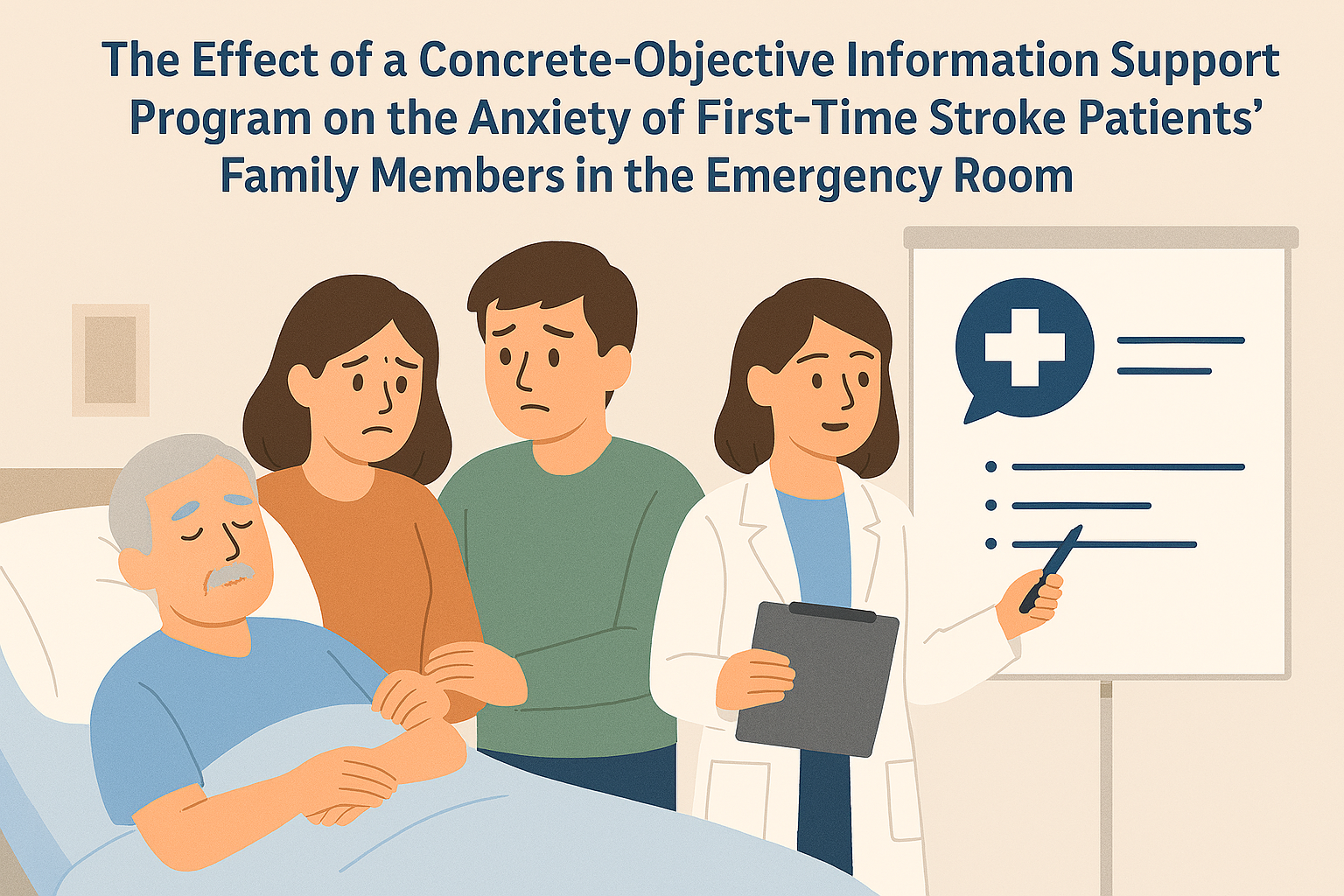
The Effect of a Concrete-Objective Information Support Program on the Anxiety of First-Time Stroke Patients’ Family Members in the Emergency Room
Keywords:
concrete-objective information, anxiety, family members, strokeAbstract
Background: Family members of individuals experiencing a stroke for the first time frequently encounter elevated levels of anxiety, primarily due to insufficient knowledge and preparation for managing such critical situations. While general information may be available, it often fails to equip them with a clear mental framework or structured understanding necessary for effectively regulating their responses. Consequently, this quasi-experimental study sought to examine the impact of a concrete–objective information support program on the anxiety levels of these family members.
Methods: A quasi-experimental, two-group pretest-posttest design was implemented in the emergency department of Sunpasitthiprasong Hospital. The sample comprised 60 family members of patients, divided into an experimental group and a control group, with 30 participants in each group. The research instruments included an information support program, a general information questionnaire, and an anxiety assessment questionnaire, all of which underwent content validation by five experts, resulting in a content validity index of .85. Data were analyzed using descriptive statistics, independent t-tests, and paired t-tests.
Results: The study demonstrated that family members of stroke patients in the emergency department who participated in the program exhibited significantly reduced anxiety scores post-intervention compared to their pre-intervention scores (p < .05). Furthermore, following the program, the anxiety scores of the experimental group were significantly lower than those of family members who received standard care (p < .05).
Conclusion: The implementation of a concrete–objective information support program through video media has been shown to effectively alleviate the anxiety experienced by family members of first-time stroke patients in the emergency room. Consequently, it is recommended that this family needs response program be adopted to efficiently mitigate anxiety.
References
Kim J, Thayabaranathan T, Donnan GA, Howard G, Howard VJ, Rothwell PM, et al. Global stroke statistics 2019. Int J Stroke 2020;15:819-38.
Lukmanulhakim L, Afriyani A, Haryani A. Caring efficacy and nurse caring behavior in taking care of critical patients. Jurnal Ners 2019;14:55. doi: 10.20473/jn.v14i1.9664.
นิพนธ์ วาตาดา. ผลของโปรแกรมการให้ข้อมูลอย่างมีแบบแผนร่วมกับการฟังดนตรีต่อความวิตกกังวลหลังการสวนหลอดเลือดหัวใจของผู้ป่วยโรคกล้ามเนื้อหัวใจขาดเลือดเฉียบพลัน [วิทยานิพนธ์ปริญญาพยาบาลศาสตรมหาบัณฑิต]. กรุงเทพฯ: จุฬาลงกรณ์มหาวิทยาลัย; 2560.
Spielberger CD. State-trait anxiety inventory for adults. Palo Alto (CA): Consulting Psychologists Press; 1983.
Zhao J, Zeng Z, Yu J, Xu J, Chen P, Chen Y, et al. Effect of main family caregiver’s anxiety and depression on mortality of patients with moderate-severe stroke. Scientific reports 2021; 11:2747-9. doi:10.1038/s41598-021-81596-8
Beck AT, Alford BA. Depression: causes and treatment. Philadelphia: University of Pennsylvania Press; 2009.
ปฐมวดี สิงห์ดง, ชนกพร จิตปัญญา. การดูแลญาติของผู้ป่วยวิกฤต: มุมมองของญาติ. วารสารมหาวิทยาลัยเจ้าฟ้า นิราธารัส 2011;3:17–32.
Khowtong W, Sukonthasarn A, Wangsrikhun S. Effectiveness of caring for acute critically ill patients based on family-centered care concept in the emergency department. Nurs J 2019; 46:176-87.
Johnson JE. Self-regulation theory and coping with physical illness. Res Nurs Health 1999;22:435-48.
พิจิตรา เล็กดำรงกุล, คนึงนิจ พงศ์ถาวรกมล, นพดล ศิริธนารัตนกุล, ศิวพร ศิริภูล, เพ็ญใจ จิตรนำทรัพย์. ผลของโปรแกรมให้ข้อมูลเชิงรูปธรรม-ปรนัยต่อความวิตกกังวลและภาวการณ์ทำหน้าที่ในผู้ป่วยมะเร็งต่อมน้ำเหลืองที่ได้รับยาเคมีบำบัด. วารสารพยาบาลศาสตร์ 2563;38:19-34.
อลงกรณ์ อักษรศรี, วัลยา ธรรมพนิชวัฒน์, ไข่มุกข์ วิเชียรเจริญ, พรรณรัตน์ แสงเพิ่ม. ผลของการให้ข้อมูลแบบรูปธรรม–ปรนัยต่อความวิตกกังวลและการมีส่วนร่วมในการดูแลบุตรของบิดามารดาใน หอผู้ป่วยวิกฤตเด็ก. วารสารการพยาบาลไทย 2555;30:80–9.
น้ำทิพย์ ประสิทธิการ, วัลย์ลดา ฉันท์เรืองวณิชย์, อรพรรณ โตสิงห์, ดนุลดา จามจุรี. ผลของการใช้แนวปฏิบัติการพยาบาลเตรียมความพร้อมญาติผู้ป่วยในการเผชิญภาวะวิกฤตของผู้ป่วยต่อการตอบสนองความต้องการของญาติผู้ป่วยขณะอยู่ในหน่วยงานอุบัติเหตุและฉุกเฉิน [วิทยานิพนธ์ปริญญาพยาบาลศาสตรมหาบัณฑิต]. กรุงเทพฯ: มหาวิทยาลัยมหิดล; 2553.
Polit DF, Beck CT. Nursing research: generating and assessing evidence for nursing practice. 9th ed. Philadelphia: Wolters Kluwer Health/Lippincott Williams & Wilkins; 2008.
สุญาดา อรวงศ์ไพศาล, จงจิต เสน่หา, อัจฉริยา พ่วงแก้ว, ครองวงศ์ มุสิกถาวร. ผลของโปรแกรมการสนับสนุนด้านข้อมูลแบบรูปธรรม–ปรนัยผ่านแอปพลิเคชันบนสมาร์ตโฟนต่อความวิตกกังวลของญาติผู้ป่วยเร่งด่วนในห้องฉุกเฉิน. วารสารพยาบาลศาสตร์ 2566;41:34–49.
ประยงค์ ทับทิม. ความต้องการและการได้รับการตอบสนองความต้องการของสมาชิกครอบครัวผู้บาดเจ็บจากอุบัติเหตุจราจรในแผนกอุบัติเหตุและฉุกเฉิน [วิทยานิพนธ์พยาบาลศาสตรมหาบัณฑิต]. มหาวิทยาลัยบูรพา; 2551.
Hsiao PR, Redley B, Hsiao YC, Lin CC, Han CY, Lin HR. Family needs of critically ill patients in the emergency department. Int Emerg Nurs 2017;30:3-8.
Yildirim T, Özlü ZK. Needs of critically ill patients' relatives in emergency departments. Nurs Midwifery Stud 2018;7:33-8.
Downloads
Published
How to Cite
Issue
Section
License
Copyright (c) 2026 Boromarajonani College of Nursing Sunpasitthiprasong

This work is licensed under a Creative Commons Attribution-NonCommercial-NoDerivatives 4.0 International License.
บทความที่ได้รับการตีพิมพ์เป็นลิขสิทธิ์ของวารสารวิทยาศาสตร์สุขภาพ วิทยาลัยพยาบาลบรมราชชนนี สรรพสิทธิประสงค์ ข้อความที่ปรากฏในบทความแต่ละเรื่องเป็นความคิดเห็นส่วนตัวของผู้เขียนแต่ละท่านไม่เกี่ยวข้องกับวิทยาลัยพยาบาลบรมราชชนนี สรรพสิทธิประสงค์ และคณาจารย์ท่านอื่นๆ ในวิทยาลัยพยาบาลฯ ความรับผิดชอบเกี่ยวกับบทความแต่ละเรื่องผู้เขียนจะรับผิดชอบของตนเอง