
The Effects of a Behavioral Enhancement Program for Preventing E-cigarette Smoking among Adolescents in Mueang Ubon Ratchathani District
Keywords:
electronic cigarette use behavior, adolescents, preventive behavior program against electronic cigarette useAbstract
Background: The rise in e-cigarette use among lower secondary students is driven by curiosity. They see e-cigarettes as safer than traditional cigarettes and often lack refusal skills due to peer pressure. Adolescents are unaware of risks and lack confidence in saying no, hindering self-protection. Thus, testing a program to prevent e-cigarette use by enhancing awareness and self-confidence is essential.
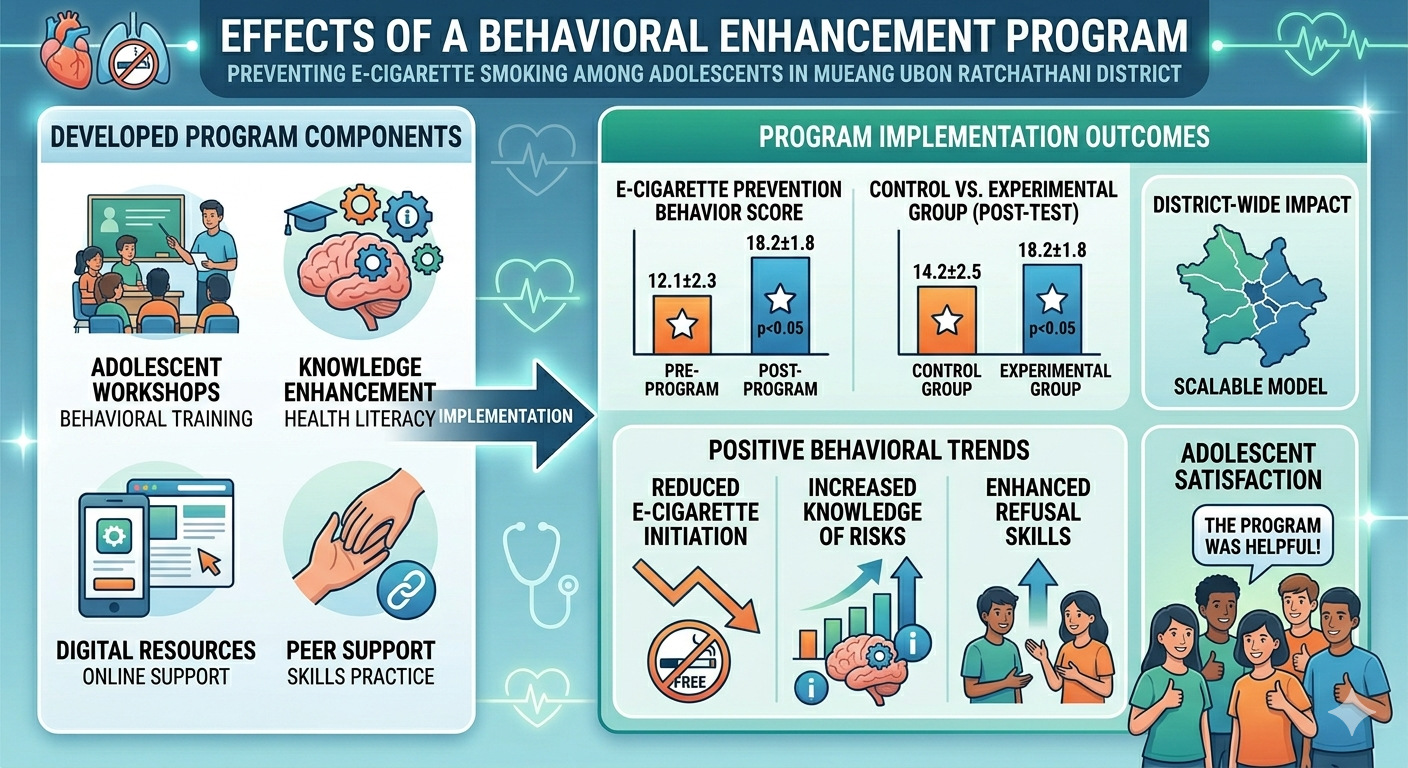
Methods: A quasi-experimental study involved 64 adolescents, aged 12-15, from opportunity extension schools in Mueang District, Ubon Ratchathani Province. Participants were divided into experimental and control groups, each with 32 individuals. The experimental group participated in the program, while the control group received the school's health education curriculum. Data collection tools included: 1) a general information questionnaire and 2) a scale measuring behavior for preventing e-cigarette use. The experimental tool was a program to prevent e-cigarette use among adolescents, consisting of six activities conducted twice a week, each lasting 60 minutes, developed and validated by experts. The behavior prevention scale for e-cigarette use had a validity index of 0.79 and a reliability coefficient of 0.92. The adolescent e-cigarette uses prevention program had a validity index of 0.75. Data were analyzed using paired-sample t-tests and independent-sample t-tests.
Results: The study revealed a significant increase in the average score for preventive behaviors against e-cigarette smoking among adolescents in the experimental group after they participated in the program (p < .05). Additionally, this average score was notably higher in the experimental group compared to the control group following the program (p < .05).
Conclusion: The research findings reveal that participants exhibited a clear understanding and perceived self-efficacy in behaviors aimed at preventing e-cigarette use.
References
ประกิต วาทีสาธกกิจ. บุหรี่ไฟฟ้ากับคำถามที่ทุกคนอยากรู้. กรุงเทพฯ: มูลนิธิรณรงค์เพื่อการไม่สูบบุหรี่; 2556.
ภัทรไพลิน จังพัฒนานนท์. รู้ทันผลิตภัณฑ์ยาสูบรูปแบบใหม่ [อินเทอร์เน็ต]. เครือข่ายเฝ้าระวังอุตสาหกรรมยาสูบ. 2557 [เข้าถึงเมื่อ 15 ส.ค. 2568]. เข้าถึงได้จาก: http://www.tobaccowatch.in.th/know_brand_page/72
ศูนย์วิจัยและจัดการความรู้เพื่อการควบคุมยาสูบ. ภัยร้ายซ่อนเร้นบุหรี่ไฟฟ้า. พิมพ์ครั้งที่ 2. กรุงเทพฯ: สินทวีกิจ พรินติ้ง; 2563.
Tobacco Control Research and Knowledge Management Center. Factors related to smoking behavior in the initial stages of secondary school students in Trat Province. Bangkok: Tobacco Control Research and Knowledge Management Center; 2021.
สุวรรณา เรืองกาญจนเศรษฐ์. วัยรุ่นกับพฤติกรรมการเสี่ยงและปัจจัยที่ส่งผลต่อการตัดสินใจ. วารสารพฤติกรรมศาสตร์ 2562;14:44-58.
ไพฑูรย์ สอนทน, นฤมล จันทร์มา, อัมพร สอนทน. พฤติกรรมการสูบบุหรี่ไฟฟ้าในวัยรุ่นและปัจจัยที่มีผลต่อการตัดสินใจทดลองใช้บุหรี่ไฟฟ้า. วารสารการแพทย์และสุขภาพ 2565;18:45-59.
อัจฉราพร สี่หิรัญวงศ์. ผลกระทบของการรับสื่อโฆษณาต่อการตัดสินใจใช้บุหรี่ไฟฟ้าของวัยรุ่นในประเทศไทย. วารสารวิจัยทางการแพทย์ 2565;29:105-18.
Villanti AC, Johnson AL, Miech RA. Trends in e-cigarette use among youth and young adults in the United States. Tobacco Control 2016;25:370-6. doi: 10.1136/tobaccocontrol-2015-052729.
ปิยวรรณ บุญเพ็ญ. การวิเคราะห์พฤติกรรมการสูบบุหรี่ไฟฟ้าในกลุ่มเยาวชน: การศึกษาในระดับมัธยมศึกษาตอนต้น. วารสารสุขภาพและพฤติกรรม 2562;9:22-30.
Pettigrew S, Roberts M, Rees M. Peer influence and e-cigarette use among adolescents: The role of social networks and pressure. J Adolesc Health 2023;72:324-31. doi: 10.1016/j.jadohealth.2023.02.005
สำนักงานกองทุนสนับสนุนการสร้างเสริมสุขภาพ. 08: ปอดพังวัย 14! บุหรี่ไฟฟ้าห้อยคอ จุดเริ่มโรค EVALI ร้ายแรง [อินเทอร์เน็ต]. 2568 [เข้าถึงเมื่อ 15 ส.ค. 2568]. เข้าถึงได้จาก: https://dol.thaihealth.or.th/Media/Index/15950052-cc1f-f011-858e-b76bc522b1fb
Duval TS, Wicklund RA. A theory of objective self awareness. Oxford: Academic Press; 1972.
Bandura A. Self-efficacy: Toward a unifying theory of behavioral change. Psychol Rev. 1977;84:191-215.
ณัฐวุธ แก้วสุทธา, ภัทร อันชื่น, พีร์ สมสวย, นันท์ชนก วีระกุล. ผลของโปรแกรมการปรับเปลี่ยนพฤติกรรมการปฏิเสธบุหรี่เชิงบวกในงานทันตกรรมโรงเรียนระดับประถมศึกษา กรุงเทพมหานคร. วารสารศรีนครินทรวิโรฒวิจัยและพัฒนา (สาขามนุษยศาสตร์และสังคมศาสตร์) 2560;9:53-68.
บุญเลิศ ปลอดปล่อง. ประสิทธิผลของโปรแกรมการสร้างเสริมความรอบรู้ด้านสุขภาพต่อพฤติกรรมการป้องกันการสูบบุหรี่ของนักเรียนมัธยมศึกษาตอนต้นในตำบลยาง อำเภอกันทรารมย์ จังหวัดศรีสะเกษ. วารสารวิจัยและพัฒนาสุขภาพศรีสะเกษ 2567;3:57-67.
Lee S, Park H. Effects of positive-negative antismoking messages to quit smoking among male college students: A randomized field study. Jpn J Nurs Sci 2020;17:12349. doi: 10.1111/jjns.12349.
ฮูดา แวะหะยี, บุญสิทธิ์ ไชยชนะ, กรรณิกา เรืองเดช. ประสิทธิผลของโปรแกรมพัฒนาทักษะชีวิตต่อการรับรู้ความสามารถของตนเองในการป้องกันการสูบบุหรี่ไฟฟ้าของนักศึกษาชั้นปีที่ 1 มหาวิทยาลัยราชภัฏยะลา. วารสารพยาบาลกระทรวงสาธารณสุข 2556;22:85-97.
Downloads
Published
How to Cite
Issue
Section
License
Copyright (c) 2026 Boromarajonani College of Nursing Sunpasitthiprasong

This work is licensed under a Creative Commons Attribution-NonCommercial-NoDerivatives 4.0 International License.
บทความที่ได้รับการตีพิมพ์เป็นลิขสิทธิ์ของวารสารวิทยาศาสตร์สุขภาพ วิทยาลัยพยาบาลบรมราชชนนี สรรพสิทธิประสงค์ ข้อความที่ปรากฏในบทความแต่ละเรื่องเป็นความคิดเห็นส่วนตัวของผู้เขียนแต่ละท่านไม่เกี่ยวข้องกับวิทยาลัยพยาบาลบรมราชชนนี สรรพสิทธิประสงค์ และคณาจารย์ท่านอื่นๆ ในวิทยาลัยพยาบาลฯ ความรับผิดชอบเกี่ยวกับบทความแต่ละเรื่องผู้เขียนจะรับผิดชอบของตนเอง