
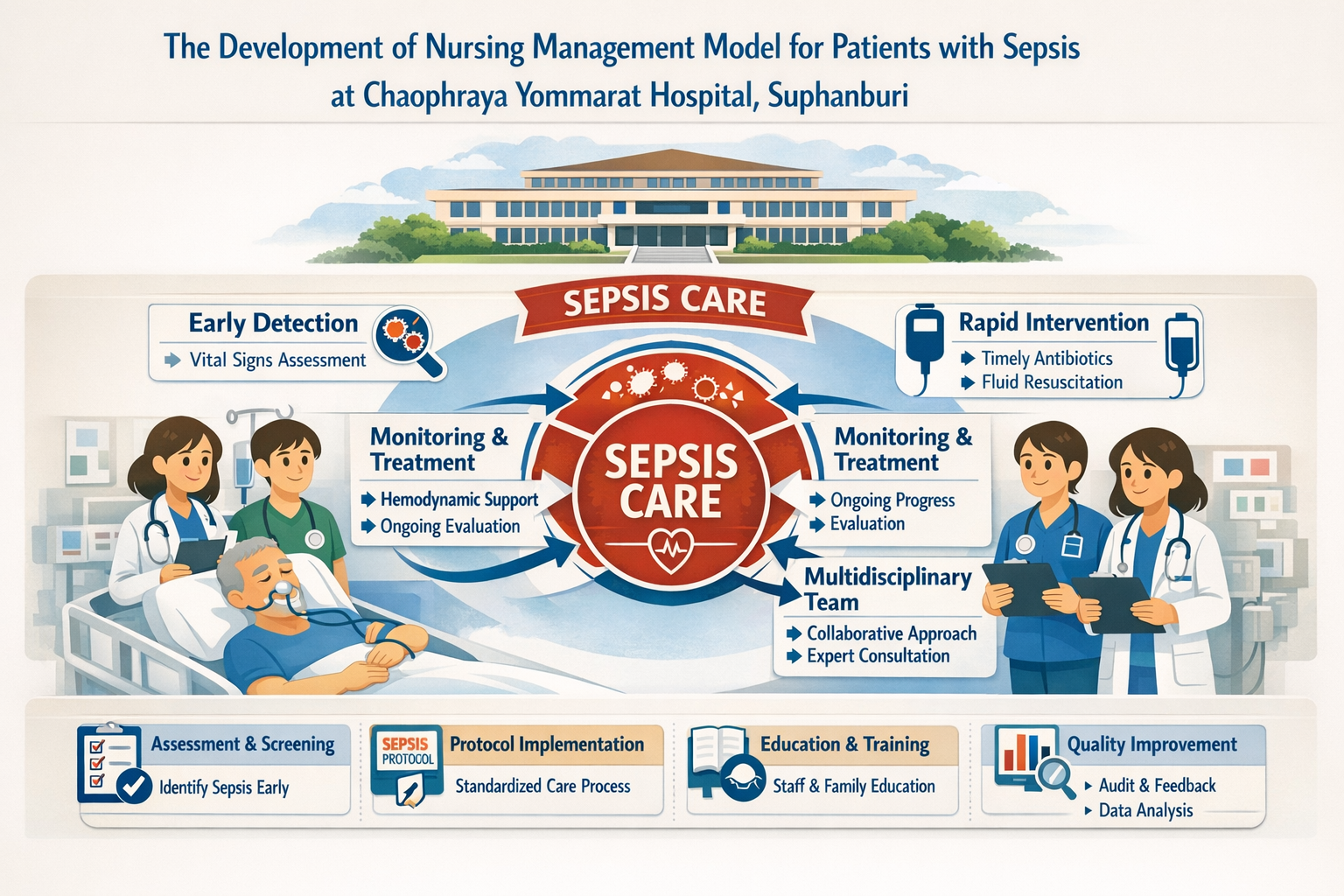
The Development of Nursing Management Model for Patients with Sepsis at Chaophraya Yommarat Hospital, Suphanburi
Keywords:
model development, nursing management, sepsis patientsAbstract
Background: Sepsis, particularly septic shock, constitutes a prevalent medical emergency arising from an aberrant physiological response to infection. This condition can precipitate circulatory failure and organ dysfunction, potentially resulting in mortality. The objective of this research and development initiative is to formulate a nursing management model for sepsis patients and to evaluate the effects of its implementation at Chaopraya Yommarat Hospital.
Methods: This research and development project involved a sample comprising 345 professional nurses and 884 patient records pertaining to bloodstream infections. The study was executed in three distinct phases: Phase 1 encompassed situational analysis and model development; Phase 2 entailed trial use and model refinement; and Phase 3 focused on the evaluation of model implementation. The instruments employed included the developed nursing management model, an observation form for practice behaviors, and a satisfaction assessment form. Data analysis was conducted using descriptive statistics and paired t-test analysis.
Results: Prior to development, the nursing service system was characterized by a lack of clarity, discontinuity in practice, and inadequate communication systems, which collectively resulted in delayed care. A novel nursing management model, developed through the integration of the nursing process and clinical supervision, was identified as both suitable and practically applicable. Following the implementation of this model, there was a statistically significant increase in the average score for nurses' compliance with standards (p < .05). Furthermore, the incidence of septic shocked creased from 27.48% to 21.02%, and professional nurses reported high overall satisfaction with the model (M = 4.18, SD = 0.76).
Conclusion: The nursing management model delineated herein can serve as a framework for the development of nursing service systems within organizations, thereby promoting adherence to established standards and ensuring patient safety. It is advisable to extend its application and evaluate the model's sustainability in diverse contexts.
References
AI-Khafaji AH, Sharma S. Multisystem organ failure of sepsis [Internet]. 2010 [cited 2024 Aug 14]. Available from: https://emedicine.medscape.com/article/169640-overview
World Health Organization. State of the world’s nursing 2020: investing in education, jobs and leadership. Geneva: World Health Organization; 2020.
โรงพยาบาลเจ้าพระยายมราช. ระบบสารสนเทศ โรงพยาบาลเจ้าพระยายมราช: สถิติผู้ป่วย. สุพรรณบุรี: โรงพยาบาลเจ้าพระยายมราช; 2566.
Evans L, Rhodes A, Alhazzani W, Antonelli M, Coopersmith CM, French C, et al. Surviving sepsis campaign: international guidelines for management of sepsis and septic shock2021. Critical care medicine 2021;49:e1063-143.
Carpenito-Moyet LJ. Understanding the nursing process: concept mapping and care planning for students. Philadelphia: Lippincott Williams & Wilkins; 2007.
Proctor B. Training for the Supervision Alliance: attitude, skills and intention. In: Hyrkas K, Fowler J, Cutcliffe JR, editors. Routledge handbook of clinical supervision: fundamental international themes. New York: Routledge; 2001. p. 23-34.
สำราญ คำมี. ปัจจัยที่มีผลต่อการปฏิบัติตามกระบวนการพยาบาลในหอผู้ป่วยของพยาบาลวิชาชีพ โรงพยาบาลสังกัดมหาวิทยาลัยแห่งหนึ่ง [วิทยานิพนธ์สาธารณสุขศาสตรมหาบัณฑิต]. นนทบุรี: มหาวิทยาลัยสุโขทัยธรรมาธิราช; 2562.
สุภานัน ชวนพิมาย, มาริสา ไกรฤกษ์. ปัจจัยที่มีอิทธิพลต่อการใช้กระบวนการพยาบาลของพยาบาลวิชาชีพ โรงพยาบาลเอกชนในเขตอำเภอเมือง จังหวัดนครราชสีมา. วารสารการพยาบาลและการดูแลสุขภาพ 2562;37:190-8.
ลดารัตน์ วณิชยานันต์, พาณี วิรัชชกุล, สุภัทรา สิงหสุรศักดิ์. การพัฒนารูปแบบการนิเทศทางคลินิกต่อการเพิ่มประสิทธิภาพการพยาบาลผู้ป่วยติดเชื้อในกระแสโลหิตชนิดรุนแรง โรงพยาบาลอุทัยธานี. วารสารสมาคมเวชศาสตร์ป้องกันแห่งประเทศไทย 2565;12:576-97.
Cruz S, Carvalho L, Sousa P. Clinical supervision in nursing: the (un) known phenomenon. Procedia Soc Behav Sci 2012;69:864–73. doi: 10.1016/j.sbspro.2012.12.009
Ofi B, Sowunmi O. Nursing documentation: experience of the use of the nursing process model in selected hospitals in Ibadan, Oyo State, Nigeria. Int J Nurs Pract 2012;18:354–62. doi: 10.1111/j.1440-172X.2012.02044.x
ผ่องพรรณ ธนา, กนกรัตน์ แสงอำไพ, สุทธิศรี ตระกูลสิทธิโชค. ผลของการนิเทศทางคลินิกต่อการใช้กระบวนการพยาบาลในการดูแลผู้ป่วยเบาหวานและความพึงพอใจในการนิเทศของพยาบาล. รายงานวิจัยฉบับสมบูรณ์. กรุงเทพฯ. คณะพยาบาลศาสตร์ มหาวิทยาลัยรังสิต; 2560.
Tuck J. A new approach to team clinical supervision on an acute admissions unit. Ment Health Pract 2017;20:24-7. doi: 10.7748/mhp.2017.e1122
มธุรส ตันติเวสส, อารีรัตน์ ขำอยู่, ประนอม โอทกานนท์. การพัฒนารูปแบบการนิเทศทางการพยาบาลสำหรับผู้ตรวจการพยาบาลนอกเวลาราชการ โรงพยาบาลสงฆ์. วารสารคณะพยาบาลศาสตร์ มหาวิทยาลัยบูรพา 2560;25:41-51.
พรทิพย์ ยศประสงค์. ผลการนิเทศทางการพยาบาลในคลินิกต่อการดูแลผู้ป่วยติดเชื้อในกระแสเลือดโรงพยาบาลสมเด็จพระยุพราชธาตุพนม. วารสารสุขภาพและสิ่งแวดล้อมศึกษา 2567;9:397-408.
ทวิกานต์ รักสวนจิก, นวรัตน์ บุญนาน, อรทัย โสระเสริฐ. การพัฒนารูปแบบการดูแลผู้ป่วยที่มีภาวะติดเชื้อในกระแสเลือดด้วยระบบทางด่วนโรงพยาบาลแกดำ อำเภอแกดำ จังหวัดมหาสารคาม. วารสารวิชาการสำนักงานสาธารณสุขจังหวัดมหาสารคาม 2567;8:198-212.
กิ่งกาญจน์ ทรัพย์เย็น, กนกทอง จาตุรงคโชค, กฤตยา ตันติวรสกุล. การพัฒนารูปแบบการนิเทศทางการพยาบาลในคลินิกเพื่อป้องกันการเกิดแผลกดทับ โรงพยาบาลบ้านโป่ง. วารสารแพทย์เขต 4-5 2562;38:300-17.
Downloads
Published
How to Cite
Issue
Section
License
Copyright (c) 2026 Boromarajonani College of Nursing Sunpasitthiprasong

This work is licensed under a Creative Commons Attribution-NonCommercial-NoDerivatives 4.0 International License.
บทความที่ได้รับการตีพิมพ์เป็นลิขสิทธิ์ของวารสารวิทยาศาสตร์สุขภาพ วิทยาลัยพยาบาลบรมราชชนนี สรรพสิทธิประสงค์ ข้อความที่ปรากฏในบทความแต่ละเรื่องเป็นความคิดเห็นส่วนตัวของผู้เขียนแต่ละท่านไม่เกี่ยวข้องกับวิทยาลัยพยาบาลบรมราชชนนี สรรพสิทธิประสงค์ และคณาจารย์ท่านอื่นๆ ในวิทยาลัยพยาบาลฯ ความรับผิดชอบเกี่ยวกับบทความแต่ละเรื่องผู้เขียนจะรับผิดชอบของตนเอง