Developing Nursing Practice Processes for Managing Patients with Uncontrolled Hypertension Through Motivational Interviewing at Thali Hospital, Loei Province
Keywords:
nursing practice process, uncontrolled hypertension, Motivational Interviewing, self-care behaviorAbstract
Background: Incorporating the principles of Motivational Interviewing (MI) into nursing practice facilitates the management of blood pressure and mitigates the risk of complications in patients with uncontrolled hypertension.
Methods: This research and development study sought to formulate a nursing action process for managing patients with uncontrolled hypertension through MI at Tha Li Hospital, Loei Province. The study was grounded in the systems theory framework and integrated a four-phase nursing process: Phase 1—Problem and Needs Analysis; Phase 2—Design and Development; Phase 3—Implementation; and Phase 4—Evaluation and Improvement. The sample comprised 10 professional nurses, selected via purposive sampling, and 40 patients with uncontrolled hypertension, chosen through simple sampling. Research instruments included a self-care behavior record form, a Motivational Interviewing conversation record form, a blood pressure monitoring form, nurse group discussion guidelines, and a satisfaction and acceptance assessment form. The quality of these tools was validated by five experts, resulting in a Content Validity Index (CVI) of 0.83–0.90 and a reliability score of 0.84. Qualitative data were analyzed using content analysis, while quantitative data were examined using descriptive statistics, paired t-test, and Chi-square test.
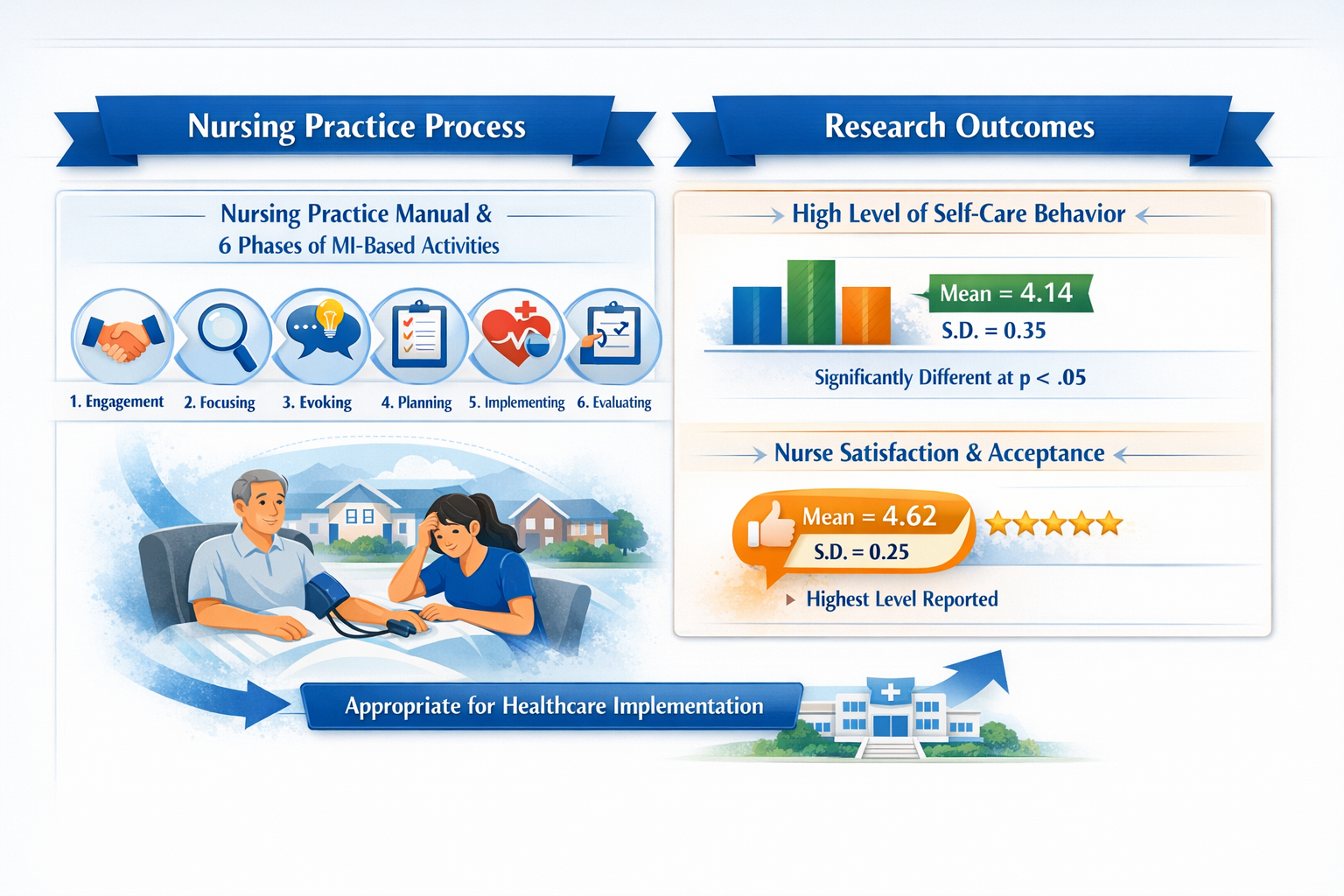
Results: The study identified that the developed nursing action process encompassed a manual and activities employing MI across six stages: providing feedback, supporting decision-making responsibility, offering advice, presenting options, expressing empathy, and enhancing potential. Furthermore, patients exhibited a high level of self-care behavior (M = 4.14, SD = 0.35), with a statistically significant difference at the .05 level, and the rate of blood pressure control increased to 80.00%. The nurse group reported the highest levels of satisfaction and acceptance (M = 4.62, SD = 0.25).
Conclusion: The integration of motivational interviewing (MI) within the nursing action process is well-suited for implementation in chronic disease clinics. Its continued promotion is recommended to sustainably enhance the quality of patient care.
References
กรมควบคุมโรค. สคร.9 เตือนประชาชน เนื่องในวันความดันโลหิตสูงโลก “ควบคุมความดันโลหิต ยืดชีวิตให้ยืนยาว” [อินเทอร์เน็ต]. 2566 [เข้าถึงเมื่อ 15 เม.ย. 2567]. เข้าถึงได้จาก: https://ddc.moph.go.th/odpc9/news.php?news=34026&deptcode=odpc9&news_views=6400
บงกช อนุฤทธิ์ประเสริฐ. คู่มือการพยาบาลผู้ป่วยโรคความดันโลหิตสูงที่ควบคุมความดันโลหิตไม่ได้ สำหรับผู้ป่วยนอก. กรุงเทพ: โรงพยาบาลศิริราช; 2564.
กรมควบคุมโรค. โรคความดันโลหิตสูง (Hypertension) [อินเทอร์เน็ต]. 2562 [เข้าถึงเมื่อ 15 เม.ย. 2567]. เข้าถึงได้จาก: https://www.ddc.moph.go.th/disease_detail.php?d=52
กรมสุขภาพจิต. สนทนาสร้างแรงจูงใจเพื่อปรับเปลี่ยนพฤติกรรมสุขภาพสำหรับผู้ป่วย NCDs. กรุงเทพฯ: บียอนด์ พับลิสชิ่ง; 2560.
Miller WR, Rollnick S. Motivational interviewing: preparing people for change. 2nd ed. New York: Guilford Press; 2002.
Oseni TIA, Oku AO, Monye IN, Ahmed SD, Duke RE, Otaigbe O, et al. Effect of motivational interviewing on lifestyle modification (MILMAPH Study). West Afr J Med 2024;41:126-34. doi: 10.1101/2024.04.16.24305912.
Huang X, Xu N, Wang Y, Sun Y, Guo A. The effects of motivational interviewing on hypertension management: A systematic review and meta-analysis. Patient Educ Couns 202;112:107760. doi: 10.1016/j.pec.2023.107760.
สำนักงานสาธารณสุขจังหวัดเลย. ระบบคลังข้อมูลด้านการแพทย์และสุขภาพ (HDC) [อินเทอร์เน็ต]. 2567 [เข้าถึง 20 เม.ย. 2567]. เข้าถึงได้จาก: https://lo.moph.go.th/lppho/fontend/?page=service_our&&topic=hdc
Faul F, Erdfelder E, Lang AG, Buchner A. G*Power 3: a flexible statistical power analysis program for the social, behavioral, and biomedical sciences. Behav Res Methods 2007;39:175-91. doi: 10.3758/bf03193146.
มิตรธิรา แจ่มใส, ธิติรัตน์ ราศิริ. ผลของโปรแกรมการสร้างแรงจูงใจต่อพฤติกรรมการดูแลตนเองและระดับความดันโลหิตในผู้ป่วย ความดันโลหิตสูงที่ควบคุมไม่ได้ของโรงพยาบาลส่งเสริมสุขภาพตำบลท่าทอง อ.เมือง จ.พิษณุโลก. วารสารวิทยาลัยพยาบาลบรมราชชนนีสุพรรณบุรี 2566;6:58-69.
สถาบันวิจัยและประเมินเทคโนโลยีทางการแพทย์ กรมการแพทย์ กระทรวงสาธารณสุข. การประเมินคุณภาพแนวทางปฏิบัติสำหรับการวิจัยและการประเมินผล (Appraisal of Guideline for Research & Evaluation II; AGREE II) ฉบับภาษาไทย. นนทบุรี: สถาบันวิจัยและประเมินเทคโนโลยีทางการแพทย์; 2556.
Hodkinson HM. Evaluation of mental test score for impairment in elderly. Age Ageing 1972;1:233-8.
กรมควบคุมโรค. รายงานการสำรวจและคัดกรองสภาวะสุขภาพ ประเด็นโรคไม่ติดต่อ ผ่าน Application smart อสม. ปี พ.ศ. 2566 [อินเทอร์เน็ต]. 2566 [เข้าถึงเมื่อ 15 เม.ย. 2567]. เข้าถึงได้จาก: https://ddc.moph.go.th/uploads/publish/1541120240306043816.pdf
ฤทัยชนก สุขจ้อง, อุมาพร ปุญญโสพรรณ, ปิยะนุช จิตตนูนท์. ผลของโปรแกรมการสัมภาษณ์เพื่อเสริมสร้างแรงจูงใจร่วมกับการสนับสนุนการจัดการตนเองต่อพฤติกรรมการชะลอไตเสื่อมและระดับความดันโลหิตในผู้ที่ควบคุมความดันโลหิตไม่ได้. รามาธิบดีพยาบาลสาร 2563;27:61-76.
เสกสรร จวงจันทร์, พนิดา สารกอง, สายชล นิลเนตร. การศึกษาประสิทธิผลของโปรแกรมการสนทนาสร้างแรงจูงใจเพื่อสนับสนุน การควบคุมความดันโลหิตของผู้ป่วยความดันโลหิตสูงที่ควบคุม ระดับความดันโลหิตไม่ได้ โรงพยาบาลโนนคูณ จังหวัดศรีสะเกษ. วารสารสำนักงานป้องกันควบคุมโรคที่ 2562;10:37-47.
พนิตนันท์ พรหมดำ, นิตยา สุขชัยสงค์. ประสิทธิผลของโปรแกรมการประยุกต์ทฤษฎีแรงจูงใจในการป้องกันโรคร่วมกับแรงสนับสนุนทางสังคมต่อพฤติกรรมรับประทานยาในผู้สูงอายุโรคความดันโลหิตสูงกรุงเทพมหานคร. วารสารพยาบาลโรคหัวใจและทรวงอก 2564;32:131-145.
Prochaska JO, Velicer WF. Transtheoretical model of health behavior change. Am J Health Promot 1997;12:38-48.
Downloads
Published
How to Cite
Issue
Section
License
Copyright (c) 2026 Boromarajonani College of Nursing Sunpasitthiprasong

This work is licensed under a Creative Commons Attribution-NonCommercial-NoDerivatives 4.0 International License.
บทความที่ได้รับการตีพิมพ์เป็นลิขสิทธิ์ของวารสารวิทยาศาสตร์สุขภาพ วิทยาลัยพยาบาลบรมราชชนนี สรรพสิทธิประสงค์ ข้อความที่ปรากฏในบทความแต่ละเรื่องเป็นความคิดเห็นส่วนตัวของผู้เขียนแต่ละท่านไม่เกี่ยวข้องกับวิทยาลัยพยาบาลบรมราชชนนี สรรพสิทธิประสงค์ และคณาจารย์ท่านอื่นๆ ในวิทยาลัยพยาบาลฯ ความรับผิดชอบเกี่ยวกับบทความแต่ละเรื่องผู้เขียนจะรับผิดชอบของตนเอง