
The Development of a Cognitive Flexibility and Inhibition Control Recovery Program on Coping in Patients with Stress at Koh Chan Hospital, Chonburi Province
Keywords:
recovery program, flexible thinking, behavioral inhibition, coping stress, stressAbstract
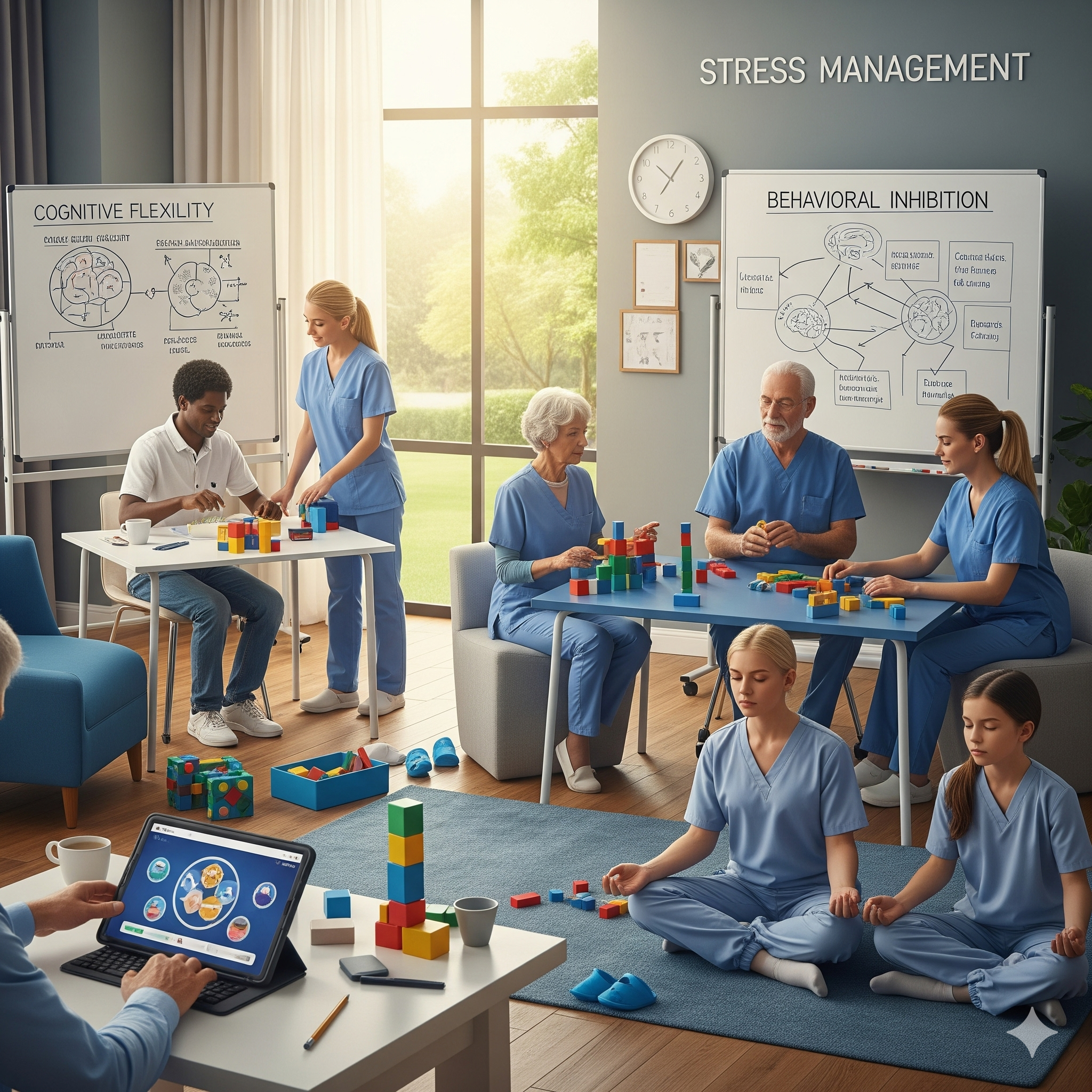
Stress is a significant mental health problem that adversely affects quality of life, particularly in Koh Chan District, Chonburi Province, where the prevalence of stress-related conditions is continuously rising. This research and development study aimed to: 1) examine the situation of patients with stress-related conditions at Koh Chan Hospital, Chonburi Province; 2) develop a rehabilitation program integrating cognitive flexibility and behavioral inhibition for problem coping; and 3) evaluate the effectiveness of the developed program among patients experiencing stress. The study was conducted in a three-phase research and development (R&D) design. Phase I examined the stress situation among working-age individuals (25–59 years) using questionnaires and in-depth interviews. Phase II involved developing a rehabilitation program by integrating cognitive rehabilitation and self-regulation concepts with local healthcare personnel. Phase III implemented and tested the program over six weeks with 30 patients diagnosed with stress. Instruments included: 1) the cognitive flexibility and behavioral inhibition program, 2) the Suanprung Stress Test-20 (SPST-20), 3) the Resilience Quotient (RQ), and 4) a cognitive flexibility assessment. Data were analyzed using descriptive statistics, paired t-tests, and content analysis.
Results: Phase I, most participants were female (mean age = 38 ± 9.67 years), with high levels of stress (Mean = 52.04, S.D. = 14.02) and low resilience (Mean = 51.89, S.D. = 11.99). Phase II developed an eight-component rehabilitation program to enhance problem-solving skills. Phase III showed significant reductions in stress (Mean = 40.57, S.D. = 9.29) and improvements in resilience, cognitive flexibility, and behavioral inhibition (Mean = 53.60, 73.13, 39.87, respectively; p < .001), affirming the program’s effectiveness and its potential for broader application within community mental health services.
References
World Health Organization. World mental health report: transforming mental health for all [Internet]. Geneva: WHO; 2022 [cited 2024 October 16]. Available from: https://www.who.int/publications/i/item/9789240049338.
สำนักงานสภาพัฒนาการเศรษฐกิจและสังคมแห่งชาติ. รายงานภาวะสังคมไทยไตรมาสที่ 2 ปี 2566. กรุงเทพฯ: สภาพัฒน์ฯ; 2566.
กรมสุขภาพจิต. สถิติผู้ป่วยด้านสุขภาพจิตระดับประเทศ ปี 2566. กรุงเทพฯ: กระทรวงสาธารณสุข; 2566.
กระทรวงสาธารณสุข. แผนยุทธศาสตร์สุขภาพจิตแห่งชาติ ฉบับที่ 2 พ.ศ. 2565–2570. กรุงเทพฯ: กรมสุขภาพจิต; 2565.
Roy C. The Roy Adaptation Model. 3rd ed. Upper Saddle River, NJ: Pearson; 2009.
Güngörmüş Z, Okanlı A. Effect of nursing interventions based on Roy adaptation model on stress and adaptation in hemodialysis patients. Int J Caring Sci 2024;17:56–64.
Hosseini M, Soltanian M. Application of Roy’s adaptation model in clinical nursing: A systematic review. J Iran Med Council 2022;5:540-56. doi: 10.18502/jimc.v5i4.11327.
Choi J, Nuechterlein KH, O'Reilly R. Cognitive remediation therapy for stress management. Int J Psychol 2018;52:215–25.
Lam P, Chien WT. Effects of self-control strategies on stress management. Stress Health 2016;32:400–9.
Lee M, Rong M, Hsu K, Liu W, Kuo H. Behavioral regulation techniques for patients with stress. Behav Sci 2018;38:321–9.
Girotti M, Bulin SE, Carreno FR. Effects of chronic stress on cognitive function – from neurobiology to intervention. Neurobiol Stress 2024;33:100670. doi: 10.1016/j.ynstr.2024.100670
Rosa‑Alcázar AI, Rosa‑Alcázar Á, Martínez‑Esparza IC, Storch EA, Olivares‑Olivares PJ. Response inhibition, cognitive flexibility and working memory in OCD, GAD and social anxiety disorder. Int J Environ Res Public Health 2021;18:3642.
โรงพยาบาลเกาะจันทร์. รายงานระบบสุขภาพอำเภอเกาะจันทร์ ปีงบประมาณ 2567. ชลบุรี: สำนักงานสาธารณสุขจังหวัดชลบุรี; 2567.
สำนักโรคไม่ติดต่อ. รายงานอัตราการฆ่าตัวตายประเทศไทย ปี 2566. กรุงเทพฯ: กรมควบคุมโรค; 2566.
Wykes T, Reeder C. Cognitive remediation therapy for schizophrenia: Theory and practice. London: Routledge; 2005.
Rosenbaum M. A schedule for assessing self-control behaviors: Preliminary findings. Behav Ther 1980;11:109–21.
กรมสุขภาพจิต. แบบวัดระดับความเครียด SPST-20. นนทบุรี: สำนักพัฒนาสุขภาพจิต; 2562.
กรมสุขภาพจิต. คู่มือการประเมิน Resilience Quotient (RQ). นนทบุรี: สำนักสุขภาพจิตสังคม; 2561.
Grotberg EH. A guide to promoting resilience in children: Strengthening the human spirit. The Hague: Bernard van Leer Foundation; 1995.
Martin MM. Cognitive flexibility and psychological health. J Pers Soc Psychol. 1998;74:332–46.
Scott T, Barros C. Enhancing adaptive thinking through flexible cognition programs. Cogn Behav Res 2020;42:198–210.
Daniel WW. Biostatistics: A foundation for analysis in the health sciences. 7th ed. New York: Wiley; 1999.
Cohen J. Statistical power analysis for the behavioral sciences. 2nd ed. Hillsdale, NJ: Lawrence Erlbaum; 1988.
Lincoln YS, Guba EG. Naturalistic inquiry. Newbury Park (CA): Sage Publications; 1985.
Kirkpatrick DL, Kirkpatrick JD. Evaluating training programs: The four levels. San Francisco: Berrett-Koehler Publishers; 2006.
Bonanno GA. Loss, trauma, and human resilience: Have we underestimated the human capacity to thrive after extremely aversive events?. Am Psychol 2004;59:20–8.
Kabat-Zinn J. Full catastrophe living: Using the wisdom of your body and mind to face stress, pain, and illness. New York: Delta; 1990.
Kabat-Zinn J, Hanh TN. The miracle of mindfulness: An introduction to the practice of meditation. Boston: Beacon Press; 2009.
Baumeister RF, Heatherton TF. Self-regulation failure: An overview. Psychol Inq. 1996;7:1–15.
Tangney JP, Baumeister RF, Boone AL. High self-control predicts good adjustment, less pathology, better grades, and interpersonal success. J Pers 2004;72:271–324.
Downloads
Published
How to Cite
Issue
Section
License
Copyright (c) 2025 Boromarajonani College of Nursing Sunpasitthiprasong

This work is licensed under a Creative Commons Attribution-NonCommercial-NoDerivatives 4.0 International License.
บทความที่ได้รับการตีพิมพ์เป็นลิขสิทธิ์ของวารสารวิทยาศาสตร์สุขภาพ วิทยาลัยพยาบาลบรมราชชนนี สรรพสิทธิประสงค์ ข้อความที่ปรากฏในบทความแต่ละเรื่องเป็นความคิดเห็นส่วนตัวของผู้เขียนแต่ละท่านไม่เกี่ยวข้องกับวิทยาลัยพยาบาลบรมราชชนนี สรรพสิทธิประสงค์ และคณาจารย์ท่านอื่นๆ ในวิทยาลัยพยาบาลฯ ความรับผิดชอบเกี่ยวกับบทความแต่ละเรื่องผู้เขียนจะรับผิดชอบของตนเอง