
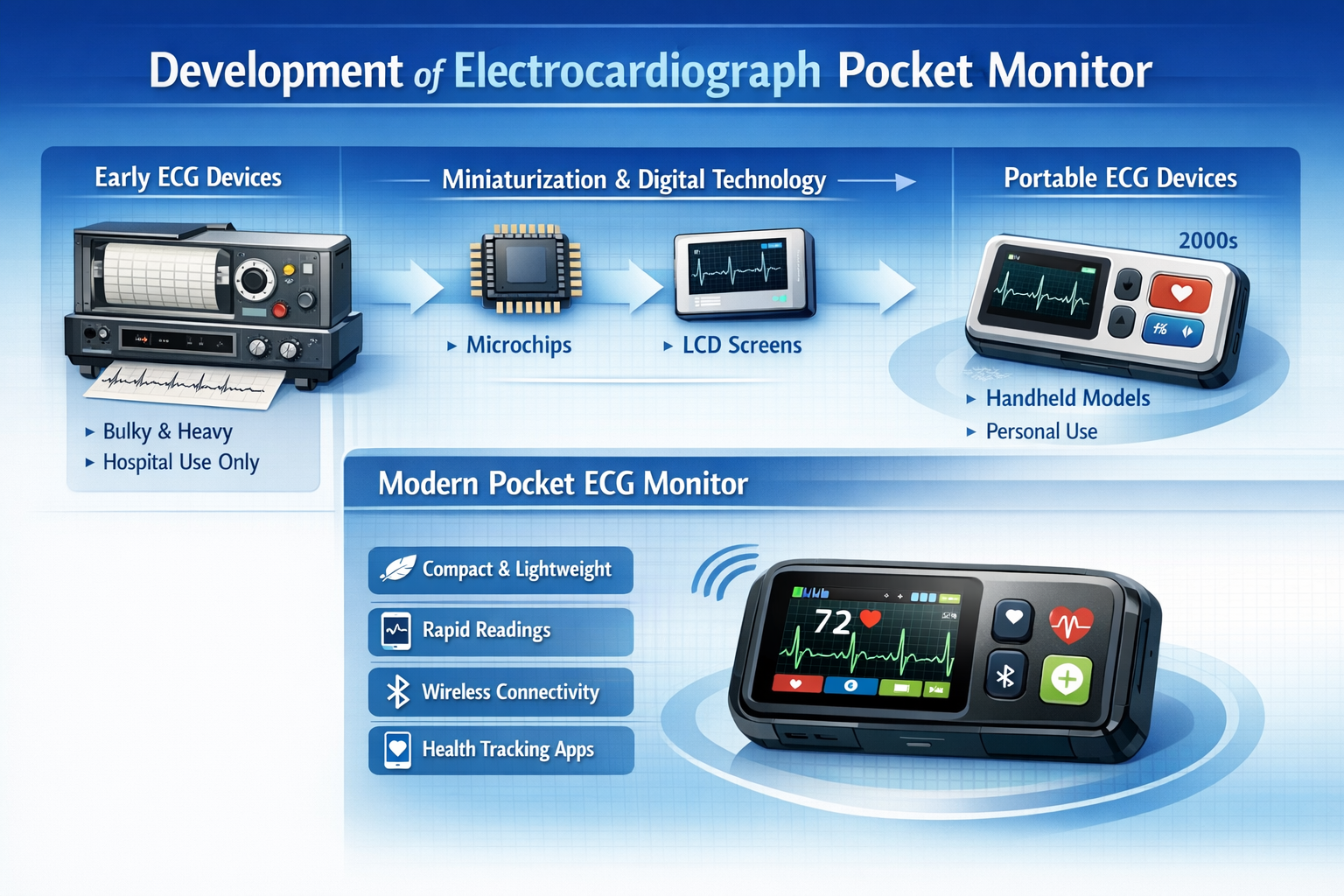
Development of Electrocardiograph Pocket Monitor
Keywords:
electrocardiogram, heart disease, vital signs simulatorAbstract
Introduction: An electrocardiogram (ECG/EKG) is an electrical signal detected by sensors that aids in monitoring and diagnosing irregularities in a patient's heart rhythms. However, standard electrocardiogram machines are still limited by their cost, size, and portability, which impacts their accessibility for continuous monitoring or use outside of hospitals.
Objectives: Consequently, this study aims to (1) develop a prototype device capable of measuring patients' electrocardiogram signals using all six limb leads (I, II, III, aVR, aVL, and aVF) and displaying the patient's heart rate, and (2) evaluate its technical performance in an exploratory (proof-of-concept) manner under controlled conditions.
Methods: A prototype of a portable electrocardiograph device, known as the Electrocardiograph Pocket Monitor, was developed. It utilizes a sensor to detect electrocardiogram signals as the input component and employs a microcontroller for signal processing. The processed electrocardiogram data is then transmitted for display on a 7-inch touchscreen. The device's performance was evaluated using a Fluke ProSim8 vital signs simulator across four experiments: amplitude measurement, heart rate measurement, battery life testing, and display performance testing.
Results and Conclusion: The portable electrocardiogram (ECG) device developed is capable of consistently measuring electrical signals from all six limb leads, with an average amplitude deviation of no more than 10% (average for 6 leads = 9.25%). Additionally, it achieves an average heart rate measurement deviation of just 0.6% when compared to the standard vital sign simulator, Fluke ProSim8. The device is powered by a battery that allows for continuous operation for approximately 26 hours. The findings of this study suggest that the newly developed portable electrocardiogram device holds promise as a tool for monitoring and screening heart rhythm abnormalities outside medical facilities. Additionally, it can serve as a prototype for future development of low-cost medical devices.
References
คมสิงห์ เมธาวีกุล. อุปกรณ์ดิจิทัลสำหรับการตรวจพบและวินิจฉัยผู้ป่วยโรคหัวใจเต้นผิดจังหวะ. วารสารกรมการแพทย์ 2566;3:39–44.
อภิญญา คล้ายใจตรง, วสุ พันไพศาล, ไกรลาส มาตรมูล. เครื่องวัดสัญญาณคลื่นเสียงหัวใจผ่านเครือข่ายไร้สายบลูทูธ. PSRU J of Sci Technol 2018;3:13-25.
เกรียงศักดิ์ พรมภักดิ์, ทัศวรรณ พุทธสกุล, นุชนาถ ยศปัญญา, เสาวลักษณ์ หน่อคาสุก, อนุชา แก้วพูลสุข. เครื่องวัดสัญญาณไฟฟ้าหัวใจแบบไร้สายโดยใช้ ADuC842. NU Science J 2007;4:123-31.
Elgendi M. On the analysis of fingertip photoplethysmogram signals. Curr Cardiol Rev 2012;8:14–25.
Elbey MA, Young D, Kanuri SH, Akella K, Murtaza G, Garg J, et al. Diagnostic utility of smartwatch technology for atrial fibrillation detection: A systematic analysis. J Atr Fibrillation 2021;13:20200446.
Strik M, Ploux S, Ramirez FD, Abu-Alrub S, Jais P, Haïssaguerre M, et al. Smartwatch-based detection of cardiac arrhythmias: beyond the differentiation between sinus rhythm and atrial fibrillation. Heart Rhythm 2021;18:1524–32.
Turakhia MP. Wearable Devices in Cardiovascular Medicine. In: Libby P, Bonow RO, Mann DL, Tomaselli GF, Bhatt DL, Solomon SD, editors. Braunwald's Heart Disease: A Textbook of Cardiovascular Medicine. 12th ed. Philadelphia: Elsevier; 2022. p.117–22.
Mirvis DM, Goldberger AL. Electrocardiography. In: Libby P, Bonow RO, Mann DL, Tomaselli GF, Bhatt DL, Solomon SD, editors. Braunwald's Heart Disease: A Textbook of Cardiovascular Medicine. 12th ed. Philadelphia: Elsevier; 2022. p.141–74.
Brandes A, Stavrakis S, Freedman B, Antoniou S, Boriani G, Camm AJ, et al. Consumer-led screening for atrial fibrillation: frontier review of the AF-SCREEN international collaboration. Circulation 2022;146:1461-74.
Svennberg E, Tjong F, Goette A, Akoum N, Biase LD, Bordachar P, et al. How to use digital devices to detect and manage arrhythmias: an EHRA practical guide. Europace 2022;24:979-1005.
Downloads
Published
How to Cite
Issue
Section
License
Copyright (c) 2026 Boromarajonani College of Nursing Sunpasitthiprasong

This work is licensed under a Creative Commons Attribution-NonCommercial-NoDerivatives 4.0 International License.
บทความที่ได้รับการตีพิมพ์เป็นลิขสิทธิ์ของวารสารวิทยาศาสตร์สุขภาพ วิทยาลัยพยาบาลบรมราชชนนี สรรพสิทธิประสงค์ ข้อความที่ปรากฏในบทความแต่ละเรื่องเป็นความคิดเห็นส่วนตัวของผู้เขียนแต่ละท่านไม่เกี่ยวข้องกับวิทยาลัยพยาบาลบรมราชชนนี สรรพสิทธิประสงค์ และคณาจารย์ท่านอื่นๆ ในวิทยาลัยพยาบาลฯ ความรับผิดชอบเกี่ยวกับบทความแต่ละเรื่องผู้เขียนจะรับผิดชอบของตนเอง