
Effects of self-efficacy enhancement program using virtual reality simulation on nursing practice confidence and learning satisfaction of nursing students before clinical nursing
Keywords:
Self-efficacy enhancement, Virtual reality simulation, Nursing practice confidence, Learning satisfaction, Nursing studentsAbstract
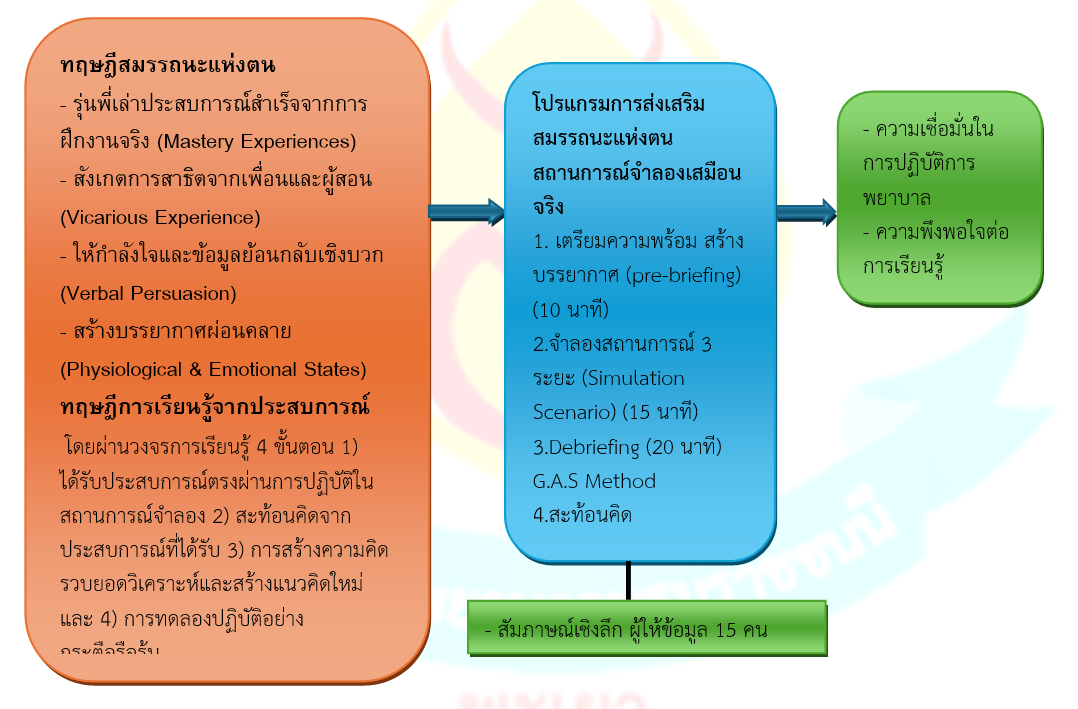
Nursing practice confidence is a critical factor influencing the quality of patient care; however, nursing students before clinical ward practicum often lack confidence, particularly in critical situations. This sequential explanatory mixed-methods study aimed to examine the effects of a self-efficacy enhancement program using virtual reality simulation on nursing practice confidence and learning satisfaction of nursing students before clinical nursing practice. The sample consisted of 54 nursing students randomly assigned to an experimental group (n=27) and a control group (n = 27) using simple randomization. Research instruments comprised: 1) a self-efficacy enhancement program using virtual reality simulation (IOC=.83–1.00), 2) a Nursing Practice Confidence Assessment (Cronbach's α=.96), 3) a Learning Satisfaction Assessment (α=.94), and 4) a semi-structured interview with 15 key informants. Data were analyzed using independent and paired t-tests. At baseline, both groups showed similar confidence levels (p=.842). Following program completion, the experimental group demonstrated significantly higher nursing practice confidence than the control group (t=11.235, d=3.11, p<.001) and significantly higher than before the program (t=21.108, d=3.18, p<.001). Learning satisfaction was significantly higher than the group receiving conventional instruction across all dimensions (t = 11.267, d=3.06, p<.001), with perceived benefits rated highest (=4.56, SD=.32, d=3.02), followed by media and equipment (d=2.98) and learning process (d=2.73). Qualitative findings revealed three key themes: building confidence through safe practice environments, enhancing engagement through realistic experiences, and connecting theory to practice through knowledge integration. These findings support the use of virtual reality simulation for preparing nursing students before clinical nursing practice.
References
Alharbi, A., Nurfianti, A., Mullen, R. F., McClure, J. D., & Miller, W. H. (2024). The effectiveness of simulation-based learning (SBL) on students' knowledge and skills in nursing programs: A systematic review. BMC Medical Education, 24, 1099. https://doi.org/10.1186/s12909-024-06080-z
Bandura, A. (1997). Self-efficacy: The exercise of control. Freeman.
Bdiri Gabbouj, S., & Zedini, C. (2024). Nursing students' satisfaction and self-confidence with simulation-based learning and its associations with simulation design characteristics and educational practices. Advances in Medical Education and Practice, 15, 1093–1102. https://doi.org/10.2147/AMEP.S477309
Braun, V., & Clarke, V. (2022). Thematic analysis: A practical guide (2nd ed.). Sage Publications.
Chabrera, C., Fernández, P., & Rodríguez, E. (2024). The use of simulation in nursing education programs: A cross-sectional interuniversity study. Nursing Forum, 59(1), 1091530. https://doi.org/10.1155/2024/1091530
Chang, W., Lin, C., Crilly, J., Lee, H., Chen, L., & Han, C. (2024). Virtual reality simulation for undergraduate nursing students for care of patients with infectious diseases: Mixed methods study. JMIR Medical Education, 10, e64780. https://doi.org/10.2196/64780
Chatchawal, N., Yuwadee, A., Urai, P., & Anchalee, A. (2022). Effects of multi-scenario simulation learning program on military nursing competency of army nursing students. Journal of the Royal Thai Army Nurses, 23(2), 109–118. Retrieved from https://he01.tci-thaijo.org/index.php/JRTAN/article/view/258938 (in Thai)
Chubkhuntod, P., Thasenaaelter, P., Kaewkunton, N., & Potchana, R. (2020). Effects of simulation-based learning approach on knowledge, self-efficacy perception, and ability to use nursing process during labor period of nursing students. Journal of Health Science, 29(6), 1062–1072. Retrieved from https://thaidj.org/index.php/JHS/article/view/9623 (in Thai)
Cohen, J. (1988). Statistical power analysis for the behavioral sciences (2nd ed.). Lawrence Erlbaum Associates.
Cruz Araújo, A. A., de Godoy, S., Arena Ventura, C. A., Rodolfo Silva, Í., Santos de Almeida, E. W., & Costa Mendes, I. A. (2022). Reflections on nursing students' fear and anxiety arising from clinical practicums. Investigación y Educación en Enfermería, 40(3), e13. https://doi.org/10.17533/udea.iee.v40n3e13
Edmondson, A. C. (2019). The fearless organization: Creating psychological safety in the workplace for learning, innovation, and growth. Wiley.
Faculty of Nursing, North Bangkok University. (2023). Report on student readiness assessment before nursing practicum, academic year 2023 [Unpublished manuscript]. (in Thai)
Field, A. (2018). Discovering statistics using IBM SPSS statistics (5th ed.). Sage Publications.
García-Velasco, L., Alcoceba-Herrero, I., García, S., López, M., Albertos-Muñoz, I., Castro, M. J., & Jiménez, J. M. (2025). Assessing anxiety and stress levels in undergraduate nursing students during their clinical placements: A quasi-experimental study. BMC Nursing, 24(1), 620. https://doi.org/10.1186/s12912-025-03264-w
Jackson, M., McTier, L., Brooks, L. A., & Wynne, R. (2024). Impact of simulation design elements on undergraduate nursing education: A systematic review. Clinical Simulation in Nursing, 89, 101519. https://doi.org/10.1016/j.ecns.2024.101519
Knowles, M. S., Holton, E. F., & Swanson, R. A. (2020). The adult learner: The definitive classic in adult education and human resource development (9th ed.). Routledge.
Kolb, D. A. (2015). Experiential learning: Experience as the source of learning and development (2nd ed.). Pearson.
Lave, J., & Wenger, E. (2021). Situated learning: Legitimate peripheral participation. Cambridge University Press.
Malterud, K., Siersma, V. D., & Guassora, A. D. (2016). Sample size in qualitative interview studies: Guided by information power. Qualitative Health Research, 26(13), 1753–1760. https://doi.org/10.1177/1049732315617444
Ministry of Public Health. (2018). Competency framework for nurses and midwives. Ministry of Public Health. (in Thai)
Pangsuk, P., & Kingmala, C. (2021). The effect of simulation-based learning on knowledge and self-efficacy of the third year nursing students in caring for emergency patients. Journal of Research in Nursing-Midwifery and Health Sciences, 41(2), 89–100. Retrieved from https://he02.tci-thaijo.org/index.php/nur-psu/article/view/200535 (in Thai)
Ramezanzade Tabriz, E., Sadeghi, M., Tavana, E., Heidarian Miri, H., & Heshmati Nabavi, F. (2024). Approaches for boosting self-confidence of clinical nursing students: A systematic review and meta-analysis. Heliyon, 10(6), e27347. https://doi.org/10.1016/j.heliyon.2024.e27347
Saragih, I. D., Tarihoran, D. E. T. A. U., Lin, W. T., & Lee, B. O. (2024). Outcomes of scenario-based simulation courses in nursing education: A systematic review and meta-analysis. Nurse Education Today, 136, 106145. https://doi.org/10.1016/j.nedt.2024.106145
Srijanpal, W., Thatan, S., & Fukfon, K. (2021). Effects of simulation-based learning on perceived self-efficacy of nursing students in caring for patients with septic shock. Journal of The Royal Thai Army Nurses, 22(1), 283–289. Retrieved from https://he01.tci-thaijo.org/index.php/JRTAN/article/view/241008 (in Thai)
Wongsaree, C. (2019). Teaching critical thinking to generation Z nursing students: A review of literature. Journal of The Royal Thai Army Nurses, 20(1), 21–29. Retrieved from https://he01.tci-thaijo.org/index.php/JRTAN/article/view/184191 (in Thai)
Downloads
Published
How to Cite
Issue
Section
License
Copyright (c) 2026 Journal of Nursing and Health Research

This work is licensed under a Creative Commons Attribution-NonCommercial-NoDerivatives 4.0 International License.

