
Control of Maxillary First Molar Inclination during Intrusion Using TAD-Supported Fixed Appliances versus Clear Aligners in Anterior Open Bite Correction
Article Sidebar
Main Article Content
Abstract
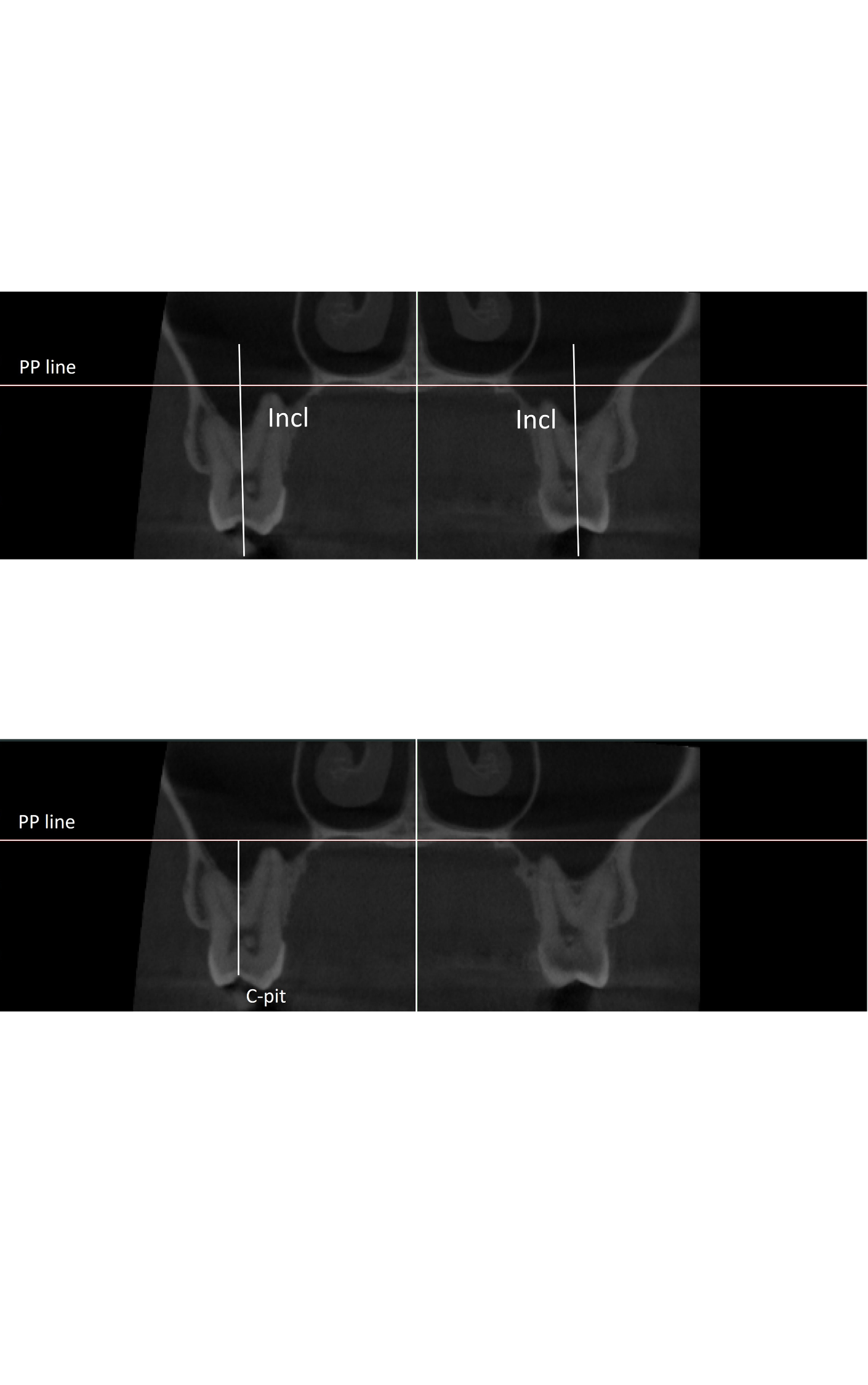
Background: Maxillary first molar intrusion is a key treatment goal for anterior open bite (AOB) patients. The effects of TAD-supported fixed appliances and clear aligners on vertical intrusion and molar inclination are not fully understood. Objective: To compare the effectiveness of TAD-supported fixed appliances and clear aligners in achieving vertical intrusion and controlling molar inclination in adult AOB patients. Materials and methods: Thirty-six adult patients with AOB were randomly assigned to two groups: 17 subjects treated with TAD-supported fixed appliances (TADs) and 19 with clear aligners (CA). Vertical and inclination changes of the maxillary first molars were measured using lateral cephalometric radiographs and CBCT. Spearman’s rank correlation analysis was performed to assess the relationship between vertical and inclination changes. Results: Both groups showed significant vertical intrusion, with the TAD-supported fixed appliance group achieving greater intrusion (1.91 ± 0.88 mm) than the clear aligner group (1.04 ± 0.77 mm). Molar inclination varied significantly between groups, with the TAD group experiencing more tipping and the clear aligner group showing better control of inclination. No significant correlation was found between vertical and inclination changes in either group (r = 0.17 for TADs, r = 0.15 for CA, P > 0.05). Conclusion: TAD-supported fixed appliances offer superior vertical intrusion compared to clear aligners, while clear aligners provide better control of molar inclination. Tailored treatment based on biomechanical demands, using skeletal anchorage for vertical control and precise aligner design for inclination stability, is recommended. Further long-term studies are needed to refine treatment protocols for AOB.
Article Details

This work is licensed under a Creative Commons Attribution-NonCommercial-NoDerivatives 4.0 International License.
References
Lopez-Gavito G, Wallen TR, Little RM, Joondeph DR. Anterior open-bite malocclusion: a longitudinal 10-year postretention evaluation of orthodontically treated patients. Am J Orthod 1985;87(3):175–86.
Kuroda S, Sakai Y, Tamamura N, Deguchi T, Takano- Yamamoto T. Treatment of severe anterior open bite with skeletal anchorage in adults: comparison with orthognathic surgery outcomes. Am J Orthod Dentofacial Orthop 2007;132(5):599–605.
Xun C, Zeng XL, Wang X. Clinical application of mini-screw implant anchorage in the treatment of skeletal anterior open bite. Angle Orthod 2007;77(1):47–56.
Erverdi N, Keles A, Nanda R. The use of skeletal anchorage in open-bite treatment: a cephalometric evaluation. Angle Orthod 2004;74(3):381–90.
Yao CC, Lee JJ, Chen HY, Chang ZC, Chang HF, Chen YJ. Maxillary molar intrusion with fixed appliances and mini-implant anchorage studied in three dimensions. Angle Orthod 2005;75(5):754–60.
Kawamura J, Park JH, Tamaya N, Oh JH, Chae JM. Biomechanical analysis of the maxillary molar intrusion: a finite element study. Am J Orthod Dentofacial Orthop 2022;161(6):775–82.
Park HS, Jang BK, Kyung HM. Maxillary molar intrusion with micro-implant anchorage (MIA). Aust Orthod J 2005;21(2):129–35.
Tangsumroengvong V, Patanaporn V, Rungsiyakul C, Chalermwong H. Intrusion of maxillary posterior teeth with miniscrew anchorage: a finite element study. CM Dent J 2021;42(1):91–101.
Ritchie C, McGregor S, Bearn DR. Temporary anchorage devices and the forces and effects on the dentition and surrounding structures during orthodontic treatment: a scoping review. Eur J Orthod 2023;45(3):324–37.
Withayanukonkij W, Chanmanee P, Promsawat M, Viteporn S, Leethanakul C. Root resorption during maxillary molar intrusion with clear aligners: a randomized controlled trial. Angle Orthod 2024;94(5):629–37.
Tasanapanont J, Wattanachai T, Apisariyakul J, Pothacharoen P, Ongchai S, Kongtawelert P, et al. Biochemical and clinical assessments of segmental maxillary posterior tooth intrusion. Int J Dent 2017;2017:1-6.
Wang X, Zhao Y, Fan M, Zhou T, Fang B, Ye N. Effects of transpalatal arch wire dimension and temporary skeletal anchorage device position on maxillary molar intrusion. Angle Orthod 2024;94(4):408–13.
Miao Z, Zhang H, Yang Y, Han Y, Leng J, Wang S. Influence of maxillary molar distalization with clear aligners on three-dimensional direction: molar distal movement, intrusion, distal tip and crown buccal torque. Prog Orthod 2023;24(1):18.
Papadimitriou A, Mousoulea S, Gkantidis N, Kloukos D. Clinical effectiveness of Invisalign® orthodontic treatment: a systematic review. Prog Orthod 2018;19(1):37.
World Medical Association. Declaration of Helsinki: ethical principles for medical research involving human subjects. JAMA 2013;310(20):2191–4.
Faul F, Erdfelder E, Lang AG, Buchner A. G*Power 3: a flexible statistical power analysis program for the social, behavioral, and biomedical sciences. Behav Res Methods 2007;39(2):175–91.
Dahlberg G. Statistical methods for medical and biological students. Br Med J 1940;2:358–9.
Rossini G, Parrini S, Castroflorio T, Deregibus A, Debernardi CL. Efficacy of clear aligners in controlling orthodontic tooth movement: a systematic review. Angle Orthod 2015;85(5):881–9.
Talens-Cogollos LM, García-Sanz V, Paredes-Gallardo V, Cibrián R, Gandía JL, Peñarrocha-Diago M. Influence of attachment shape and placement on molar movement with aligners: a finite element study. J Clin Exp Dent 2021;13(3):e252–9.
Harris K, Ojima K, Dan C, Upadhyay M, Alshehri A, Kuo CL, et al. Evaluation of open bite closure using clear aligners: a retrospective study. Prog Orthod 2020;21(1):23.
Vilamas K, Leethanakul C. The root length change in posterior teeth intrusion in anterior open bite patient. Proc Multidiscip Res 2024;2(5):59.
Kravitz ND, Kusnoto B, Begole E, Obrez A, Agran B. How well does Invisalign work? A prospective clinical study evaluating the efficacy of tooth movement with Invisalign. Am J Orthod Dentofacial Orthop 2009;135(1):27–35.
Hoederath H, Bourauel C, Drescher D. Differences between two transpalatal arch systems upon first-, second-, and third-order bending activation. J Orofac Orthop 2001;62(1):58–73.
Crismani AG, Celar AG, Burstone CJ, Bernhart TG, Bantleon HP, Mittlboeck M. Sagittal and vertical load-deflection and permanent deformation of transpalatal arches connected with palatal implants: an in-vitro study. Am J Orthod Dentofacial Orthop 2007;131(6):742–52.
Rebellato J. Two-couple orthodontic appliance systems: transpalatal arches. Semin Orthod 1995;1(1):44–54.
