
Correction of Anterior Open Bite with Clear Aligner: A Case Report
Article Sidebar
Main Article Content
Abstract
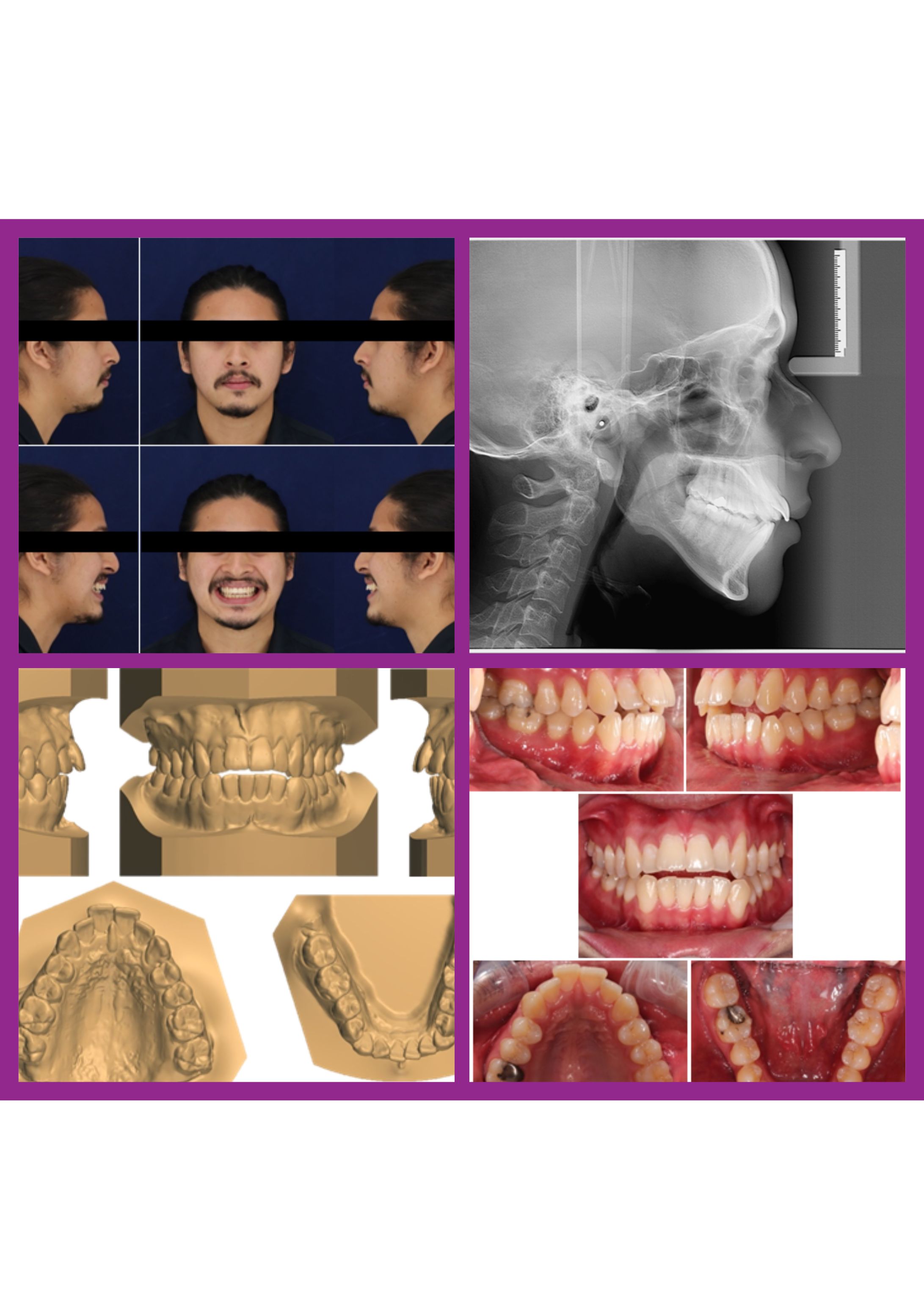
Background: This case report describes the orthodontic management of a 22-year-old Thai male with anterior open bite and a skeletal Class II hyperdivergent pattern. The patient exhibited a convex profile, increased lower anterior facial height, and severe crowding in the lower arch. Malocclusion presented as a large overjet (6 mm), negative overbite (−3 mm), and Class II canine and Class III molar relationships. A clear aligner system was chosen to address both aesthetic concerns and functional needs. Treatment objectives included correction of anterior open bite, establishment of Class I canine and molar relationships, resolution of crowding, improvement of dental midlines, and enhancement of facial profile. A total of 51 pairs of aligners were used in two sets, with interproximal reduction and expansion employed to create space and correct arch form discrepancies. After 26 months of treatment, normal overjet and overbite were achieved, both arches were well aligned, and a Class I molar and canine relationship was established. The patient’s profile improved with a normal smile line and reduced buccal corridor. Posttreatment records confirmed the stability of results with no root resorption or temporomandibular joint symptoms. Cephalometric evaluation showed improved incisor inclinations and a normalized interincisal angle. The patient successfully entered the retention phase with full-time wear of clear retainers. This case highlights the efficacy of clear aligners in treating complex malocclusions that include anterior open bite when case selection, biomechanics, and compliance are carefully managed.
Article Details

This work is licensed under a Creative Commons Attribution-NonCommercial-NoDerivatives 4.0 International License.
References
Lone IM, Zohud O, Midlej K, Paddenberg E, Krohn S, Kirschneck C, et al. Anterior open bite malocclusion: from clinical treatment strategies towards the dissection of the genetic bases of the disease using human and collaborative cross mice cohorts. J Pers Med 2023;13(11):1617.
Alsafadi AS, Alabdullah MM, Saltaji H, Abdo A, Youssef M. Effect of molar intrusion with temporary anchorage devices in patients with anterior open bite: a systematic review. Prog Orthod 2016;17:9.
AlMogbel A. Clear aligner therapy: up to date review article. J Orthod Sci 2023;12:37.
Simon M, Keilig L, Schwarze J, Jung BA, Bourauel C. Treatment outcome and efficacy of an aligner technique-- regarding incisor torque, premolar derotation and molar distalization. BMC Oral Health 2014;14:68.
Zhou C, Feng Z, Ren J, Luo H, Ieong HC, Li R, et al. The effects of clinical crown length on the sagittal movement of maxillary central incisor in clear aligner treatment: a finite element exploration. BMC Oral Health 2025;25(1):357.
Schiffman E, Ohrbach R, Truelove E, Look J, Anderson G, Goulet JP, et al. Diagnostic criteria for temporomandibular disorders (DC/TMD) for clinical and research applications: recommendations of the international RDC/TMD consortium network and orofacial pain special interest groupdagger. j oral facial pain headache 2014;28(1):6-27.
Bolton WA. Disharmony in tooth size and its relation to the analysis and treatment of malocclusion. Angle Orthod 1958;28(3):113-30.
Chintawongvanich J, Thongudomporn U. Arch dimension and tooth size in class i malocclusion patients with anterior crossbite. J Dent Assoc Thai 2013;63(1):31-38.
Mishra G, R B, Bhogte SA, Chitra P. Idiopathic osteosclerosis in orthodontic patients: a report of two cases. Cureus 2024;16(2):e53426.
Sorathesn K. Craniofacial norm for Thai in combined orthodontic surgical procedure. J Dent Assoc Thai 1988;38(5):190-201.
Suchato W, Chaiwat J. Cephalometric evaluation of the dentofacial complex of Thai adults. J Dent Assoc Thai 1984;34(5):233-43.
Dachkunakron S. Thai adult norms in various lateral cephalometric analyses. J Dent Assoc Thai 1994;44(5):202-14.
Pornsirianand V, Chavanavesh J, Kanpittaya P, Somboonsavatdee A. Retrospective cross-sectional study of quadratic-linear correlations between cephalometric measurements and profile esthetics in adult orthodontic patients. Int Dent J 2025;75(3):1472-81.
Proffit WR, Fields HW, Larson B, Sarver DM. Contemporary orthodontics. 6th ed. South Asia ed. St. Louis: Elsevier Health Sciences; 2018.p.664-7.
Hsu JY, Cheng JH, Feng SW, Lai PC, Yoshida N, Chiang PC. Strategic treatment planning for anterior open bite: a comprehensive approach. J Dent Sci 2024;19(3):1328-37.
Li N, Wang C, Yang M, Chen D, Tang M, Li D, et al. Effects of different tooth movement patterns and aligner thicknesses on maxillary arch expansion with clear aligners: a threedimensional finite element study. Front Bioeng Biotechnol 2024;12:1424319.
Olteanu ND, Romanec C, Cernei ER, Karvelas N, Nastri L, Zetu IN. Scoping review-the effectiveness of clear aligners in the management of anterior open bite in adult patients. Medicina (Kaunas) 2025;61(6):1113.
Iunes TF, A.P, Urzal, V. The effectiveness of aligners in the treatment of anterior open bite in adult patients: a systematic review and critical appraisal. Oral 2024;4(2): 173-84.
Blundell HL. Deep bite correction with clear aligners – after 26 years where are we at? Semin Orthod 2025:1–5.
Shahabuddin N, Kang J, Jeon HH. Predictability of the deep overbite correction using clear aligners. Am J Orthod Dentofacial Orthop 2023;163(6):793-801.
Papadimitriou A, Mousoulea S, Gkantidis N, Kloukos D. Clinical effectiveness of Invisalign(R) orthodontic treatment: a systematic review. Prog Orthod 2018;19(1):37.
