
Clinical Accuracy of Structured‑Light vs Active‑Illumination Multi‑View Stereo 3D Facial Scanners: A Comparative Study
Article Sidebar
Main Article Content
Abstract
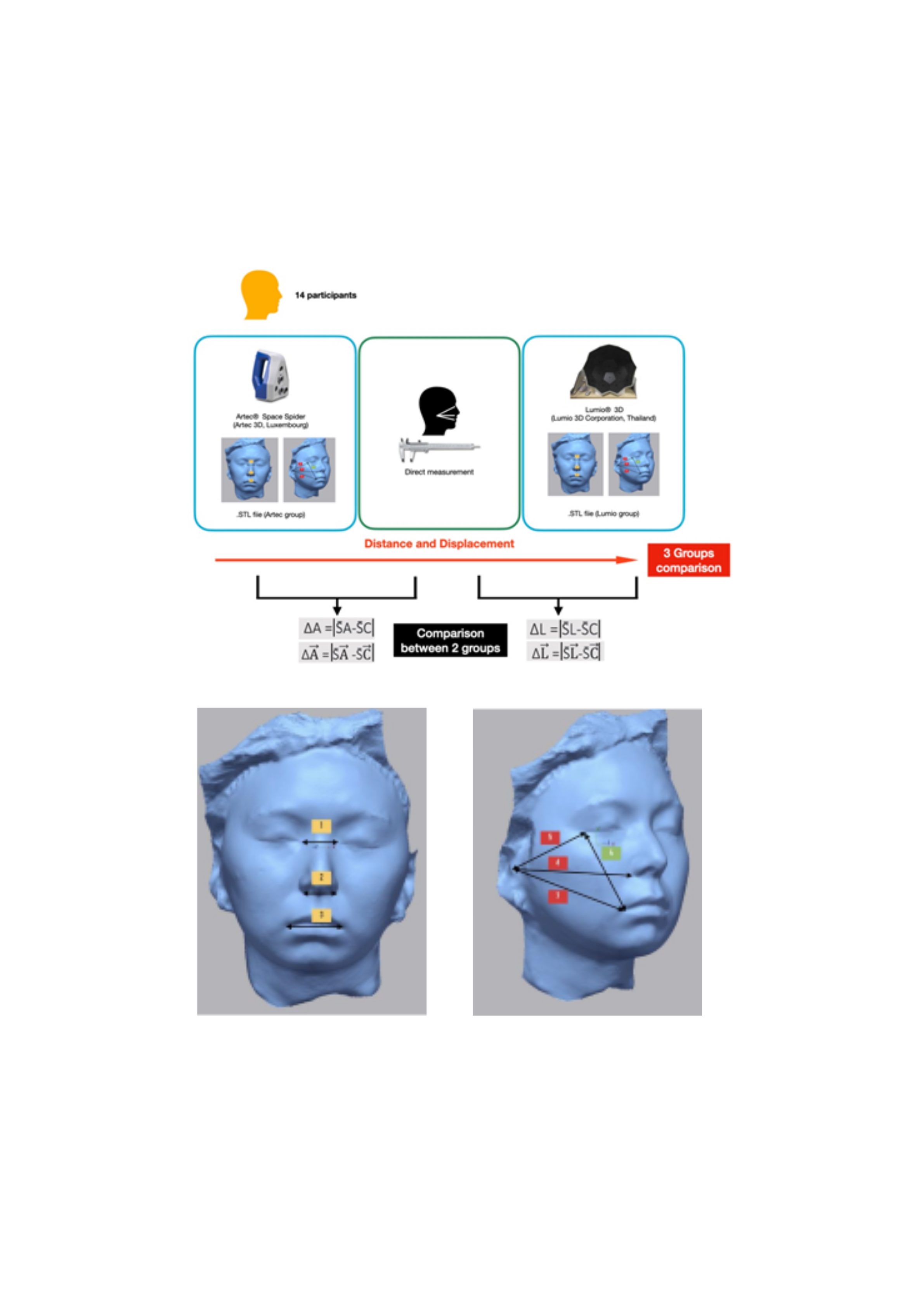
Background: Three-dimensional facial scanners are widely used in medical and dental fields for diagnostics, treatment planning, and postoperative evaluations. While scanner specifications provide nominal accuracy, actual clinical accuracy may vary due to facial complexity. Objective: This study aimed to evaluate and compare the clinical accuracy of two 3D facial scanners with different technologies: the structured light system (Artec® Space Spider, Artec 3D, Luxembourg) and the active illumination multi-view stereo system (Lumio® 3D, Lumio 3D Corporation, Thailand). Materials and methods: Fourteen participants underwent simultaneous 3D facial scanning using both scanners. An examiner measured distances and displacements between imaginary lines defined by anatomical landmarks, both directly on the participants’ faces and on their 3D models. Measurements were categorized into three groups and analyzed using one-way ANOVA and the Kruskal-Wallis test. Deviations in displacements and distances between each scanner’s data and the direct measurements were evaluated using paired t-tests and Wilcoxon signed-rank tests (P < 0.05). Results: No statistically significant differences were found among the three measurement groups overall. However, a significant difference in displacement deviation was observed between the two scanners in the orbital and nasal regions. Conclusion: Artec® space spider and Lumio® 3D scanners showed no significant difference in facial scanning accuracy compared to the direct measurement method. However, significant discrepancies were noted in the eye and nose region, likely due to anatomical complexity and movement. These areas may require special attention for improved scanning precision.
Article Details

This work is licensed under a Creative Commons Attribution-NonCommercial-NoDerivatives 4.0 International License.
References
Berlin NF, Berssenbrügge P, Runte C, Wermker K, Jung S, Kleinheinz J, et al. Quantification of facial asymmetry by 2D analysis - a comparison of recent approaches. J Craniomaxillofac Surg 2014;42(3):265-71.
Xia JJ, Shevchenko L, Gateno J, Teichgraeber JF, Taylor TD, Lasky RE, et al. Outcome study of computer-aided surgical simulation in the treatment of patients with craniomaxillofacial deformities. J Oral Maxillofac Surg 2011;69(7):2014-24.
Troulis MJ, Everett P, Seldin EB, Kikinis R, Kaban LB. Development of a three-dimensional treatment planning system based on computed tomographic data. Int J Oral Maxillofac Surg 2002;31(4):349-57.
Swennen GR, Schutyser F. Three-dimensional cephalometry: spiral multi-slice vs cone-beam computed tomography. Am J Orthod Dentofacial Orthop 2006;130(3):410-6.
Scarfe WC, Li Z, Aboelmaaty W, Scott SA, Farman AG. Maxillofacial cone beam computed tomography: essence, elements and steps to interpretation. Aust Dent J 2012;57 Suppl 1:46-60.
Mangano C, Luongo F, Migliario M, Mortellaro C, Mangano FG. Combining intraoral scans, cone beam computed tomography and face scans: the virtual patient. J Craniofac Surg 2018;29(8):2241-6.
Javaid M, Haleem A, Kumar L, Current status and applications of 3D scanning in dentistry. Clin Epidemiol Glob Health 2019;7(2):228-33.
Petrides G, Clark JR, Low H, Lovell N, Eviston TJ. Threedimensional scanners for soft-tissue facial assessment in clinical practice. J Plast Reconstr Aesthet Surg 2021;74(3):605-14.
Artopoulos A, Buytaert JA, Dirckx JJ, Coward TJ. Comparison of the accuracy of digital stereophotogrammetry and projection moiré profilometry for three-dimensional imaging of the face. Int J Oral Maxillofac Surg 2014;43(5):654-62.
Marić I, Šiljeg A, Domazetović F, Precision assessment of artec space spider 3D handheld scanner for quantifying tufa formation dynamics on small limestone plates (PLs). In proceedings of the 8th international conference on geographical information systems theory, applications and management; Science and Technology Publications, Lda; 2022.p.27-29.
Chalearnthongtakul S, Arunjaroensuk S, Kaboosaya B, Dhanesuan K, Tunwatatanapong B, Pimkhaokham A, The accuracy and precision of twelve-angle camera facial scan system for measurement of facial soft tissue. J Dent Assoc Thai 2023;73(2):145-52.
Zhao YJ, Xiong YX, Wang Y. Three-dimensional accuracy of facial scan for facial deformities in clinics: a new evaluation method for facial scanner accuracy. PLoS One 2017;12(1):e0169402.
Rudolph H, Salmen H, Moldan M, Kuhn K, Sichwardt V, Wöstmann B, et al. Accuracy of intraoral and extraoral digital data acquisition for dental restorations. J Appl Oral Sci 2016;24(1):85-94.
Piedra-Cascón W, Meyer MJ, Methani MM, Revilla-León M. Accuracy (trueness and precision) of a dual-structured light facial scanner and interexaminer reliability. J Prosthet Dent 2020;124(5):567-74.
Amornvit P, Sanohkan S. The accuracy of digital face scans obtained from 3D scanners: an in vitro study. Int J Environ Res Public Health 2019;16(24):5061.
Ebrahim MA. 3D laser scanners’ techniques overview. Int J Sci Res 2015;4(10):323-31.
Ye H, Lv L, Liu Y, Liu Y, Zhou Y. Evaluation of the accuracy, reliability, and reproducibility of two different 3D facescanning systems. Int J Prosthodont 2016;29(3):213-8.
Quinzi V, Polizzi A, Ronsivalle V, Santonocito S, Conforte C, Manenti RJ, et al. Facial scanning accuracy with stereophotogrammetry and smartphone technology in children: a systematic review. Children (Basel) 2022;9(9):1390.
Lin CC, Hung JH, Huang YH. Immediate ocular changes after light-emitting diode displays exposure-a preliminary study. Front Med (Lausanne). 2022;9:848794.
Buck U, Buße K, Campana L, Schyma C. Validation and evaluation of measuring methods for the 3D documentation of external injuries in the field of forensic medicine. Int J Legal Med 2018;132(2):551-61.
Popan IA, Balc N, Popan A, Carean A. Experimental study on reverse engineering in case of composite materials cut by water jet cutting. InMATEC 2018;178:03004.
Özsoy U, Sekerci R, Hizay A, Yildirim Y, Uysal H. Assessment of reproducibility and reliability of facial expressions using 3D handheld scanner. J Craniomaxillofac Surg 2019;47(6):895-901.
Plooij JM, Maal TJ, Haers P, Borstlap WA, Kuijpers-Jagtman AM, Bergé SJ. Digital three-dimensional image fusion processes for planning and evaluating orthodontics and orthognathic surgery. A systematic review. Int J Oral Maxillofac Surg 2011;40(4):341-52.
