
Comparison of Heat Generation Between Manual Metal Strips and Motor Stripping Discs for Interproximal Reduction: A Systematic Review and Meta-Analysis
Article Sidebar
Main Article Content
Abstract
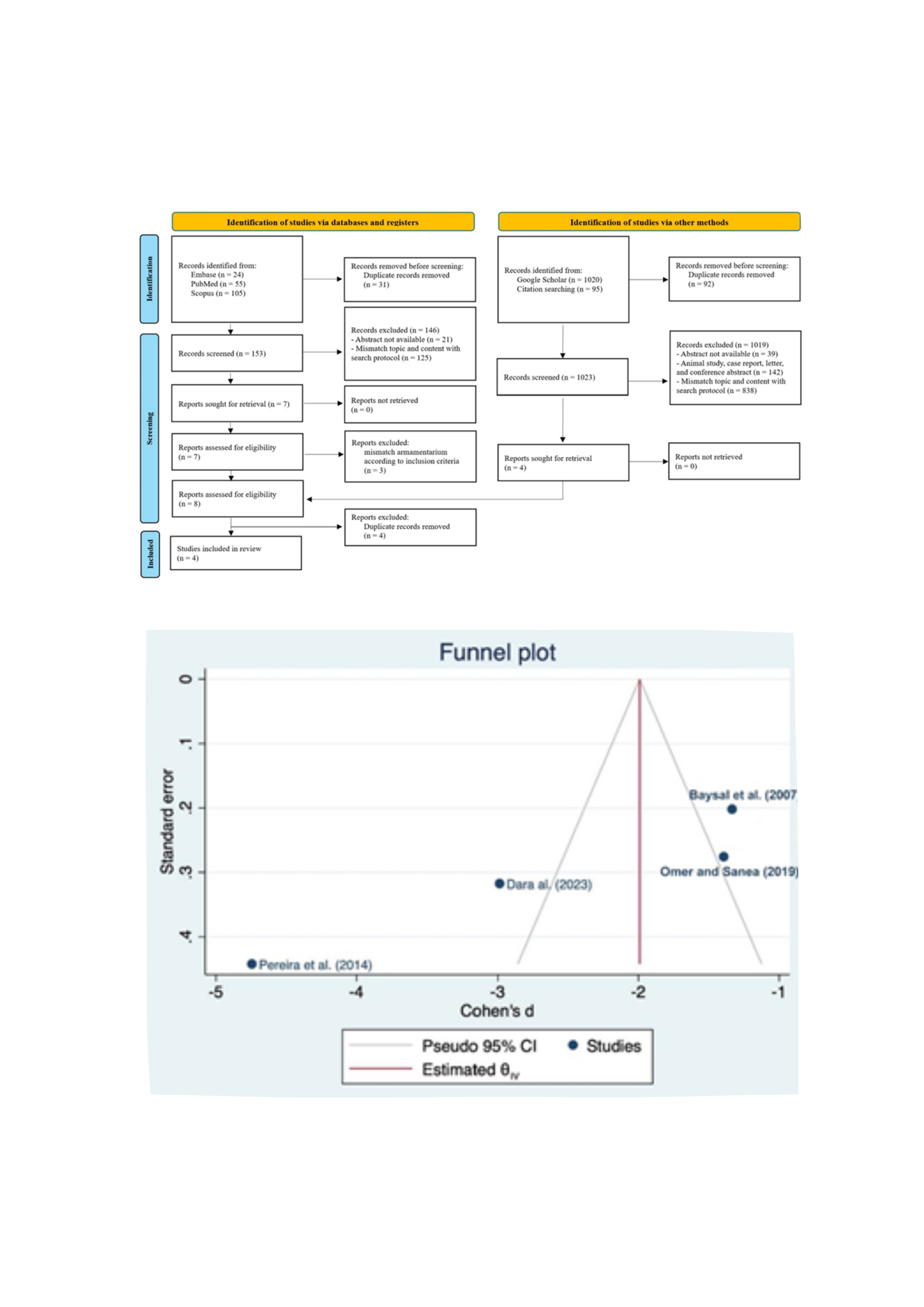
Background: Interproximal reduction (IPR) is a widely used orthodontic procedure that reduces the mesiodistal thickness of teeth to alleviate crowding and achieve optimal occlusion. It involves contouring tooth surfaces using manual or motor instruments. Despite being commonly used, there are concerns about the potential thermal impact on dental pulp caused by friction during the procedure. Objective: To conduct a systematic review and meta-analysis comparing the temperature changes, measured in degrees Celsius, between manual metal strips and motor stripping discs during IPR in a non-clinical setting. Materials and methods: A comprehensive literature search was conducted using four databases: Embase, PubMed, Scopus, and Google Scholar. The risk of bias in the identified studies was assessed using the QUIN tool. Meta-analysis and subgroup analysis were performed, while publication bias was evaluated using Egger’s test. A sensitivity analysis was also conducted. Results: Four in vitro studies met the inclusion criteria, showing a low to moderate risk of bias. The meta-analysis, which included data from 354 tooth surfaces, found that motor stripping discs generated higher temperatures than manual metal strips, with a mean difference of 2.57°C (95 % confidence interval = −3.89, −1.26). A subgroup analysis of premolar teeth showed similar results. Sensitivity analysis confirmed the robustness of the findings. Conclusion: Both manual and motor IPR methods generate mild heat. Clinicians should be aware of overheating risks and employ intermittent stripping with water coolants to reduce temperature increases. The predominance of in vitro studies highlights the need for more clinical trials to enhance generalizability.
Article Details

This work is licensed under a Creative Commons Attribution-NonCommercial-NoDerivatives 4.0 International License.
References
Livas C, Jongsma AC, Ren Y. Enamel reduction techniques in orthodontics: a literature review. Open Dent J 2013;7:146–51.
Pindoria J, Fleming PS, Sharma PK. Inter-proximal enamel reduction in contemporary orthodontics. Br Dent J 2016;221(12):757–63.
Ballard ML. Asymmetry in tooth size: a factor in the etiology, diagnosis and treatment of malocclusion. Angle Orthod 1944;14(3):67–70.
Begg PR. Stone age man’s dentition: with reference to anatomically correct occlusion, the etiology of malocclusion, and a technique for its treatment. Am J Orthod 1954;40(4):298–312.
Chudasama D, Sheridan JJ. Guidelines for contemporary air-rotor stripping. J Clin Orthod 2007;41(6):315–20.
Bolton WA. Disharmony in tooth size and its relation to the analysis and treatment of malocclusion. Angle Orthod 1958;28(3):113–30.
Zachrisson BU. JCO/interviews Dr. Bjorn U. Zachrisson on excellence in finishing. Part 1. J Clin Orthod 1986;20(7):460–82.
Aasen TO, Espeland L. An approach to maintain orthodontic alignment of lower incisors without the use of retainers. Eur J Orthod 2005;27(3):209–14.
Hudson AL. A study of the effects of mesiodistal reduction of mandibular anterior teeth. Am J Orthod 1956;42(8):615–24.
Suwanwitid P, Changsiripun C, Jaruprakorn T, Komolpis R, Chengprapakorn S, Kanpittaya P. Interproximal enamel reduction: what clinicians should know. SWU Dent J 2022;15(2):102–10.
Koretsi V, Chatzigianni A, Sidiropoulou S. Enamel roughness and incidence of caries after interproximal enamel reduction: a systematic review. Orthod Craniofac Res 2014;17(1):1–13.
Gómez-Aguirre JN, Argueta-Figueroa L, Castro-Gutiérrez MEM, Torres-Rosas R. Effects of interproximal enamel reduction techniques used for orthodontics: a systematic review. Orthod Craniofac Res 2022;25(3):304–19.
Lau XE, Liu X, Chua H, Wang WJ, Dias M, Choi JJE. Heat generated during dental treatments affecting intrapulpal temperature: a review. Clin Oral Investig 2023;27(5):2277–97.
Zach L, Cohen G. Pulp response to externally applied heat. Oral Surg Oral Med Oral Pathol 1965;19:515–30.
Sebo P, de Lucia S. Performance of machine translators in translating French medical research abstracts to English: a comparative study of DeepL, Google Translate, and CUBBITT. PLoS One 2024;19(2):e0297183.
Sheth VH, Shah NP, Jain R, Bhanushali N, Bhatnagar V. Development and validation of a risk-of-bias tool for assessing in vitro studies conducted in dentistry: The QUIN. J Prosthet Dent 2024;131(6):1038–42.
Baysal A, Uysal T, Usumez S. Temperature rise in the pulp chamber during different stripping procedures. Angle Orthod 2007;77:478–82.
d’Ornellas Pereira JC, Jr., Weissheimer A, de Menezes LM, de Lima EM, Mezomo M. Change in the pulp chamber temperature with different stripping techniques. Prog Orthod 2014;15(1):55.
Omer ABA, Sanea JA. A comparison of thermal changes among four different interproximal reduction systems in orthodontics. J Contemp Dent Pract 2019;20(6):738–42.
Dara A, Datla PKV, Priya CVP, Manda A, Kandikatla P, Polineti P. Evaluation and comparison of thermal changes in the pulp chamber in different inter proximal reduction techniques: an in-vitro study. Uttar Pradesh J Zool 2023;44(24):303–10.
Gul Amuk N, Kurt G, Cakmak G, Er O. Evaluation of time-dependent temperature changes during different interdental stripping procedures by thermal imaging: an in vitro study. Oral Health Prev Dent 2019;17(6):591–8.
Kailasam V, Rangarajan H, Easwaran HN, Muthu MS. Proximal enamel thickness of the permanent teeth: a systematic review and meta-analysis. Am J Orthod Dentofacial Orthop 2021;160(6):793–804.e3.
Cavalcanti BN, Otani C, Rode SM. High-speed cavity preparation techniques with different water flows. J Prosthet Dent 2002;87(2):158–61.
Ottl P, Lauer HC. Temperature response in the pulpal chamber during ultrahigh-speed tooth preparation with diamond burs of different grit. J Prosthet Dent 1998;80(1):12–9.
Farah RI. Effect of cooling water temperature on the temperature changes in pulp chamber and at handpiece head during high-speed tooth preparation. Restor Dent Endod 2019;44(1):e3.
Sehgal M, Sharma P, Juneja A, Kumar P, Verma A, Chauhan V. Effect of different stripping techniques on pulpal temperature: in vitro study. Dental Press J Orthod 2019;24(1):39–43.
Kells BE, Kennedy JG, Biagioni PA, Lamey PJ. Computerized infrared thermographic imaging and pulpal blood flow: Part 1. A protocol for thermal imaging of human teeth. Int Endod J 2000;33(5):442–7.
Daubert DM, Kelley JL, Udod YG, Habor C, Kleist CG, Furman IK, et al. Human enamel thickness and ENAM polymorphism. Int J Oral Sci 2016;8(2):93–7.
Banga K, Arora N, Kannan S, Singh A, Malhotra A. Evaluation of temperature rise in the pulp during various IPR techniques—An in vivo study. Prog Orthod 2020;21:40.
Kus A, Isik Y, Cakir MC, Coşkun S, Özdemir K. Thermocouple and infrared sensor-based measurement of temperature distribution in metal cutting. Sensors 2015;15(1):1274–91.
