
Orthodontic Space Closures with Canine Substitution for Bilateral Congenitally Missing Maxillary Lateral Incisors: A Case Report
Article Sidebar
Main Article Content
Abstract
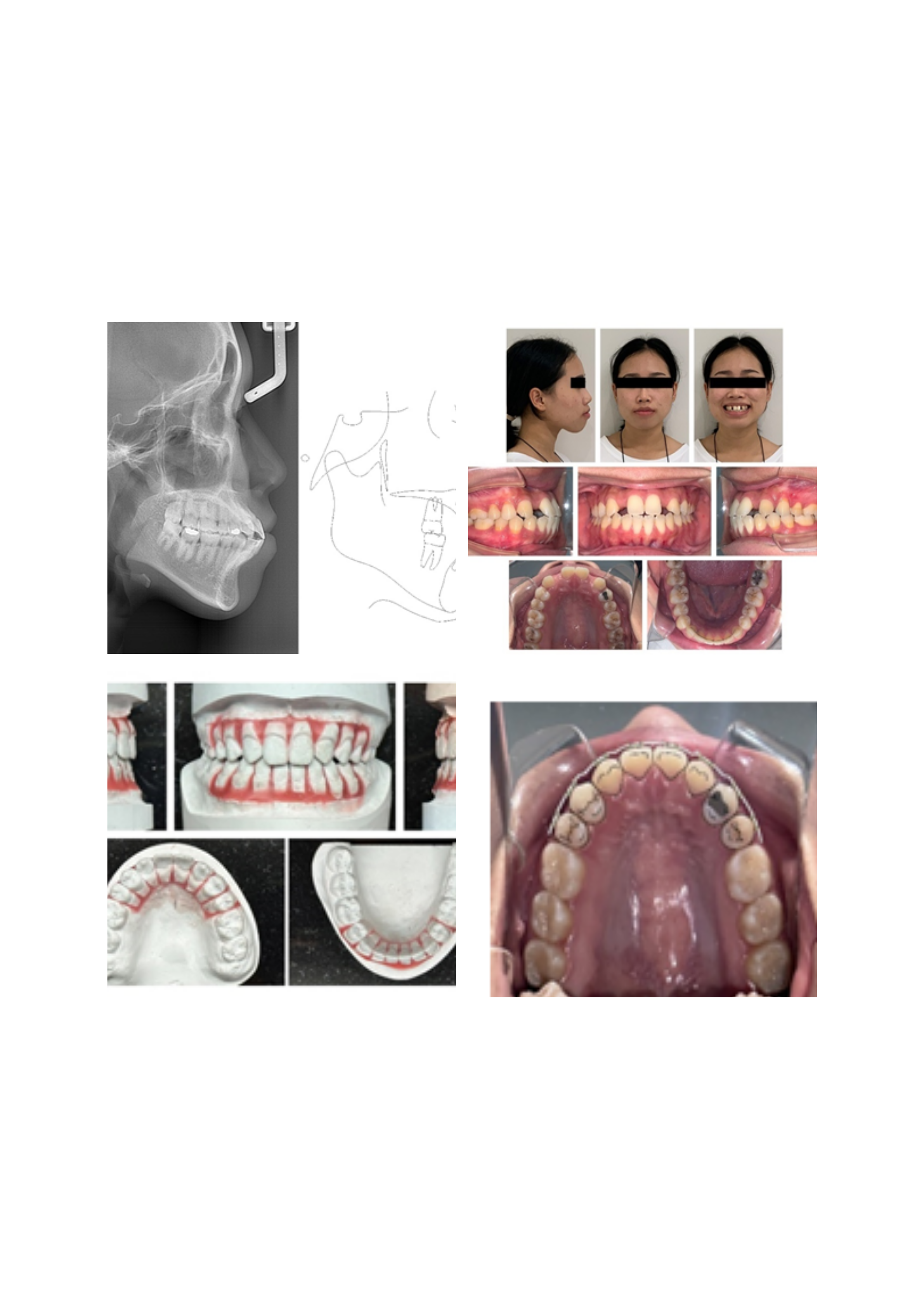
Missing maxillary lateral incisors creates an esthetic and functional issue that necessitates unique orthodontic and restorative considerations. Consequently, various patient-specif ic factors, in particular patient satisfaction, should be meticulously evaluated prior to determining whether to close the space with canine substitution or open the space with tooth replacement. This case report describes successful space closure and canine repositioning used in the orthodontic treatment of a 25-year-old female patient with Class I malocclusion with bimaxillary dental protrusion and bilateral congenitally missing maxillary lateral incisors. Enhancing a patient’s appearance and functionality requires minimizing the use of a prosthesis and improving the patient’s facial profile, which includes the canine-like size, color, and shape of the maxillary first premolar. Orthodontic treatment was completed, with favorable results. The treatment time was 25 months. Although this case required some adjunctive procedures to improve the esthetics, the patient declined as she was very satisfied with the achieved results. After two years of follow-up, a stable occlusion with a satisfactory facial profile and functional excursion without interference was achieved. Functionality and esthetics can be improved by choosing this approach, which is less invasive as well as more economical.
Article Details

This work is licensed under a Creative Commons Attribution-NonCommercial-NoDerivatives 4.0 International License.
References
Shapiro SD, Farrington FH. A potpourri of syndromes with anomalies of dentition. In: Jorgenson RJ, editors. Dentition genetic effects. birth defects: original article series. New York: March of Dimes Birth Defects Foundation; 1983.p.129-40.
Graber LW. Congenital absence of teeth: a review with emphasis on inheritance pattern. J Am Dent Assoc 1978;96:266-75.
Alvesalo L, Portin P. The inheritance pattern of missing, peg-shaped and strongly mesio-distally reduced upper lateral incisors. Acta Odontol Scand 1969;27:563-75.
Kanchanasevee C, Theerapanon T, Intarak N, Pittayapat P, Porntaveetus T. Prevalence and pattern of tooth agenesis in non-syndromic Thai dental patients. RSU Int Res Conf 2019:36-44.
De Coster PJ, Marks LA, Martens LC, Huysseune A. Dental agenesis Genetic and clinical perspectives. J Oral Pathol Med 2009;38:1–17.
Schalk-van der Weide Y, Steen WH, Bsman F. Distribution of missing teeth and tooth morphology in patients with oligodon-tia. ASDC J Dent Child 1992;59(2):133–40.
Chung CJ, Han JH, Kim KH. The pattern and prevalence of hypodontia in Koreans. Oral Dis 2008;14:620–5.
Stamatiou J, Symons AL. Agenesis of the permanent lateral incisor: distribution, number and sites. J Clin Pediatr Dent 1991;15:244-6.
Kokich VO Jr. Congenitally missing teeth: orthodontic management in the adolescent patient. Am J Orthod Dentofacial Orthop 2002;121:594-5.
Robertsson S, Mohlin B. The congenital missing upper lateral incisor. A retrospective study of orthodontic space closure versus restorative treatment. Eur I Orthod 2000;22:697-710.
Dechkunakorn S, Chaiwat J, Sawaengkit P, Anuwongnukorh N, Taweesedt N. Thai adult norms in various lateral cephalometric analyses. J Dent Assoc Thai 1994;44(5):202-13.
Savarrio L, McIntyre GT. To open or to close space—that is the missing lateral incisor question. Dental Update 2005;32(1):16–25.
Wriedt S, Werner P, Wehrbein H. Tooth shape and color as criteria for or against orthodontic space closure in case of a missing lateral incisor. J Orofacial Orthop 2007;68(1):47–55.
Woodworth DA. Bilateral congenital absence of maxillary lateral incisors--a craniofacial and dental cast analysis. Am J Orthod 1985;87:280-93.
Thordarson A, Zachrisson BU, Mjor IA. Remodeling of canines to the shape of lateral incisors by grinding: a longterm clinical and radiographic evaluation. Am J Orthod Dentofacial Orthop 1991;100:123-32.
Kokich VG. Managing orthodontic-restorative treatment for the adolescent patient. In: McNamara JA, Brudon WL, editors. Orthodontics and dentofacial orthopedics. Ann Arbor, Michigan: Needham Press Inc; 2001.p.1-30.
BU, Rosa M. Integrating esthetic dentistry and space closure in patients with missing maxillary lateral incisors. J Clin Orthod 2001;35:221-34.
McNeill RW, Joondeph DR. Congenitally absent maxillary lateral incisors: treatment planning considerations. Angle Orthod 1973;43:24-9.
Sabri R. Management of missing lateral incisors. J Am Dent Assoc 1999;130:80-4.
Burke SP, Silveira AM, Goldsmith LJ, Yancey JM, Van Stewart A, Scarfe WC. A meta-analysis of mandibular intercanine width in treatment and postretention. Angle Orthod 1998;68(1):53-60.
Senty EL. The maxillary cuspid and missing lateral incisors: esthetics and occlusion. Angle Orthod 1976;46:365-71.
Henns RJ. The canine eminence. Angle Orthod 1974;44:326-8.
Nordquist GG, McNeill RW. Orthodontic versus restorative treatment of the congenitally absent lateral incisor-long term periodontal and occlusal evaluation. J Periodontol 1975;46:139-43.
Rosa M, Zachrisson BU. Integrating esthetic dentistry and space closure in patients with missing maxillary lateral incisors. J Clin Orthod 2001;35:221-34.
Guillaume B. Dental implants: a review. Morphologie. 2016;100(331):189-98.
Jemt T. Single implants in the anterior maxilla after 15 years of follow-up: comparison with central implants in the edentulous maxilla. Int J Prosthodont 2008;21:400-8.
Wheeler RC. Textbook of dental anatomy. Philadelphia: WB Saunders;1965.p.315-27.
Gianelly AA. Arch width after extraction and nonextraction treatment. Am J Orthod Dentofacial Orthop 2003;123:25-8.
Shaw WC. The influence of children’s dentofacial appearance on their social attractiveness as judged by peers and lay adults. Am J Orthod 1981;79:399-415.
Kokich VG, Nappen DL, Shapiro PA. Gingival contour and clinical crown length: their effect on the esthetic appearance of maxillary anterior teeth. Am J Orthod 1984;86:89-97.
