
Upper Lip Changes After Upper Incisor Proclination in Deep Bite Patients
Article Sidebar
Main Article Content
Abstract
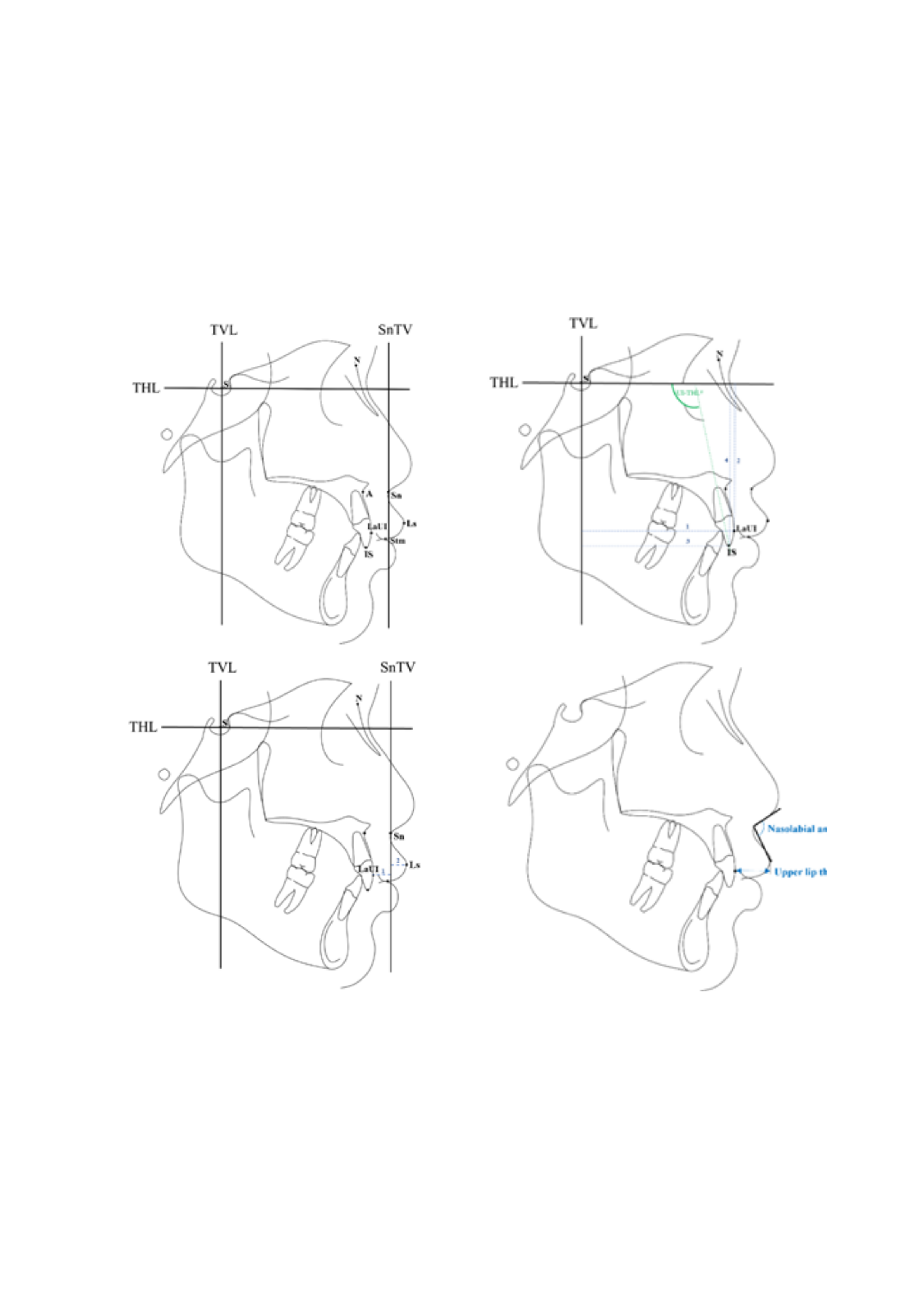
Background: No previous studies examined the effects of upper lip (UL) change following upper incisor (UI) intrusion by labial proclination in deep bite (DB) non-growing patients. Objective: To compare changes in the UI and UL after labial proclination between UI retroclination (RI) and normal inclination (NI) groups in DB patients. Materials and methods:Pretreatment (T1) and posttreatment (T2) lateral cephalograms of 41 subjects who underwent UI labial proclination were divided into two groups according to UI inclination: RI group (UI-THL<113°) and NI group (113°≤ UI-THL≤ 119°). Cephalograms used the true horizontal and true vertical lines to measure the UI and UL parameters. Treatment changes were compared both within and between the groups. Results: At T1, the RI group showed significantly more retroclined and retruded UI, increased incisal show at rest (ISR) and overbite compared to the NI group. Soft tissues were comparable, except for thicker lip in RI. At T2, the RI group exhibited normal inclination and position, while greater proclination and protrusion were observed in NI. No significant differences were observed in the ISR, overbite, or soft tissue variables between the groups. The treatment change (T2-T1) in both groups exhibited a significant proclination of the UIs. However, the RI group showed no significant change in the UL, while NI group revealed significant UL protrusion.Conclusion: The UL changes in the RI group did not show significant differences. In contrast, the NI group showed more UL protrusion, although it exhibited lesser proclination of UI compared to RI group.
Article Details

This work is licensed under a Creative Commons Attribution-NonCommercial-NoDerivatives 4.0 International License.
References
Moorrees CF, Gron AM, Lebret LM, Yen PK, Fröhlich FJ. Growth studies of the dentition: a review. Am J Orthod 1969;55(6):600-16.
Thasanabanchong S, Raksaseri P. The components of occlusal pattern in a group of Thai school children 7-11 years of age. J Dent Assoc Thai 1986;36(6):207-16.
Kitsahawong S. Prevalence of malocclusion of secondary school student in Muang district, Khon Kaen. Khon Kaen Dent J 2000;3(1):56-65.
Sonnesen L, Svensson P. Temporomandibular disorders and psychological status in adult patients with a deep bite. Eur J Orthod 2008;30(6):621-9.
Littlewood SJ, Mitchell L. An introduction to orthodontics: OUP Oxford 2019:55-60.
Nanda R. Correction of deep overbite in adults. Dental Clinics of North America 1997;41(1):67-87.
Ruankaeo K, Suntornlohanakul S. Factors affecting patient satisfaction in orthodontic treatment. Thai J Orthod 2023;13(1):44-51.
Varlık SK, Alpakan ÖO, Türköz Ç. Deepbite correction with incisor intrusion in adults: a long-term cephalometric study. Am J Orthod Dentofacial Orthop 2013;144(3):414-9.
Aydoğdu E, Özsoy Ö P. Effects of mandibular incisor intrusion obtained using a conventional utility arch vs bone anchorage. Angle Orthod 2011;81(5):767-75.
McDowell EH, Baker IM. The skeletodental adaptations in deep bite correction. Am J Orthod Dentofacial Orthop 1991;100(4):370-5.
Parker CD, Nanda RS, Currier GF. Skeletal and dental changes associated with the treatment of deep bite malocclusion. Am J Orthod Dentofacial Orthop 1995;107(4):382-93.
Mirabella D, Bacconi S, Gracco A, Lombardo L, Siciliani G. Upper lip changes correlated with maxillary incisor movement in 65 orthodontically treated adult patients. World J Orthod 2008;9(4):337-48.
Cao L, Zhang K, Bai D, Jing Y, Tian Y, Guo Y. Effect of maxillary incisor labiolingual inclination and anteroposterior position on smiling prof ile esthetics. Angle Orthod 2011;81(1):121-9.
Baccetti T, Franchi L, McNamara Jr JA, editors. The cervical vertebral maturation (CVM) method for the assessment of optimal treatment timing in dentofacial orthopedics. Semin Orthod 2005;11(3):119-29.
Nanda RS. The rates of growth of several facial components measured from serial cephalometric roentgenograms. Am J Orthod 1955;41(9):658-73.
Nuntasukkasame A, Suntornlohanakul S, Charoemratrote C. Natural head position: the role in lateral cephalometric analysis. OJ Thai Assoc Orthod 2012;2:10.
Koo TK, Li MY. A Guideline of selecting and reporting intraclass correlation coeff icients for reliability research. J Chiropr Med 2016;15(2):155-63.
Cooke MS, Orth D, Wei SH. A summary f ive factor cephalometric analysis based on natural head posture and the true horizontal. Am J Orthod Dentofacial Orthop 1988;93(3):213-23.
Wen J, Liu S, Ye X, Xie X, Li J, Li H, et al. Comparative study of cephalometric measurements using 3 imaging modalities. J Am Dent Assoc 2017;148(12):913-21.
Unat B, Samruajbenjakun B. The use of cone beam computed tomography in orthodontics. Thai J Orthod 2020;9(1):19-29.
Jain N, Soni S. An overview of class II division 2 malocclusion. Int J Health Sci 2021;5(S2):214-21.
Jeelani W, Fida M, Shaikh A. The maxillary incisor display at rest: analysis of the underlying components. Dental Press J Orthod 2018;23(6):48-55.
Silberberg N, Goldstein M, Smidt A. Excessive gingival display--etiology, diagnosis, and treatment modalities. Quintessence Int 2009;40(10):809-18.
Hunt O, Johnston C, Hepper P, Burden D, Stevenson M. The influence of maxillary gingival exposure on dental attractiveness ratings. Eur J Orthod 2002;24(2):199-204.
Sarver D, Ackerman M. Dynamic smile visualization and quantif ication: part 2. Smile analysis and treatment strategies. Am J Orthod Dentofacial Orthop 2003;124:116-27.
Dua V, Gupta S, Singh C. Evaluation of the nasolabial angle in the Indian population. Contemp Clin Dent 2010;1(2):79-82.
Quinzi V, Paskay L, D’Andrea N, Albani A, Annalisa M, Saccomanno S. Evaluation of the nasolabial angle in orthodontic diagnosis: a systematic review. Appl Sci 2021;11:1-18.
Nandini S, Prashanth CS, Somiah SK, Reddy SR. An evaluation of nasolabial angle and the relative inclinations of the nose and upper lip. J Contemp Dent Pract 2011;12(3):152-7.
Oliver BM. The influence of lip thickness and strain on upper lip response to incisor retraction. Am J Orthod 1982;82(2):141-9.
Faraoni D, Schaefer ST. Randomized controlled trials vs. observational studies: why not just live together? BMC Anesthesiol 2016;16(1):102
