
บทบาทของพยาบาลในการดูแลผู้ป่วยที่มีผลข้างเคียงในระบบผิวหนังจากยากลุ่ม EGFR Inhibitors
Article Sidebar
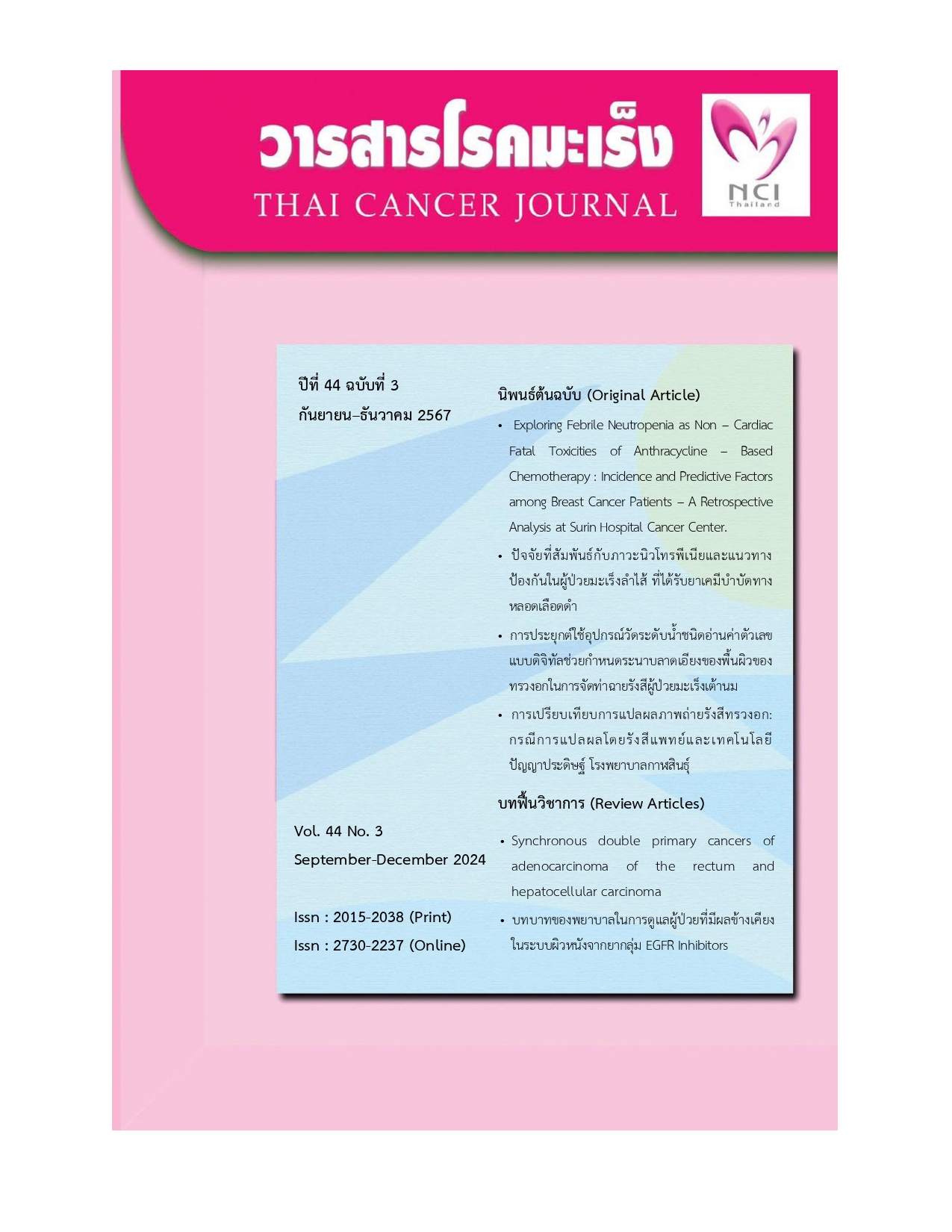
Main Article Content
บทคัดย่อ
ยามุ่งเป้ากลุ่ม EGFR Inhibitors เป็นยาที่ใช้ในการรักษาผู้ป่วยมะเร็งปอดที่มีการกลายพันธุ์ของยีน EGFR ซึ่งยาในกลุ่มนี้สามารถออกฤทธิ์ได้อย่างจำเพาะเจาะจง ทำให้การรักษานั้นมีประสิทธิภาพเพิ่มมากขึ้น แต่ถึงอย่างไรก็ตาม ยาในกลุ่มนี้ยังก่อให้เกิดผลข้างเคียงในระบบต่างๆ โดยเฉพาะในระบบผิวหนัง ทำให้ผู้ป่วยสูญเสียภาพลักษณ์ ไม่สุขสบายจากผลข้างเคียง ซึ่งส่งผลทำให้มีคุณภาพชีวิตที่ลดลงได้ ดังนั้น พยาบาลซึ่งเป็นบุคลากรที่มีบทบาทสำคัญในการดูแลผู้ป่วยกลุ่มนี้ จึงต้องมีองค์ความรู้ โดยการประยุกต์ใช้ความรู้ที่ได้จากหลักฐานเชิงประจักษ์มาปรับใช้ในแต่ละบทบาทของการดูแลผู้ป่วย บทความนี้ได้กล่าวถึง พยาธิสภาพและผลข้างเคียงในระบบผิวหนัง แนวทางในการป้องกันและรักษา บทบาทของพยาบาลในด้านการประเมินและการให้คำแนะนำในการดูแลตนเองเกี่ยวกับผลข้างเคียงในระบบผิวหนัง
Article Details

อนุญาตภายใต้เงื่อนไข Creative Commons Attribution-NonCommercial-NoDerivatives 4.0 International License.
บทความทีตีพิมพ์ในวารสารโรคมะเร็งนี้ถือว่าเป็นลิขสิทธิ์ของมูลนิธิสถาบันมะเร็งแห่งชาติ และผลงานวิชาการหรือวิจัยของคณะผู้เขียน ไม่ใช่ความคิดเห็นของบรรณาธิการหรือผู้จัดทํา
เอกสารอ้างอิง
American Cancer Society. Targeted drug therapy for non-small cell lung cancer [Internet]. ACS; [cited 2024 January 20]. Available from: https://www.cancer.org/cancer/types/lung-cancer/treating-non-small-cell/targeted-therapies.html
Lucia STANCULEANU D, Zob D, Catalina TOMA O, Georgescu B, Papagheorghe L, Ioana MIHAILA R, et al. Cutaneous toxicities of molecular targeted therapies. Maedica (Bucur) [Internet]. 2017 Jan [cited 2024 Sep 1];12:48. Available from:/pmc/articles/ PMC5574072/
Diamanti O, Zacheo TM, Lando C, Magro C, Pauletti G, Zemella E, et al. Pilot study: Nurses’ role in management of cutaneous toxicity in patients with targeted therapies anti EGFR-Is’ treatment. Annals of Oncology [Internet]. 2018 Oct 1 [cited 2024 Sep 1];29:viii697. Available from: http://www.annalsofoncology.org/article/S0923753419488601/fulltext
Klungsaeng S, Senggunprai L. Protein serine-threonine kinase as drug target in cancer treatment. Srinagarind Med J.2020;35:488-95.
Zubair T, Bandyopadhyay D. Small molecule EGFR inhibitors as anti-cancer agents: discovery, mechanisms of action, and opportunities. Int J Mol Sci.2023;24:1-9.
Macdonald JB, Macdonald B, Golitz LE, LoRusso P, Sekulic A. Cutaneous adverse effects of targeted therapies: Part I: Inhibitors of the cellular membrane. J Am Acad Dermatol [Internet]. 2015 [cited 2024 Sep 1];72:203–18. Available from: https://pubmed.ncbi.nlm. nih.gov/25592338/
Reyes-Habito CM, Roh EK. Cutaneous reactions to chemotherapeutic drugs and targeted therapy for cancer: Part II. Targeted therapy. J Am Acad Dermatol [Internet]. 2014 [cited 2024 Sep 1];71:217.e1-217.e11. Available from: https://pubmed.ncbi.nlm.nih.gov/ 25037801/
Lupu I, Voiculescu VM, Bacalbasa N, Prie BE, Cojocaru I, Giurcaneanu C. Cutaneous adverse reactions specific to epidermal growth factor receptor inhibitors. J Med Life [Internet]. 2015 [cited 2024 Sep 1];8(Spec Issue):57. Available from: /pmc/articles/PMC4564034/
Garden BC, Wu S, Lacouture ME. The risk of nail changes with epidermal growth factor receptor inhibitors: a systematic review of the literature and meta-analysis. J Am Acad Dermatol [Internet]. 2012 [cited 2024 Sep 1];67:400–8. Available from: https://www.ncbi. nlm.nih.gov/books/NBK109674/
Melosky B, Leighl NB, Rothenstein J, Sangha R, Stewart D, Papp K. Management of egfr tki–induced dermatologic adverse events. Current Oncology [Internet]. 2015 [cited 2024 Sep 1];22:123. Available from: /pmc/articles/PMC4399609/
Barton-Burke M, Ciccolini K, Mekas M, Burke S. Dermatologic reactions to targeted therapy: a focus on epidermal growth factor receptor inhibitors and nursing care. Nurs Clin North Am [Internet]. 2017 Mar 1 [cited 2024 Sep 1];52:83. Available from:/pmc/articles/PMC 5645079/
US Department of Health and Human Services. Common terminology criteria for adverse events (CTCAE). (No Title). 2017 Jan 3.
Kozuki T. Skin problems and EGFR-tyrosine kinase inhibitor. Jpn J Clin Oncol [Internet]. 2016 Apr 1 [cited 2024 Sep 1];46:291. Available from: /pmc/articles/PMC4886131/
Huynh Dagher S, Blom A, Chabanol H, Funck-Brentano E. Cutaneous toxicities from targeted therapies used in oncology: Literature review of clinical presentation and management. Int J Womens Dermatol [Internet]. 2021 Dec 1 [cited 2024 Sep 1]; 7(5Part A): 615–24. Available from: https://pubmed.ncbi.nlm.nih.gov/35024416/
Williams LA, Ginex PK, Ebanks GL, Ganstwig K, Ciccolini K, Kwong BY, et al. ONS GuidelinesTM for cancer treatment-related skin toxicity. Oncol Nurs Forum [Internet]. 2020 [cited 2024 Sep 1];47:539–56. Available from: https://pubmed.ncbi.nlm.nih.gov/ 32830806/
Deutsch A, Leboeuf NR, Lacouture ME, McLellan BN. Dermatologic adverse events of systemic anticancer therapies: cytotoxic chemotherapy, targeted therapy, and immunotherapy. https://doi.org/101200/EDBK_289911 [Internet]. 2020 May 18 [cited 2024 Sep 1];485–500. Available from: https://ascopubs.org/doi/10.1200/EDBK_289911
