
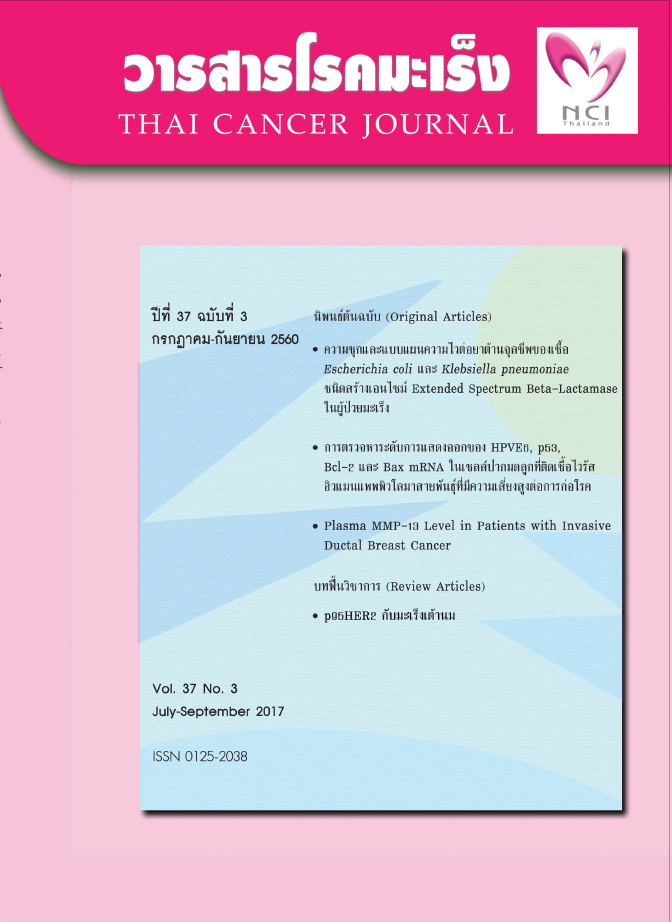
การตรวจหาระดับการแสดงออกของ HPVE6, p53, Bcl-2 and Bax mRNA ในเซลล์ปากมดลูกที่ติดเชื้อไวรัสฮิวแมนแพพพิวโลมาสายพันธุ์ที่มีความเสี่ยงสูงต่อการก่อโรค
Article Sidebar
Main Article Content
บทคัดย่อ
การติดเชื้อไวรัสฮิวแมนแพพพิวโลมาสายพันธุ์ที่มีความเสี่ยงสูงต่อการก่อโรค (HR HPV) เป็นระยะเวลานานเป็นสาเหตุของการเกิดมะเร็งปากมดลูก โดยโปรตีน E6 ของไวรัสดังกล่าวมีบทบาทสำคัญในการยับยั้งการทำงานของ p53 นอกจากนี้บางการศึกษาคาดว่าโปรตีน E6 อาจมีผลต่อการทำงานของยีน/โปรตีนในกระบวนการตายแบบ apoptosis การศึกษานี้มีวัตถุประสงค์เพื่อตรวจหาสายพันธุ์ของ HPV และระดับการแสดงออกของยีนที่มีบทบาทในกระบวนการ apoptosis ได้แก่ p53, Bcl-2 และ Bax รวมทั้งการแสดงออกของ HPVE6 mRNA ในเซลล์ปากมดลูกที่พบการติดเชื้อ HR HPV เปรียบเทียบกับตัวอย่างเซลล์ปากมดลูกที่ไม่พบการติดเชื้อ HPV โดยการเก็บตัวอย่างเซลล์ปากมดลูกจำนวน 50 ตัวอย่างใน liquid based และมีผลการตรวจทางเซลล์วิทยาในช่วงระหว่างเดือนมิถุนายน 2559 ถึง พฤษภาคม 2560 การตรวจหาสายพันธุ์ของไวรัสใช้วิธี polymerase chain reaction-enzyme immunoassay (PCR-EIA) และสุ่มตัวอย่างจำนวน 15 ตัวอย่างจากทั้งหมด 50 ตัวอย่าง ซึ่ง 15 ตัวอย่างพบ 14 ตัวอย่างเป็นเซลล์ที่มีความผิดปรกติเพียงเล็กน้อยจนถึง low-grade squamous intraepithelial lesion (LSIL) และอีกหนึ่งตัวอย่างพบความผิดปรกติแบบ high-grade squamous intraepithelial lesion (HSIL) นำผลการตรวจเชื้อ HPV มาแบ่งกลุ่มตัวอย่าง 5 กลุ่มคือ กลุ่มที่ไม่พบการติดเชื้อ HPV, พบการติดเชื้อ HPV16, พบการติดเชื้อ HPV18, พบการติดเชื้อ HR HPV อื่น และกลุ่มที่พบการติดเชื้อร่วมระหว่าง HPV16/18 และ HR HPV อื่น กลุ่มละ 3 ตัวอย่าง และตรวจหาระดับการแสดงออกของ p53, Bcl-2, Bax และ HPVE6 mRNA ด้วยวิธี two-step reverse trancriptase polymerase chain reaction (RT-PCR) ผลการศึกษาพบสายพันธุ์ที่ 52 มากที่สุด ตามด้วย HPV 16 และ 18 ตามลำดับ และพบว่าการแสดงออกของ p53, Bcl-2 และ Bax mRNA ในเซลล์ปากมดลูกที่มีการติดเชื้อ HPV มีระดับสูงกว่าเซลล์ที่ไม่มีการติดเชื้อเพียงเล็กน้อย ในขณะที่ระดับการแสดงออกของ HPVE6 mRNA พบสูงสุดในกลุ่มที่พบการติดเชื้อ HPV16 เมื่อเปรียบเทียบกับกลุ่มอื่น จากการศึกษานี้สรุปได้ว่า การติดเชื้อ HR HPV อาจมีผลต่อการทำงานของกระบวนการตายแบบ apoptosis ถึงแม้ว่าระดับการแสดงออกของยีนที่นำมาใช้ในการศึกษานี้ยังให้ผลไม่แน่ชัดแต่ก็เป็นข้อมูลที่น่าสนใจในการนำไปศึกษากระบวนการเกิดมะเร็งปากมดลูกในระดับโมเลกุลในอนาคตต่อไป
Article Details
บทความทีตีพิมพ์ในวารสารโรคมะเร็งนี้ถือว่าเป็นลิขสิทธิ์ของมูลนิธิสถาบันมะเร็งแห่งชาติ และผลงานวิชาการหรือวิจัยของคณะผู้เขียน ไม่ใช่ความคิดเห็นของบรรณาธิการหรือผู้จัดทํา
เอกสารอ้างอิง
HPV Information Center. Human Papillomavirus and Related Disease Report. Available at: www.hpvcentre.net. Accessed on October 30, 2014.
zur Hausen H. Papillomavirus and cancer, From basic studies to clinical application. Nat Rev Cancer 2002;2:342-50.
Gillison ML, Shah KV. Chapter 9; Role of Mucosual Human Papillomavirus in Nongenital Cancer. J Natl Cancer Inst Monogr 2003;31:57-65.
International Agency for Research on Cancer Monograph on Evaluation of Carcinogen Risks to Humans; Human papillomavirus 1995;64:35-222.
Munoz N, Bosch F, de Sanjose S, Herrero R, Castellsague X, Shah K, et al. Epidemiologic classification of human papillomavirus types associated cancer. N Engl J Md 2003;348:518-27.
Walboomers M, Jacob MM, Manos MM, Bosch FX, Kummer JA, Shah KV, et al. Human papillomavirus is a necessary cause of invasive cervical cancer worldwide. J Pathol 1999;189:12-9.
Ramet J, van Esso D, Meszner Z. Position paper -HPV and the primary prevention of cancer: improving vaccine uptake by paediatricians. Eur J Pediatr 2011;170:309-21.
Kim SH, Oh JM, No JH, Bang YJ, Juhnn YS, Song YS. Involvement of NF- B and AP-1 in COX-2 upregulation by human papilllomavirus 16 E5 oncoprotein. Carcinogenesis 2009;30:753-7.
Moody CA, Laimins LA. Human papillomavirus oncoproteins athhways to transformation. Nat Rev Cancer 2010;10:550-60.
Kim MK, Kim HS, Kim SH, Oh JM, Han JY, Lim JM, et al. Review article; Human papillomavirus type 16 E5 oncoprotein as a new target for cervical cancer treatment. Biochem Pharmacol 2010;80:1930-5.
Malaguarnera L. Implication of apoptosis regulators in tumorigenesis. Cancer and Metastasis Rev 2004; 33:367-87.
Zhivotovsky B, Kroemer G. Apoptosis and genomic instability. Nat ReV 2004;5:752-62.
Liao S, Deng D, Hu X, Wang W, Li L, Li W, et al. HPV16/18 E5, a promising candidate for cervical cancer vaccines, affects SCPs, cell proliferation and cell cycle, and forms a potential network with E6 and E7. Int J Mol Med 2013;31:120-8.
Ayatollahi H, Sharifi N, Sadeghian MH, Alenabi A, Ghasemian-Moghadam HR. Immunohistochemical Expression of Apoptosis Regulators in Squamous Cell Carcinoma of the Cervix and Their Associaion with Human Papillomavirus 16/18 Subtypes. Balkan Med J 2014;31:202-7.
Grace VM, Shalini JV, Lekha TT, Devaraj S, Devaraj H. Co-overwxpression of p53 and bcl-2 proteins in HPV-induced squamous cell carcinoma of the uterine cervix. Gynecol Oncol 2003;91:51-8.
Klapsinou E, Argyri E, Panotopoulou E, Daskalopoulou D, Patsouris E, Nonni A, et al. Bax and Bak expression in cervical smears of women with lowand high-risk HPV types: a study of 120 cases. J Cytol 2015;32:223-9.
Jacob MV, van den Brule AJ, Snijder PJ, Helmerhorst TJ, Meijer CJ, Walboomer JM. A non-radioactive PCR enzyme-immunoassay enables a rapid identification of HPV-16 and 18 in cervical scrapes after GP5+/6+PCR. J Med Virol 1996;49:223-9.
Oh JM, Kim SH, Cho EA, Song YS, Kim WH, Juhnn YS. Human papillomavirus type 16E5 protein inhibits hydrogen peroxide-induced apoptosis by stimulating ubiquitin-proteasome-mediated degradation of Bax in human cervical cells. Carcinogenesis 2010;31: 402-10.
Kantathavon N, Mahidol C, Sritana N, Sricharunrat T, Phoolcharoen N, Auewarakul C, et al. Genotypic distribution of human papillomavirus (HPV) and cervical cytology finding in 5,906 Thai women undergoing cervical cancer screening programs. Infect Agent Cancer 2015;10:7.
Marks MA, Gupta S, Liaw KL, Tadesse A, Kim E, Phongnarisorn C, et a. Prevalence and correlated of HPV among women attending family-planing clinics in Thailand. BMC Infect Dis 2015;15:159.
Bharti A, Shukla S, Mahata S, Hedau S, Das BC. Human papillomavirus and control of cervical cancer in India. Expert Rev Obstet 2010;5:329-46.
Woodman CB, Collins SI, Young LS. The natural history of cervical HPV infection: unresolved issues. Nat Rev Cancer 2007;7:11-22.
