
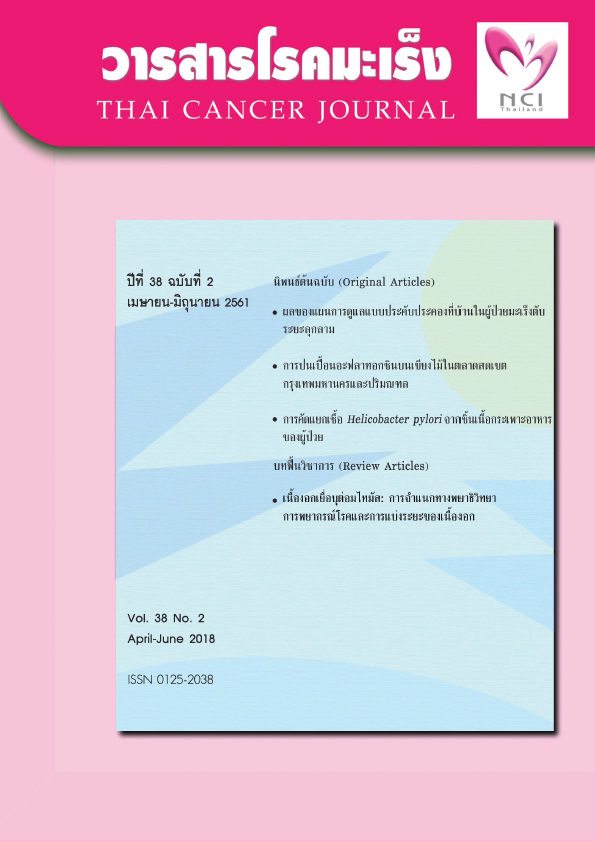
ผลของแผนการดูแลแบบประคับประคองที่บ้านในผู้ป่วยมะเร็งตับระยะลุกลาม
Article Sidebar
Main Article Content
บทคัดย่อ
การได้เสียชีวิตอย่างสงบที่บ้านมักเป็นความปรารถนาของผู้ป่วยระยะสุดท้าย การช่วยให้ผู้ป่วยได้ใช้ชีวิตวาระสุดท้ายในสถานที่ที่ต้องการเป็นภารกิจสำคัญของการดูแลแบบประคับประคองที่ส่งผลต่อคุณภาพชีวิตของผู้ป่วยในเวลาที่เหลืออยู่ การวิจัยกึ่งทดลองนี้มีวัตถุประสงค์เพื่อศึกษาผลของแผนการดูแลแบบประคับประคองที่บ้านในผู้ป่วยมะเร็งตับระยะลุกลามต่อการเสียชีวิตที่บ้านและการใช้บริการสุขภาพในระยะท้ายของชีวิต ประยุกต์แนวคิดการดูแลแบบประคับประคองในชุมชนและการดูแลผู้ป่วยระยะท้ายที่บ้านเพื่อให้ผู้ป่วยได้ใช้เวลาในวาระสุดท้ายที่บ้านตามที่ผู้ป่วยต้องการ กลุ่มตัวอย่างเป็นผู้ป่วยมะเร็งตับระยะลุกลามที่มารับการรักษาที่โรงพยาบาลแพร่ จำนวน 267 รายแบ่งเป็น 2 กลุ่ม กลุ่มทดลองจำนวน 131 ราย ได้รับการรักษาตามระบบปกติของโรงพยาบาลและได้รับแผนการดูแลแบบประคับประคองที่บ้านที่ประกอบด้วยการจัดการอาการและการสนับสนุนครอบครัวอย่างต่อเนื่องเป็นระยะเวลา 12 เดือน กลุ่มเปรียบเทียบที่ได้รับการรักษาตามระบบปกติของโรงพยาบาล รวบรวมข้อมูลหลังการทดลองจากเวชระเบียนผู้ป่วย ผลการศึกษาพบว่าหลังการทดลองกลุ่มทดลองมีอัตราการเสียชีวิตที่บ้าน มากกว่ากลุ่มเปรียบเทียบ (P<0.001) โดยสามเดือนสุดท้ายก่อนเสียชีวิตกลุ่มทดลองมารับบริการที่แผนกฉุกเฉิน เข้ารักษาในโรงพยาบาล และมีจำนวนวันนอนโรงพยาบาลเฉลี่ย น้อยกว่ากลุ่มเปรียบเทียบ (P<0.001) จึงกล่าวได้ว่าแผนการดูแลแบบประคับประคองที่บ้านในผู้ป่วยมะเร็งตับระยะลุกลามเพิ่มโอกาสการเสียชีวิตที่บ้าน และลดการใช้บริการสุขภาพในโรงพยาบาล สมควรสนับสนุนให้มีการดูแลแบบประคับประคองที่บ้านเกิดขึ้นในระบบบริการสุขภาพปฐมภูมิ
Article Details
บทความทีตีพิมพ์ในวารสารโรคมะเร็งนี้ถือว่าเป็นลิขสิทธิ์ของมูลนิธิสถาบันมะเร็งแห่งชาติ และผลงานวิชาการหรือวิจัยของคณะผู้เขียน ไม่ใช่ความคิดเห็นของบรรณาธิการหรือผู้จัดทํา
เอกสารอ้างอิง
International Health Policy Program, Ministry of Public Health. Burden of Diseases and Injuries in Thailand. Medium-term Report 2017. Available at: http://bodthai.net/download/burden-of-disease-andinjuries-
in-thailand-1999/. Accessed November 3, 2017.
ชุติมา อรรคลีพันธ์ุ และคณะ.การสำรวจการเข้าถึงสถานพยาบาลและรายจ่ายด้านสุขภาพของผู้ป่วยที่เสียชีวิต พ.ศ. 2548-2549. กรุงเทพฯ: สำนักงานพัฒนานโยบายสุขภาพระหว่างประเทศ; 2553.
Gozalo P, Plotzke M, Mor VT, Miller CS, Teno MJ. Changes in Medicare Costs with the Growth of Hospice Care in Nursing Homes. N Engl J Med 2015; 372:1823-31.
Sinsuwan W, Pairojkul S, Gomutbutra P, Kongkum K, Kosuwon W. A Retrospective, Single Center, Observational Study, Comparing the Direct Cost of End-Of-Life Care Patients with Advanced Cancer Care: Palliative Care versus Usual Care. J Palliat Care Med 2016;6:243.
Zhang B, Nilsson E M, Prigerson GH. Factors Important to Patients' Quality-of-Life at the End-of-Life. Arch Intern Med 2012;172:1133-42.
Ngamjarus C, Chongsuvivatwong V. n4Studies: Sample size and power calculations for iOS. The Royal Golden Jubilee Ph.D. Program - The Thailand Research Fund & Prince of Songkla University 2014.
Shaw KL, Clifford C, Thomas K, Meehan H. Review: improving end-of-life care: a critical review of the gold standards framework in primary care. Palliat Med 2010;24:317-29.
ศรีเวียง ไพโรจน์กุล.Training of the Trainer in Palliative Care Module 7 Discharge planning and Referral System and Home Care. ขอนแก่น: โรงพิมพ์คลังนานาวิทยา; 2560.
Treeprasertsuk S, Poovorawan K, Soonthornworasiri N, Chaiteerakij R, Thanapirom K, Mairiang P, et al. A significant cancer burden and high mortality of intrahepatic cholangiocarcinoma in Thailand: a nationwide database study. BMC Gastroenterol 2017;17:3.
Prioleau P, Soones N T, Ornstein K, Zhang M, Smith BC, Wajnberg A. Predictors of Place of Death Among Patients in a Home-Based. Primary and Palliative Care Program. J Am Geriatr Soc 2016;64:2317-21.
Gomes B , Calanzani N , Koffman J , Higginson JI. Is dying in hospital better than home in incurable cancer and what factors influence this? A population-based study. BMC Med 2015;13:235.
Nagaviroj K, Anothaisintawee T. A Study of the Association between Multidisciplinary Home Care and Home Death Among Thai Palliative Care Patients. Am J Hosp Palliat Care 2017;34:397-403.
Varani S, Dall'Olio GF, Messana R, Tanneberge S, Pannuti R, Pannuti F. Clinical and demographic factors associated to the place of death in advanced cancer patients assisted at home in Italy. Prog Palliat Care 2015;23:61-7.
Ahlner-Elmqvist M, JordhØy MS, Jannert M, Fayers P, Kaasa S. Place of death: hospital-based advanced home care versus conventional care. A prospective study in palliative cancer care. Palliat Med 2004; 18:585-93.
Okamoto Y, Fukui S, Yoshiuchi K, Ishikawa T. Do Symptoms among Home Palliative Care Patients with Advanced Cancer Decide the Place of Death? Focusing on the Presence or Absence of Symptoms during Home Care. J Palliat Med 2016;19:488-95.
Brumley R, Enguidanos S, Jamison P, Seitz R, Morgenstern N, Saito S, et al. Increased satisfaction with care and lower costs: results of a randomized trial of in-home palliative care. J Am Geriatr Soc 2007;55:993-1000.
Numico G, Cristofano A, Mozzicafreddo A, Cursio EO, FrancoP, Courthod G, et al. Hospital admission of cancer patients: avoidable practice or necessary care? PLoS One 2015;10:e0120827.
Abel J, Pring A, Rich A, Malik T, Verne J. The impact of advance care planning of place of death, a hospice retrospective cohort study. BMJ Support Palliat Care 2013;3:168-73.
