
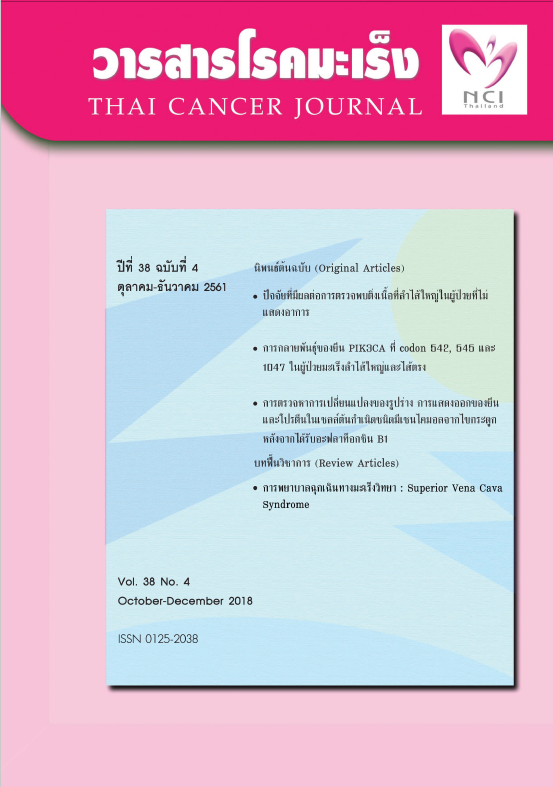
การตรวจหาการเปลี่ยนแปลงของรูปร่าง การแสดงออกของยีน และโปรตีนในเซลล์ต้นกำเนิดชนิดมีเซนไคมอลจากไขกระดูกหลังจากได้รับอะฟลาท็อกซิน B1
Article Sidebar
Main Article Content
บทคัดย่อ
ปัจจุบันโรคมะเร็งเป็นโรคที่เป็นปัญหาสำคัญทางสาธารณสุขของทุกประเทศทั่วโลก เนื่องจากการตรวจวินิจฉัย การรักษาและการหาสาเหตุของโรคมะเร็งระยะแรกยังมีข้อจำกัดอยู่ ดังนั้นการวิจัยเพื่อค้นหากลไกการเกิดโรคมะเร็งจึงมีความสำคัญในการนำไปใช้ประโยชน์เพื่อควบคุมโรคมะเร็งในอนาคต การใช้เซลล์ต้นกำเนิดของมนุษย์มาเป็นตัวแทนเพื่อค้นหาสารก่อมะเร็งในสิ่งแวดล้อมจึงเป็นแนวคิดที่น่าสนใจ และในประเทศไทยยังไม่มีการศึกษาวิจัยเรื่องดังกล่าวมาก่อน การศึกษานี้จึงมีวัตถุประสงค์เพื่อตรวจหาการเปลี่ยนแปลงของรูปร่าง การแสดงออกของยีน และโปรตีนในเซลล์ต้นกำเนิดภายหลังได้รับสารก่อมะเร็งอะฟลาท็อกซิน B1 (Aflatoxin B1: AFB1) โดยทดลองนำเซลล์ต้นกำเนิดชนิดมีเซนไคมอลจากไขกระดูกของมนุษย์ (human mesenchymal stem cells derived from bone marrow) มาเป็นแบบจำลองในการศึกษากลไกการเกิดโรคมะเร็งด้วยการใช้ AFB1 ที่ความเข้มข้น 25 µM AFB1, 50 µM AFB1 และ 100 µM AFB1 เมื่อเวลาผ่านไป 8, 16 และ 24 ชั่วโมง สังเกตการเปลี่ยนแปลงรูปร่างและจำนวนของเซลล์ การแสดงออกของยีน Bmi-1 เปรียบเทียบกับยีน GAPDH ด้วยวิธี real-time PCR และการเปลี่ยนแปลงของโปรตีนด้วยการตรวจหาแบบแผนโปรตีน (proteome pattern) ด้วยเครื่อง MALDI-TOF/TOF mass spectrometer จากการศึกษาพบว่า มีการแสดงออกของยีน Bmi-1 ซึ่งเป็น oncogene ควบคุมการแบ่งตัวของเซลล์เพิ่มขึ้นเป็น 2 เท่าจากเซลล์ปกติ (2 – ∆∆CT=2.07) หลังจากได้รับสารก่อมะเร็ง AFB1 ที่ความเข้มข้น 50 µM AFB1 นาน 24 ชั่วโมง ซึ่งแสดงว่าเซลล์ต้นกำเนิดกำลังเริ่มมีการเปลี่ยนแปลงไปเป็นเซลล์มะเร็ง แต่ยังไม่กลายเป็นเซลล์มะเร็ง จึงไม่พบการเปลี่ยนแปลงของรูปร่างและจำนวนของเซลล์ ส่วนการเปลี่ยนแปลงของโปรตีนพบโปรตีนที่มีมวลโมเลกุล 2423.79 และ 3174.93 ดาลตัน มีการเพิ่มปริมาณและลดปริมาณลงแปรผันกับสภาวะของเซลล์ที่กำลังจะกลายเป็นเซลล์มะเร็ง ตามลำดับ ผลจากการศึกษานี้แสดงให้เห็นแนวโน้มที่จะสามารถใช้เซลล์ต้นกำเนิดชนิดมีเซนไคมอลจากไขกระดูกของมนุษย์เป็นแบบจำลองในการศึกษากลไกการเกิดโรคมะเร็งทดแทนการใช้สัตว์ทดลองได้ และอาจช่วยให้ค้นพบตัวบ่งชี้ทางพันธุกรรมและโปรตีนวิทยาในการวินิจฉัยโรคและพยากรณ์โรค เพื่อติดตามและค้นหาผู้มีความเสี่ยงสูงที่จะเป็นโรคมะเร็งระยะเริ่มแรกในอนาคต
Article Details
บทความทีตีพิมพ์ในวารสารโรคมะเร็งนี้ถือว่าเป็นลิขสิทธิ์ของมูลนิธิสถาบันมะเร็งแห่งชาติ และผลงานวิชาการหรือวิจัยของคณะผู้เขียน ไม่ใช่ความคิดเห็นของบรรณาธิการหรือผู้จัดทํา
เอกสารอ้างอิง
Guillouzo A, Morel F, Fardel O, Meunier B. Use of human hepatocyte cultures for drug metabolism studies. Toxicology 1993;82:209-19.
Kafert-Kasting S, Alexandrova K, Barthold M, Laube B, Friedrich G, Arseniev L, et al. Enzyme induction in cryopreserved human hepatocyte cultures. Toxicology 2006;220:117-25.
Ratanasavanh D, Baffet G, Latinier MF, Rissel M, Guillouzo A. Use of hepatocyte co-cultures in the assessment of drug toxicity from chronic exposure. Xenobiotica 1988;18:765-71.
Kang SJ, Jeong SH, Kim EJ, Cho JH, Park YI, Park SW, et al. Evaluation of hepatotoxicity of chemicals using hepatic progenitor and hepatocyte-like cells derived from mouse embryonic stem cells : Effect of chemicals on ESC-derived hepatocyte differentiation. Cell Biol Toxicol 2013;29:1-11.
Thomson JA, Itskovitz-Eldor J, Shapiro SS, Waknitz MA, Swiergiel JJ, Marshall VS, et al. Embryonic stem cell lines derived from human blastocysts. Science 1998;282:1145-7.
Mitalipov S, Kuo HC, Byrne J, Clepper L, Meisner L, Johnson J, et al. Isolation and characterization of novel rhesus monkey embryonic stem cell lines. Stem Cells 2006;24:2177-86.
Sritanaudomchai H, Pavasuthipaisit K, Kitiyanant Y, Kupradinun P, Mitalipov S, Kusamran T. Characterization and multilineage differentiation of embryonic stem cells derived from a buffalo parthenogenetic embryo. Mol Reprod Dev 2007;74:1295-302.
Fliedner TM, Calvo W, KÖrbling M, Nothdurft W, Pflieger H, Ross W. Collection, storage and transfusion of blood stem cells for the treatment of hemopoietic failure. Blood Cells 1979;5:313-28.
Harrison DE. Long-term erythropoietic repopulating ability of old, young, and fetal stem cells. J Exp Med 1983;157:1496-504.
Huang S, Lu G, Wu Y, Jirigala E, Xu Y, Ma K, et al. Mesenchymal stem cells delivered in a microspherebased engineered skin contribute to cutaneous
wound healing and sweat gland repair. J Dermatol Sci 2012;66:29-36.
Lee SY, Huang GW, Shiung JN, Huang YH, Jeng JH, Kuo TF, et al. Magnetic Cryopreservation for Dental Pulp Stem Cells. Cells Tissues Organs 2012;196:2333.
Singh A, Park H, Kangsamaksin T, Singh A, Readio N, Morris RJ. Keratinocyte Stem Cells and the Targets for Nonmelanoma Skin Cancer. Photochem Photobiol 2012;88:1099-110.
Takahashi K., Yamanaka S. Induction of pluripotent stem cells from mouse embryonic and adult fibroblast cultures by defined factors. Cell 2006;126: 663-76.
Khakoo AY, Pati S, Anderson SA, Reid W, Elshal MF, Rovira II, et al. Human mesenchymal stem cells exert potent antitumorigenic effects in a model of Kaposi's sarcoma. J Exp Med 2006;203:1235-47.
Ganta C, Chiyo D, Ayuzawa R, Rachakatla R, Pyle M, Andrews G, et al. Rat umbilical cord stem cells completely abolish rat mammary carcinomas with no evidence of metastasis or recurrence 100 days posttumor cell inoculation. Cancer Res 2009;69:181520.
Ayuzawa R, Doi C, Rachakatla RS, Pyle MM, Maurya DK, Troyer D, et al. NaÏve human umbilical cord matrix derived stem cells significantly attenuate growth of human breast cancer cells in vitro and in vivo. Cancer Lett 2009;280:31-7.
Gauthaman K, Yee FC, Cheyyatraivendran S, Biswas A, Choolani M, Bongso A. Human umbilical cord Wharton's jelly stem cell (hWJSC) extracts inhibit cancer cell growth in vitro. J Cell Biochem 2012;113:2027-39.
Fong CY, Subramanian A, Biswas A, Gauthaman K, Srikanth P, Hande MP, et al. Derivation efficiency, cell proliferation, freeze-thaw survival, stem-cell pro perties and differentiation of human Wharton's jelly stem cells. Reprod Biomed Online 2010;21: 391-401.
Hasegawa R, Tiwawech D, Hirose M, Takaba K, Hoshiya T, Shirai T, et al. Suppression of diethylnitrosamine-initiated preneoplastic foci development in the rat liver by combined administration of four antioxidants at low doses. Jpn J Cancer Res 1992; 83:431-7.
บดินทร์ บุตรอินทร์. สารพิษจากเชื้อรา: อะฟลา ท็อกซิน (Mycotoxin Aflatoxin. วารสารเทคนิคการแพทย์เชียงใหม่ 2555;45:1-8.
Martins ML and Martins HM. Aflatoxin M (1) in yoghurts in Portugal. Int J Food Microbiol 2004; 91:315-7.
Livak KJ and Schmittgen TD. Analysis of relative gene expression data using real-time quantitative PCR and the 2 -∆∆CT Method. Methods 2001;25:402-8.
Ghaderia M, Allamehb A, Soleimanib M, Forouzandehb M. Assessing the cytotoxic effects of Aflatoxin B1 in mesenchymal stem cells isolated from human umbilical cord blood. Clin Biochem 2011; 44:S358.
Ghaderi M, Allameh A, Soleimani M, Rastegar H, Ahmadi-Ashtiani HR. A comparison of DNA damage induced by aflatoxin B1 in hepatocyte-like cells, their progenitor mesenchymal stem cells and CD34(+) cells isolated from umbilical cord blood. Mutat Res 2011;719:14-20.
